The European Union and European Bank for Reconstruction and Development are extending a major risk-sharing programme into Sub-Saharan Africa, using a €70 million guarantee expansion to help unlock investment in clean energy, industrial decarbonisation and critical raw materials.
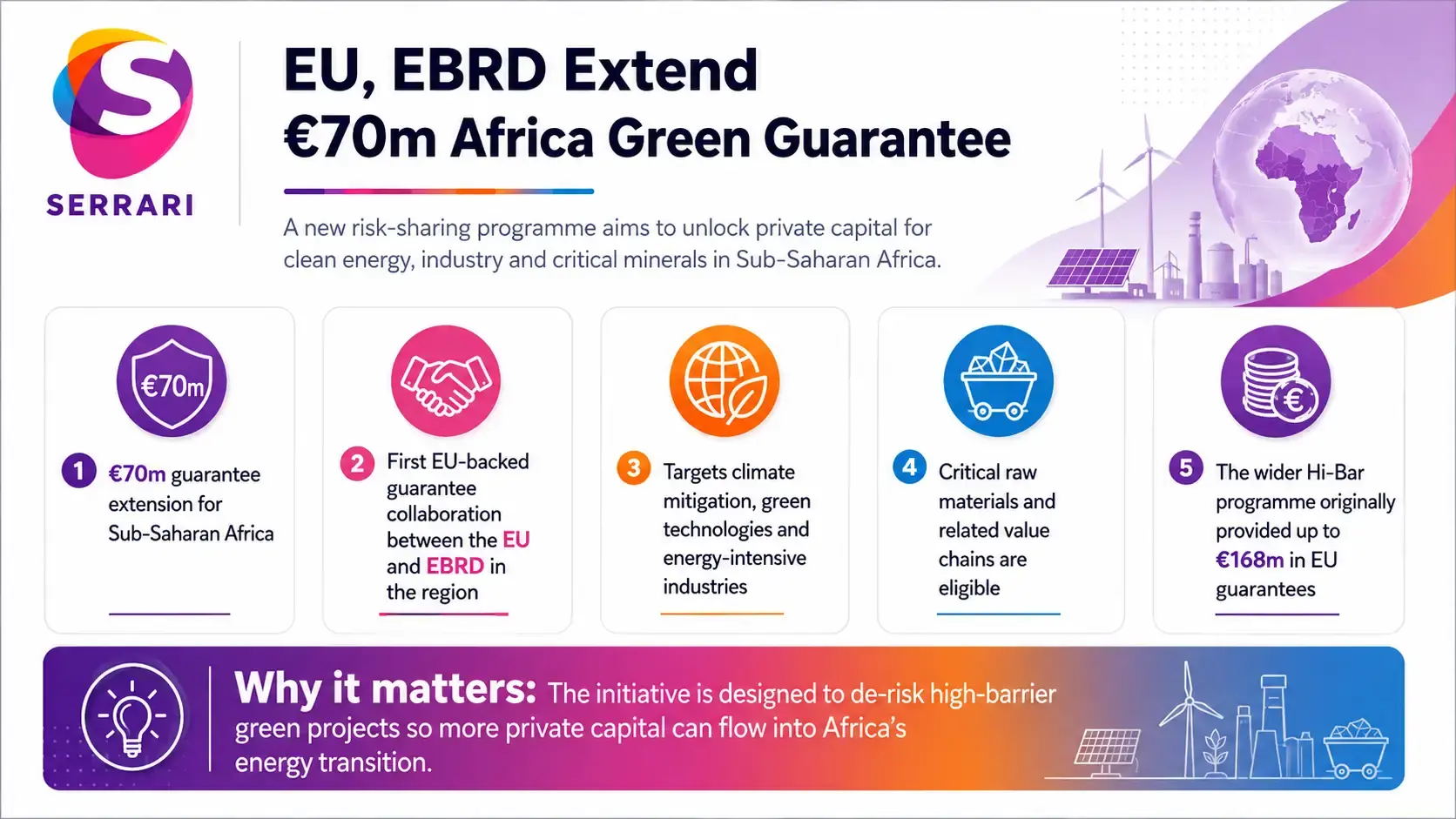
The €70 million extension to the EFSD+ Hi-Bar programme is designed to support projects that might be commercially promising but struggle to attract conventional financing because of technology, market, regulatory or execution risks. Rather than supplying €70 million directly to projects, the guarantee absorbs part of the financial risk, potentially allowing substantially more private capital to participate.
Key Overview
- The EU and EBRD have agreed to extend the EFSD+ High-Barrier, or Hi-Bar, programme into Sub-Saharan Africa.
- The expansion provides €70 million in additional guarantee capacity.
- It marks the institutions’ first collaboration involving EU-backed guarantees in the region.
- Target areas include renewable and low-carbon energy, energy-intensive industries and critical raw-material value chains.
- The original Hi-Bar programme provided for up to €168 million in EU guarantees.
- The programme is intended particularly for first-of-a-kind technologies and investments that have yet to reach sufficient commercial scale.
Guarantees Target Africa’s Investment-Risk Problem
The importance of the programme lies less in the headline amount than in how the money is used. Many African infrastructure and industrial projects face financing costs that reflect not only construction requirements but also currency volatility, regulatory uncertainty, limited project histories and perceived country risk.
The Hi-Bar guarantee structure is intended to reduce some of those risks so that lenders and investors can finance projects they might otherwise consider too difficult or expensive. It focuses on climate technologies and business models facing unusually high financing barriers, including new technologies and established technologies that have not yet reached commercial scale in particular markets.
Guarantees therefore operate differently from grants or direct loans. They can provide protection against defined risks while leaving private investors responsible for financing and evaluating the underlying project. If designed effectively, a comparatively limited guarantee can mobilise investment worth several times its face value.
That approach is increasingly important as Africa confronts a large climate-financing gap. Recent estimates indicate African countries require more than $242 billion annually through 2030 to implement climate commitments and respond to climate impacts, against climate-finance inflows of around $29.5 billion.
Energy and Industrial Decarbonisation Take Priority
The guarantee programme will concentrate heavily on energy and energy-intensive industries. Eligible investments can include projects supporting energy-system transformation, cleaner industrial processes and technologies capable of reducing the carbon intensity of manufacturing and processing.
This is significant for African economies trying to industrialise while simultaneously modernising electricity systems. Reliable and affordable power is essential for manufacturing, mining, processing, transport infrastructure and digital industries, yet major projects can face significant financing hurdles before construction begins.
The programme also specifically covers critical raw materials and their value chains. That creates potential opportunities beyond mineral extraction. Financing could potentially support processing, refining, energy infrastructure and other activities necessary to increase the value retained within African economies.
However, guarantees alone cannot make a weak project bankable. Developers still need credible revenue models, reliable power and transport infrastructure, sound contractual arrangements, environmental safeguards and predictable regulation. Risk-sharing can improve financing conditions, but it cannot substitute for strong project preparation.
Context is everything. Stay ahead of shifting trends with today’s market updates, and uncover emerging opportunities using the Serrari Group Market Index and Marketplace. Then, take control of your own financial future by exploring our Money & Life Reset Transformation Blueprint ™ to build stronger habits, create better systems, and design a path toward lasting wealth.
Europe Expands Its Green-Finance Architecture
The €70 million initiative forms part of the EU’s broader Global Gateway investment strategy and sits alongside several other guarantee programmes intended to mobilise private capital.
One example is the Green Energy for Africa and Asia programme, which provides guarantee capacity of up to €361 million alongside up to €22.82 million in technical assistance. That programme covers renewable power, battery storage, green hydrogen and critical raw-material value chains.
Another programme provides up to €332 million in guarantees for renewable-energy transition investments across several regions, including Sub-Saharan Africa. These facilities illustrate a wider shift in development finance toward using public guarantees and blended-finance structures to make private investment viable in projects carrying risks commercial investors may be unwilling to accept alone.
For African governments, the opportunity will be greatest where these facilities fit into broader national investment strategies rather than supporting isolated projects. Investment in renewable generation, for example, produces greater economic benefits when transmission grids, industrial infrastructure and productive demand develop alongside it.
The Real Test Will Be Private Capital Mobilisation
A €70 million guarantee should not be interpreted as €70 million of new infrastructure spending. Its ultimate impact will depend on how many projects reach financial close and how much additional private capital the risk protection enables.
That distinction is especially important given the scale of Africa’s financing requirements. Estimates put annual investment needs for structural transformation across areas including transport, energy, education and technology at approximately $495.6 billion through 2030, far beyond what individual development-finance programmes can provide.
The Hi-Bar expansion therefore represents one part of a much larger effort to reduce the cost and perceived risk of financing Africa’s transition. Success will depend on whether the guarantee converts promising but difficult projects into investable transactions that proceed from development to financing, construction and operation.
For African economies, the wider opportunity is to ensure that green investment contributes not only to lower emissions but also to stronger domestic industries, employment, technology transfer and value addition. Whether the programme achieves that will ultimately depend on the projects financed and how deeply those investments connect to local economies.
Your financial future isn’t something you wait for—it’s something you build.
The real question is: when do you begin?
Move beyond simply staying informed.
Navigate the markets with clarity—track trends through the Serrari Group Market Index, uncover opportunities in the Serrari Marketplace, and build practical knowledge with our Curated Wealth Builder Platform.
Stay connected to what truly matters.
Get daily insights on macro trends and financial movements across Kenya, Africa, and global markets—delivered through the Serrari Newsletter.
Growth opens doors.
Advance your career through professional programs including ACCA, HESI A2, ATI TEAS 7 , HESI EXIT , NCLEX – RN and NCLEX – PN, Financial Literacy!🌟—designed to move you forward with confidence.
See where money is flowing—clearly and in real time.
Track Money Market Funds, Treasury Bills, Treasury Bonds, Green Bonds, and Fixed Deposits, alongside global and African indexes, key economic indicators, and the evolving Crypto and stablecoin landscape—all within Serrari’s Market Index.