Türkiye has launched the Türkiye Emissions Trading System (TR ETS), establishing a domestic framework for carbon pricing, emissions trading and climate finance. The system will begin with a 2026–2027 pilot phase, followed by its first implementation period from 2028 to 2035.
The scheme will cover major sectors including cement, fertilizers, iron and steel, and power generation. Revenue from carbon allowances and other sources will be directed to climate-related activities, including just-transition measures.
Key Overview
- System: Türkiye Emissions Trading System (TR ETS)
- Pilot: 2026–2027
- First implementation period: 2028–2035
- Key sectors: Cement, fertilizers, iron and steel, power
- Allocation: Free allowances and auctions
- Auction platform: Energy Exchange Istanbul (EXIST)
- Main purpose: Domestic carbon pricing and green-transition financing
Türkiye Establishes Domestic Carbon Market
Türkiye has introduced a national emissions trading system designed to establish a domestic carbon market and put a price on greenhouse gas emissions.
The regulation published in the Official Gazette provides a framework for monitoring, reporting and verifying emissions, issuing allowances and managing the carbon market.
Environment and Climate Change Minister Murat Kurum said the regulation establishes the legal framework for Türkiye’s emissions trading system and carbon market as the country advances its green-transition goals.
The system is particularly important for Türkiye’s export industries because of its close trade relationship with the European Union.
TR ETS and EU Carbon Border Adjustment
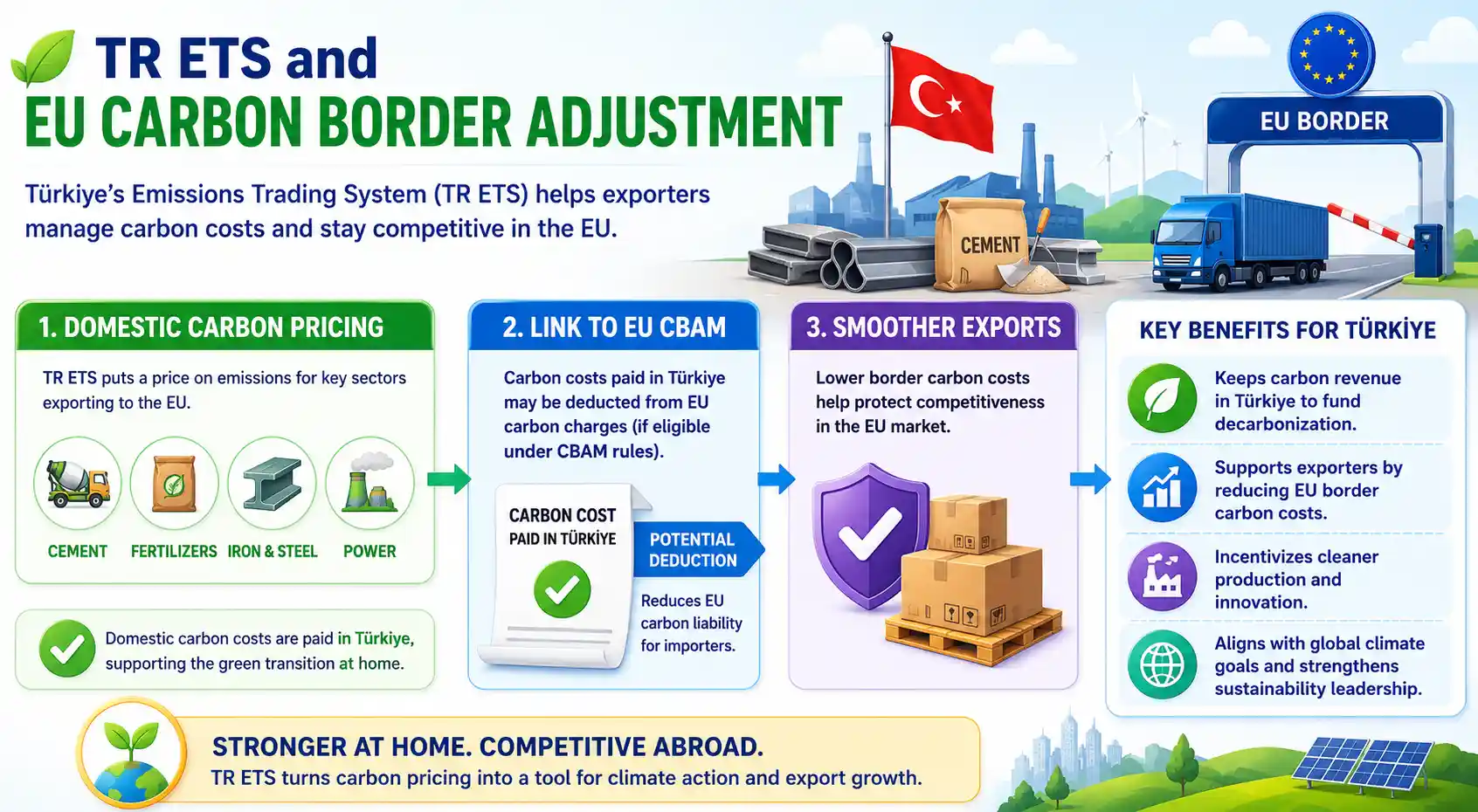
The launch is closely linked to the EU’s Carbon Border Adjustment Mechanism (CBAM), which covers imports including steel, aluminium, cement, fertilizers, electricity and hydrogen.
Under CBAM, carbon costs paid in the country of production can potentially be deducted from an importer’s EU carbon liability where the payment qualifies under the mechanism.
For Turkish exporters, this creates an incentive to establish domestic carbon pricing rather than leaving carbon-related costs to be collected at the EU border.
The TR ETS will not automatically eliminate CBAM payments, but could allow more carbon-related revenue to remain in Türkiye and support domestic decarbonization.
Pilot Phase Starts in 2026
The TR ETS will operate through a 2026–2027 pilot phase, before entering its first formal implementation period from 2028 to 2035.
Covered installations will require emissions permits valid for five years. Facilities will be classified according to annual emissions:
- Category A: Up to 50,000 tonnes of CO₂ equivalent
- Category B: 50,000-500,000 tonnes
- Category C: Exceeding 500,000 tonnes
Regulated entities must submit verified annual greenhouse gas emissions and activity-level reports to the Directorate of Climate Change by April 30 each year.
Intensity-Based Carbon Pricing
Unlike systems based on a fixed absolute emissions ceiling, Türkiye’s ETS uses sector-specific benchmarks and emission-intensity metrics.
Benchmark values are being developed for cement, fertilizers, iron and steel, and power generation. The overall annual allowance cap will be calculated using verified activity levels and applicable benchmarks.
This structure could allow companies to increase production while maintaining compliance if they improve emissions performance per unit of output.
However, an intensity-based approach also means total emissions could rise if industrial production expands faster than emissions efficiency improves.
Free Allowances and Auctions
Allowances will be distributed through free allocations and primary-market auctions.
Free allocations will be determined using sector benchmarks, activity levels, sectoral activity factors and applicable free-allocation rates. Allowances not distributed for free will be directed toward auctions and the market stability reserve.
Energy Exchange Istanbul (EXIST) will conduct primary-market allowance auctions.
The regulation also introduces a complementary carbon-price mechanism allowing companies to voluntarily pay an additional amount on top of the price of allowances purchased through primary auctions.
Context is everything. Stay ahead of shifting trends with today’s market updates, and uncover emerging opportunities using the Serrari Group Market Index and Marketplace. Then, take control of your own financial future by exploring our Money & Life Reset Transformation Blueprint ™ to build stronger habits, create better systems, and design a path toward lasting wealth.
Carbon Revenues to Support Climate Action
Revenue from emissions permits, primary-market allowance sales, market-stability operations, authorized international carbon credits and certain administrative fines will be recorded as special revenues and allocated to the Climate Change Directorate.
Under Türkiye’s Climate Law, up to 10% of these revenues may support just-transition measures for vulnerable groups and sectors affected by the transition away from carbon-intensive activities.
This creates a direct connection between carbon-market revenues and climate action.
Flexibility and Market Stability
The system allows companies to bank surplus allowances within an implementation period and borrow allowances from future years within the same period.
Covered facilities may also use domestic carbon-offset credits to meet part of their annual compliance obligations.
A market stability reserve will hold part of the allowances otherwise destined for primary auctions. The Directorate of Climate Change can activate the reserve based on allowance supply and market prices.
Facilities facing allowance shortages may also access an additional reserve, subject to conditions, with access capped at 10% of the ETS cap.
Carbon Market Board to Define Next Steps
Several operational details remain to be determined by Türkiye’s Carbon Market Board, chaired by the environment minister.
The board will oversee important aspects of the system, including free-allocation rates, offset limits, price corridors and the scope and duration of the pilot and implementation periods.
The Energy Market Regulatory Authority will establish detailed rules covering auctions and registry operations.
The first National Allocation Plan, which will determine the system’s allowance cap and allocation figures, is expected within 60 days of the annual reporting deadline.
Outlook
Türkiye’s emissions trading system represents a major step toward establishing a domestic carbon market and preparing exporters for rising international carbon costs.
The 2026–2027 pilot phase will allow regulators and companies to test the framework before full implementation begins in 2028.
The system could also create opportunities for investment in carbon-market infrastructure, emissions reduction, carbon credits and industrial decarbonization. Its effectiveness will depend on how Türkiye implements benchmarks, allowance allocations, pricing mechanisms and market-stability measures.
FAQs
1. What is Türkiye’s Emissions Trading System (TR ETS)?
The TR ETS is Türkiye’s new domestic carbon market framework designed to price greenhouse gas emissions and support the country’s green transition.
2. When will Türkiye’s emissions trading system begin?
The TR ETS will have a pilot phase from 2026 to 2027, followed by its first formal implementation period from 2028 to 2035.
3. Which sectors will be covered by the TR ETS?
The initial framework focuses on cement, fertilizers, iron and steel, and power generation, with sector-specific emissions benchmarks being developed.
4. How will revenue from the TR ETS be used?
Revenue from emissions allowances, carbon credits and certain fines will be allocated to the Climate Change Directorate to support climate action, including just-transition measures.
Sources: Carbon Herald, International Carbon Action Partnership (ICAP), Sxcoal
Your financial future isn’t something you wait for—it’s something you build.
The real question is: when do you begin?
Move beyond simply staying informed.
Navigate the markets with clarity—track trends through the Serrari Group Market Index, uncover opportunities in the Serrari Marketplace, and build practical knowledge with our Curated Wealth Builder Platform.
Stay connected to what truly matters.
Get daily insights on macro trends and financial movements across Kenya, Africa, and global markets—delivered through the Serrari Newsletter.
Growth opens doors.
Advance your career through professional programs including ACCA, HESI A2, ATI TEAS 7 , HESI EXIT , NCLEX – RN and NCLEX – PN, Financial Literacy!🌟—designed to move you forward with confidence.
See where money is flowing—clearly and in real time.
Track Money Market Funds, Treasury Bills, Treasury Bonds, Green Bonds, and Fixed Deposits, alongside global and African indexes, key economic indicators, and the evolving Crypto and stablecoin landscape—all within Serrari’s Market Index.