Toyota plans to produce its next-generation Lexus battery-electric vehicle (BEV) in Shanghai from autumn 2027, making China the first market for the model. The SUV will use gigacasting technology to reduce body weight and improve driving range as Toyota responds to strong Chinese EV demand.
Key Overview
- Production start: Autumn 2027
- Location: Shanghai, China
- Brand: Lexus
- Initial output: About 1,000 vehicles per month
- Technology: Gigacasting
- Potential weight reduction: Up to 20% for some body sections
- China BEV sales: 8.57 million in 2025
- Projected China BEV sales: 11.41 million by 2030
Toyota Shifts Lexus EV Strategy Toward China
Toyota will build its next-generation battery-electric vehicle (BEV) in China before anywhere else, marking a rare break from the company’s usual practice of debuting new technology in Japan first.
The model, which will be sold under the Lexus brand, is expected to be produced at a plant in Shanghai starting in autumn 2027. Initial production is expected to be about 1,000 vehicles a month, before scaling to tens of thousands annually by 2028.
The move highlights the growing importance of China’s electric vehicle market to Toyota’s product development and sales strategy.
Toyota has until now generally developed and produced advanced vehicles in Japan before expanding them into other markets. The decision to launch and produce the next-generation Lexus EV in China reflects the country’s overwhelming EV demand and the growing influence of local consumer preferences.
Lexus EV to Use Gigacasting Technology
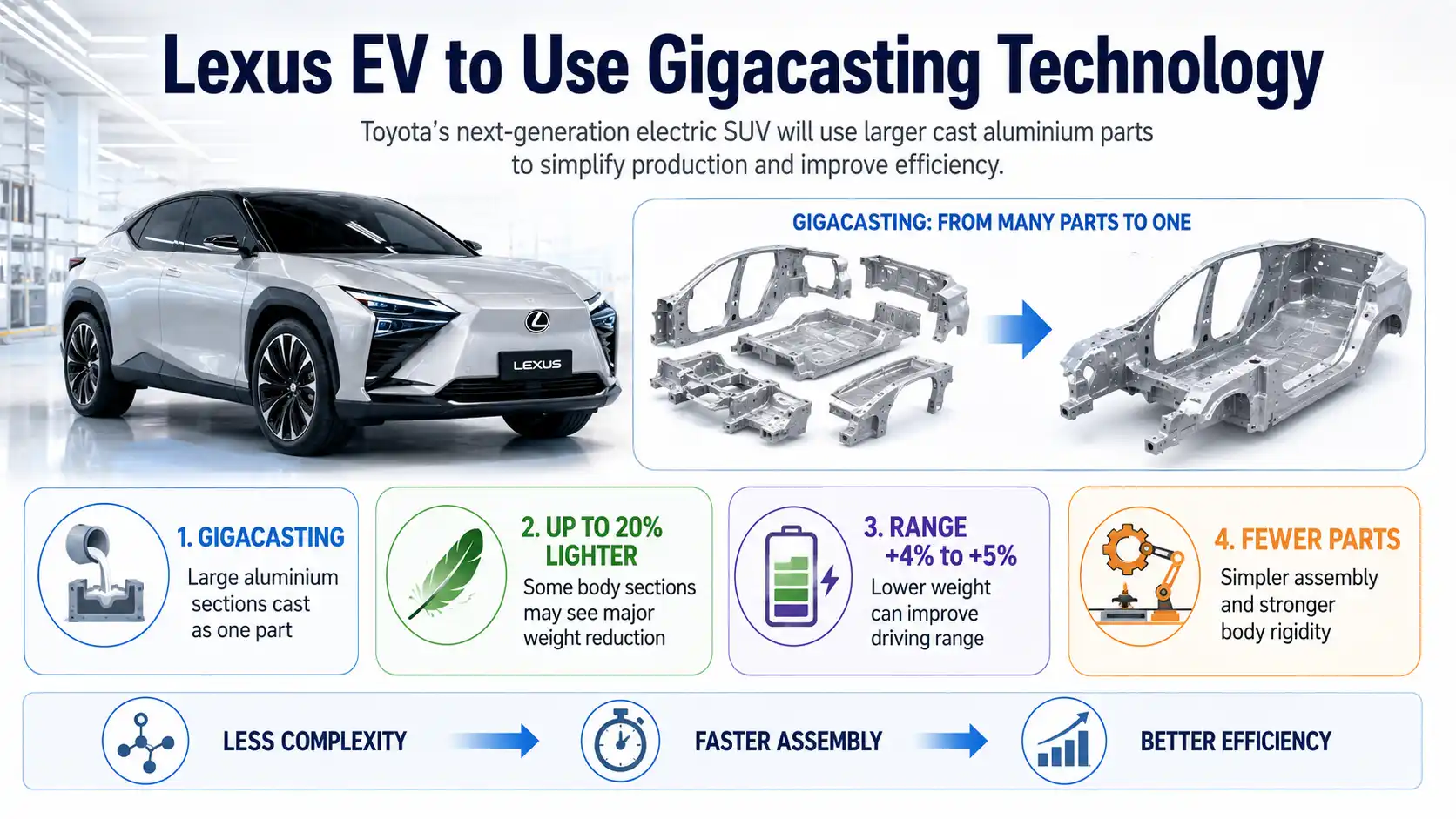
The new Lexus electric SUV will use gigacasting, a manufacturing technique that moulds multiple aluminium body sections into a single large component.
The technology reduces the number of components and assembly processes required to build the vehicle. According to the report, gigacasting can reduce the weight of some body structures by up to 20%.
The lower weight is expected to provide an estimated boost of around 4-5% to a typical BEV’s driving range, while also improving body rigidity and simplifying assembly.
The use of the technology is part of Toyota’s effort to improve the efficiency of its next-generation EV manufacturing and vehicle design.
At an initial production rate of 1,000 vehicles per month, annualised output would be about 12,000 units. This would represent approximately 12% of the Shanghai plant’s planned annual capacity of 100,000 vehicles, suggesting that Toyota will take a cautious approach to increasing production.
Strong Chinese EV Demand Drives Strategy
China’s position as the world’s largest EV market appears to have influenced Toyota’s decision to develop and produce the new model there.
EV sales in China reached 8.57 million units last year, accounting for about 60% of global sales, according to GlobalData. The volume was approximately three times Europe’s sales and more than 100 times the number sold in Japan.
China’s BEV sales are projected to rise to 11.41 million vehicles by 2030, providing a significant market opportunity for automakers.
Toyota, the world’s largest automaker by sales, has faced sustained competition from Chinese brands in recent years. The company is therefore adjusting its EV product plans to better reflect local demand.
In particular, Chinese consumers generally show stronger demand for SUVs, prompting Toyota to shift its next-generation EV focus toward the SUV format.
Toyota Halts Separate EV Coupe Project
Toyota had been developing a lower-slung, more streamlined next-generation electric coupe in Japan but halted the project in spring 2026, according to Nikkei.
The company subsequently shifted its next-generation EV focus toward SUVs, where demand is stronger in China.
The change illustrates how Toyota is increasingly adapting its product strategy according to individual markets rather than relying on a single global approach.
Competition in China’s EV market has also intensified, with local manufacturers continuing to introduce new electric models.
Toyota’s electric vehicle range in China already includes a budget SUV and a saloon equipped with displays from Huawei Technologies.
Shanghai Plant Expands Lexus EV Production
The Lexus Shanghai plant is located in Jinshan district in the southwestern part of the city.
Toyota announced in February 2025 that it would establish a wholly owned company in Shanghai to develop and produce Lexus battery electric vehicle (BEV) models and batteries.
The plant broke ground in June 2025 and was expected to be completed in August 2026, with production beginning in 2027.
The facility will make Lexus the second foreign auto brand after Tesla to have a wholly owned vehicle plant in China.
The investment also gives Toyota greater control over Lexus EV production in one of the world’s most important electric vehicle markets.
Context is everything. Stay ahead of shifting trends with today’s market updates, and uncover emerging opportunities using the Serrari Group Market Index and Marketplace. Then, take control of your own financial future by exploring our Money & Life Reset Transformation Blueprint ™ to build stronger habits, create better systems, and design a path toward lasting wealth.
Toyota Faces Growing Competition in China
China is Toyota’s third-largest market after the United States and Japan. However, the company has faced increasing pressure from domestic Chinese automakers.
Local manufacturers have expanded rapidly across electric vehicles, batteries and related technologies, increasing competition for established global brands.
Toyota’s decision to produce its next-generation Lexus EV locally could allow the company to respond more quickly to Chinese consumer preferences and market developments.
The use of advanced manufacturing technologies such as gigacasting could also help Toyota improve production efficiency and vehicle competitiveness.
Toyota Maintains Global Production Plans
The shift toward China does not mean Toyota is abandoning its Japanese manufacturing base.
Nikkei Asia has reported that Toyota plans to produce 10.5 million vehicles worldwide in 2027, including Lexus, as hybrid demand rises and total output moves above 10 million units.
Production in Japan is expected to total at least 3.5 million vehicles, above the three million-unit benchmark Toyota maintains to preserve manufacturing capabilities and employment in its domestic operations.
Toyota’s broader strategy therefore continues to include hybrids and conventional vehicles alongside its growing BEV portfolio.
Toyota Reports Strong First-Quarter Earnings
Toyota reported net income of Y1.47tn ($9.32bn) for the first quarter of its 2027 financial year, an increase of 75.6%, and raised its FY2027 guidance.
Consolidated sales revenue for the three months to June 30, 2026, reached ¥13.52tn, up 10.4% YoY. Operating income, however, fell 8.8% to ¥1.06 trillion.
The financial performance comes as Toyota continues balancing investments in electric vehicles with demand for hybrids and its wider global vehicle portfolio.
Outlook
Toyota’s decision to build its next-generation Lexus BEV in China first signals a significant adjustment in its approach to electric vehicle development and manufacturing.
The combination of strong Chinese EV demand, growing competition from local manufacturers and consumer preference for SUVs is pushing Toyota to place greater emphasis on the Chinese market.
With production scheduled to begin in Shanghai in autumn 2027, the new Lexus EV will also serve as an important test of Toyota’s gigacasting technology, local manufacturing strategy and ability to compete in China’s rapidly expanding electric vehicle market.
FAQs
1. Where will Toyota build its next-generation Lexus BEV?
Toyota plans to build the next-generation Lexus battery-electric vehicle at its new plant in Shanghai, China, starting in autumn 2027.
2. What is gigacasting and how will it benefit the Lexus BEV?
Gigacasting moulds multiple aluminium body parts into a single large component. The technology can reduce the weight of some body structures by up to 20%, potentially improving driving range and production efficiency.
3. Why is Toyota producing the Lexus BEV in China first?
The move reflects the strong demand for electric vehicles in China, where EV sales have grown rapidly and consumers have shown strong preference for electric SUVs.
4. How many Lexus BEVs will Toyota initially produce in Shanghai?
Production is expected to start at around 1,000 vehicles per month, or approximately 12,000 vehicles annually, before increasing to tens of thousands of vehicles per year by 2028.
Sources: Automotive World, Just Auto, CnEVPost, Seoul Economic Daily, Yahoo Finance
Your financial future isn’t something you wait for—it’s something you build.
The real question is: when do you begin?
Move beyond simply staying informed.
Navigate the markets with clarity—track trends through the Serrari Group Market Index, uncover opportunities in the Serrari Marketplace, and build practical knowledge with our Curated Wealth Builder Platform.
Stay connected to what truly matters.
Get daily insights on macro trends and financial movements across Kenya, Africa, and global markets—delivered through the Serrari Newsletter.
Growth opens doors.
Advance your career through professional programs including ACCA, HESI A2, ATI TEAS 7 , HESI EXIT , NCLEX – RN and NCLEX – PN, Financial Literacy!🌟—designed to move you forward with confidence.
See where money is flowing—clearly and in real time.
Track Money Market Funds, Treasury Bills, Treasury Bonds, Green Bonds, and Fixed Deposits, alongside global and African indexes, key economic indicators, and the evolving Crypto and stablecoin landscape—all within Serrari’s Market Index.