
Kenya’s new post-retirement medical funds regulations allow retirees to transfer part of their accrued pension savings into registered medical funds specifically designed to finance healthcare after retirement. Under the Retirement Benefits (Post-Retirement Medical Funds) Regulations, 2026, an eligible member may transfer up to 50% of accrued retirement benefits at retirement, subject to the applicable scheme rules and regulatory limits. The framework aims to help retirees manage healthcare costs without depending entirely on their regular pension income or retirement lump sum.
Key Overview
The new regulations establish a formal framework for using retirement benefits to finance medical expenses after employment. Retirees can potentially ring-fence part of their accumulated savings for healthcare rather than receiving all eligible benefits through conventional retirement arrangements. However, the 50% figure is not a universal entitlement in every circumstance. Members of pension schemes that are not provident funds face a separate 10% limit on accrued benefits before commutation, while additional voluntary contributions may also be transferred.
Post-Retirement Medical Funds Get New Regulatory Framework
Kenyan retirees now have a clearer mechanism for setting aside part of their pension savings specifically for healthcare expenses.
The Retirement Benefits (Post-Retirement Medical Funds) Regulations, 2026 establish rules governing dedicated medical funds that can receive retirement savings and use them to finance healthcare after a member leaves employment.
National Treasury Cabinet Secretary John Mbadi said in the Gazette notice that a retiring member may opt to transfer up to 50% of accrued benefits from a retirement benefits scheme into a registered post-retirement medical fund.
The change could make healthcare a more explicit part of retirement planning, rather than leaving retirees to meet medical bills solely from ordinary pension income or cash received at retirement.
How the 50% Pension Transfer Works
The headline provision allows a member, upon retirement, to transfer as much as 50% of accrued retirement benefits to a registered post-retirement medical fund.
Importantly, the provision is optional.
A retiree is not automatically required to transfer half of their savings into a medical fund. Instead, eligible members can decide whether allocating part of their retirement benefits specifically to healthcare fits their financial circumstances.
That distinction matters because retirement needs vary considerably.
Someone with comprehensive health insurance, substantial savings or other sources of retirement income may make a different decision from a retiree whose expected medical expenses represent one of their biggest financial risks.
Separate 10% Rule Applies in Certain Pension Schemes
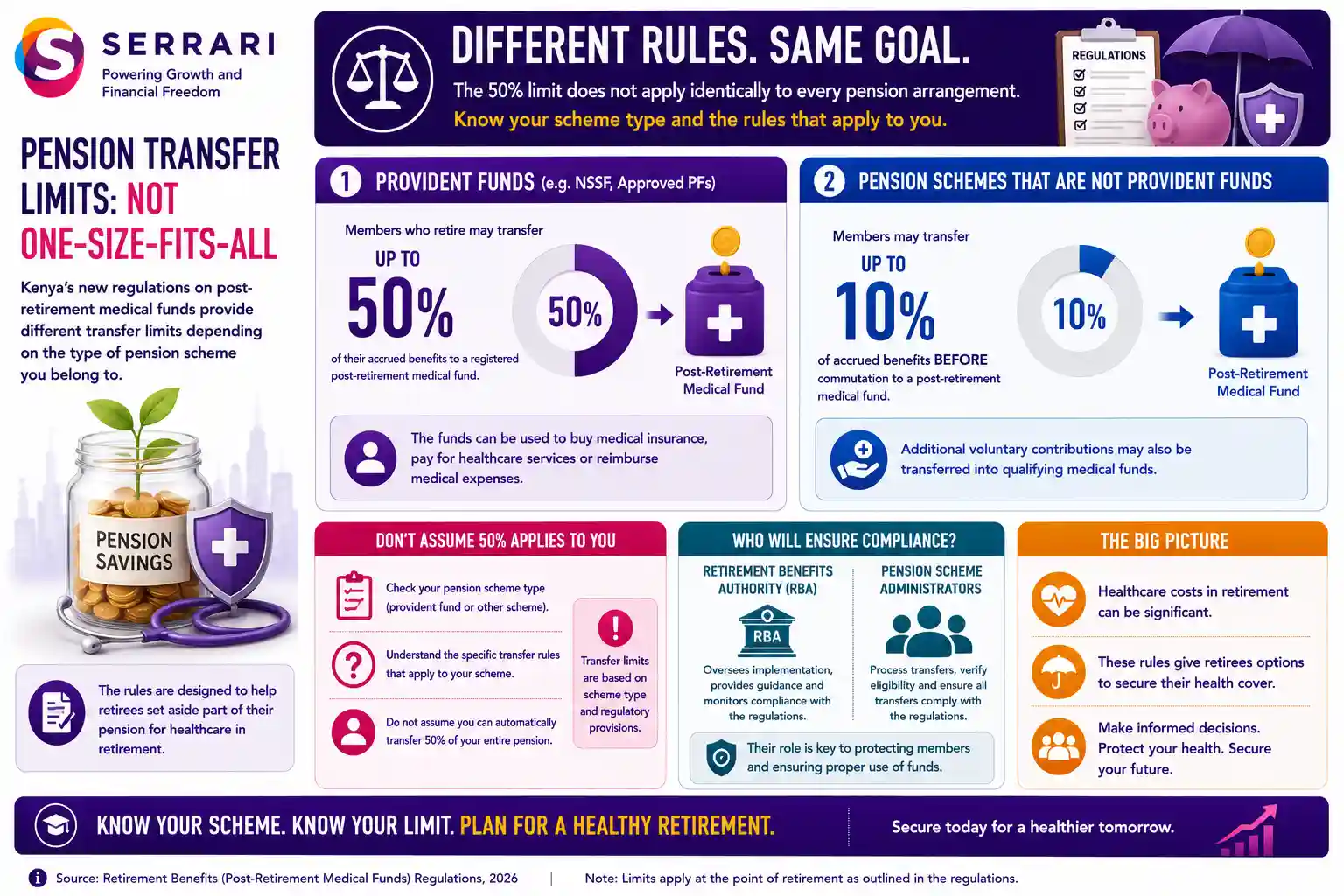
The 50% limit should also not be interpreted as applying identically to every pension arrangement.
For members of pension schemes that are not provident funds, the regulations establish a separate provision allowing up to 10% of accrued benefits before commutation to be transferred to a post-retirement medical fund.
Additional voluntary contributions may also be transferred into qualifying medical funds.
The distinction makes it important for individual pension members to check their scheme type and applicable rules before assuming that 50% of their entire accumulated pension can automatically be moved.
The Retirement Benefits Authority (RBA) and individual scheme administrators will therefore have an important role in implementation and ensuring transfers comply with the regulations.
Context is everything. Stay ahead of shifting trends with today’s market updates and uncover emerging opportunities using the Serrari Group Market Index and Marketplace. Then, take control of your own financial future by exploring our Money & Life Reset Transformation Blueprint ™ to build stronger habits, create better systems, and design a path toward lasting wealth.
Why Healthcare Is Becoming a Retirement Issue
Healthcare can become one of the largest and least predictable expenses during retirement.
People generally face greater demand for medical services as they age, while employer-sponsored medical benefits may end or change when employment stops.
Without dedicated savings or medical insurance, retirees can be forced to draw heavily from pension income to pay for hospitalisation, medication, consultations and other healthcare services.
Ring-fencing retirement savings for medical purposes could reduce this risk.
Instead of treating retirement savings as one pool from which every expense must be financed, a retiree could separate money intended for healthcare from funds required for housing, food and other living costs.
How Post-Retirement Medical Funds Could Help Retirees
The framework effectively introduces another potential destination for retirement savings.
Previously, pension arrangements primarily focused on providing lump sums, pension income and other conventional retirement benefits.
Dedicated medical funds introduce a healthcare-specific component.
For retirees, the advantage is financial planning certainty. Money allocated to the medical fund can remain dedicated to healthcare rather than being mixed with ordinary spending.
This could be especially valuable where major medical expenses occur several years into retirement.
However, transferring pension savings into a medical fund also involves a trade-off. Every shilling allocated specifically to healthcare is a shilling that may no longer be available for other retirement expenses in the same way.
Retirees therefore need to consider both expected healthcare costs and their broader income requirements.
Existing Medical Funds Given 12 Months to Comply
The regulations also establish a transition period for existing arrangements.
Existing post-retirement medical funds have been given 12 months from the commencement of the regulations to comply with the new regulatory framework.
The transition period should allow fund operators to adjust their governance, administration and other requirements to the new rules.
Formal regulation is particularly important because retirees may depend on these funds for many years.
Clear oversight can help establish standards around how contributions are handled, how benefits are provided and how medical funds operate within Kenya’s broader retirement-benefits system.
What the Rules Mean for Retirement Planning
The regulations expand the choices available to Kenyans approaching retirement, but they do not eliminate the need to balance competing financial priorities.
Allocating the maximum amount to healthcare may provide greater protection against future medical expenses, but it could reduce the amount available to generate ordinary retirement income.
Conversely, allocating too little could leave a retiree exposed to significant medical expenses later.
The appropriate allocation will therefore depend on factors including existing insurance coverage, age, expected retirement income, other savings and the benefits available under the person’s pension scheme.
The key change is that post-retirement medical funds now have a clearer regulatory structure through which eligible pension savings can be specifically dedicated to healthcare.
FAQs
What are post-retirement medical funds?
Post-retirement medical funds are dedicated arrangements designed to help individuals finance healthcare expenses after retirement. Under Kenya’s new regulations, eligible pension scheme members can transfer part of their accumulated retirement savings into a registered medical fund instead of relying entirely on ordinary pension income to cover healthcare costs.
Can Kenyan retirees transfer 50% of their pension to a medical fund?
The regulations provide that a retiring member may opt to transfer up to 50% of accrued retirement benefits into a registered post-retirement medical fund. However, the rules differ depending on the type of retirement scheme, so the 50% figure should not be treated as an automatic limit applicable identically to every member.
What is the 10% limit for pension scheme members?
For members of pension schemes that are not provident funds, the regulations provide a separate limit of up to 10% of accrued benefits before commutation that may be transferred into a post-retirement medical fund. Additional voluntary contributions may also be eligible for transfer.
Are retirees required to transfer their pension savings into medical funds?
No. The regulations describe the transfer as an option rather than a mandatory requirement. Retirees should consider their healthcare needs, existing insurance, expected pension income and other retirement expenses before deciding how much, if any, of their eligible savings to allocate to a medical fund.
Your financial future isn’t something you wait for—it’s something you build.
The real question is: when do you begin?
Move beyond simply staying informed.
Navigate the markets with clarity—track trends through the Serrari Group Market Index, uncover opportunities in the Serrari Marketplace, and build practical knowledge with our Curated Wealth Builder Platform.
Stay connected to what truly matters.
Get daily insights on macro trends and financial movements across Kenya, Africa, and global markets—delivered through the Serrari Newsletter.
Growth opens doors.
Advance your career through professional programs including ACCA, HESI A2, ATI TEAS 7 , HESI EXIT , NCLEX – RN and NCLEX – PN, Financial Literacy!🌟—designed to move you forward with confidence.
See where money is flowing—clearly and in real time.
Track Money Market Funds, Treasury Bills, Treasury Bonds, Green Bonds, and Fixed Deposits, alongside global and African indexes, key economic indicators, and the evolving Crypto and stablecoin landscape—all within Serrari’s Market Index.