

















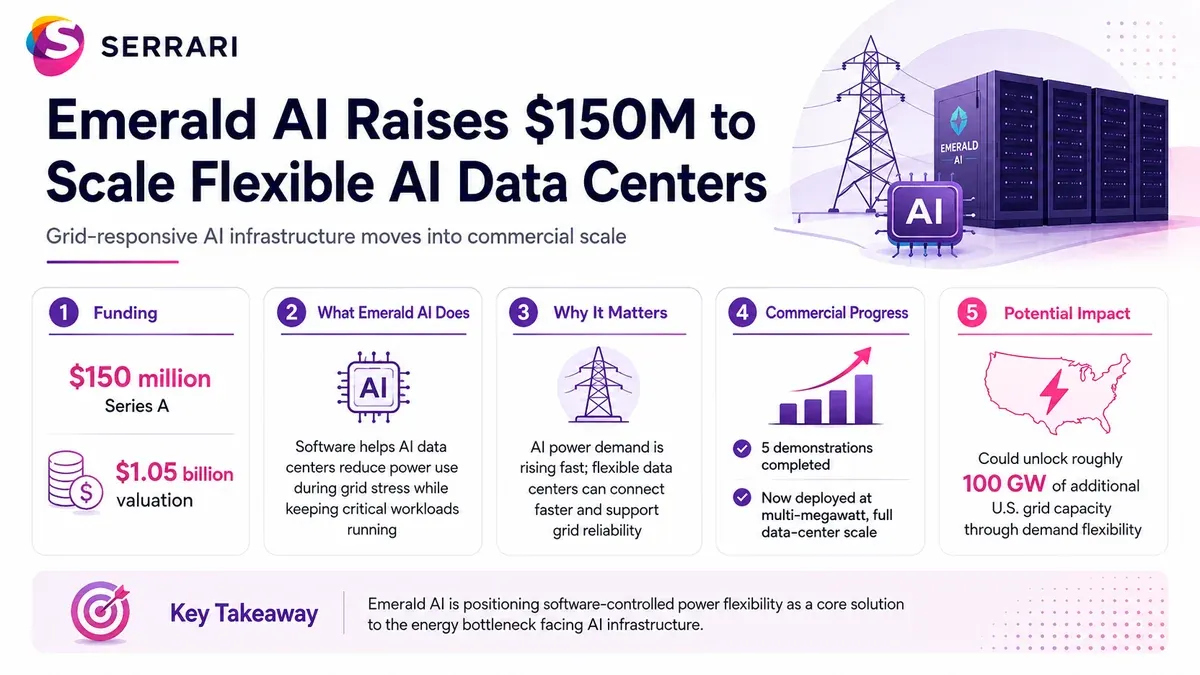
Emerald AI has raised an oversubscribed $150 million Series A at a $1.05 billion valuation as it moves its power-management technology from demonstrations into large-scale commercial deployments. The financing, co-led by Energize Capital and DCVC, positions the company to expand software designed to make AI data centers responsive to grid conditions instead of operating as continuously inflexible electricity loads.
The raise comes as electricity availability becomes an increasingly important constraint on AI infrastructure development. Data centers are projected to contribute about half of U.S. electricity-demand growth through 2030, increasing pressure on utilities, transmission networks and developers searching for faster ways to connect new computing capacity.
Key Overview
- Emerald AI raised $150 million at a $1.05 billion valuation, with Energize Capital and DCVC co-leading the Series A.
- Its Emerald Conductor platform coordinates AI workloads and power consumption so data centers can reduce demand when electricity grids are under stress.
- The company has completed five commercial demonstrations across the U.S. and UK and has progressed to multi-megawatt commercial deployment.
- Flexible AI facilities could potentially make available roughly 100 GW of additional capacity on the existing U.S. grid by shifting demand during constrained periods.
- Emerald AI says 12 Fortune Global 500 companies are now investors as technology, utility and energy groups increasingly converge around AI infrastructure.
From Power Consumer to Grid-Responsive Asset
Emerald AI’s central proposition is that AI data centers do not always need to draw their maximum electricity requirement continuously. Its Conductor platform orchestrates computational workloads alongside on-site energy resources, allowing facilities to adjust electricity demand when the grid experiences congestion, peak demand or other stresses.
The approach differs from simply switching off computing infrastructure. Critical workloads can continue operating while lower-priority or time-flexible workloads are shifted, slowed or rescheduled. Tests highlighted by NVIDIA showed the technology achieving power reductions of up to 40% in certain demonstrations while maintaining required computing performance.
That flexibility could address one of the AI industry’s most difficult infrastructure challenges: available grid connections. New generation and transmission infrastructure can require years to plan and construct, while AI companies are attempting to deploy large data centers considerably faster.
Research cited in assessments of flexible computing suggests the existing U.S. electricity system could accommodate roughly 100 GW of additional flexible load under appropriate operating conditions. This does not mean 100 GW of permanently unused electricity is immediately available. Rather, flexibility could allow more computing capacity to use existing infrastructure by reducing consumption during the relatively limited periods when the grid is most constrained.
Context is everything. Stay ahead of shifting trends with today’s market updates, and uncover emerging opportunities using the Serrari Group Market Index and Marketplace. Then, take control of your own financial future by exploring our Money & Life Reset Transformation Blueprint ™ to build stronger habits, create better systems, and design a path toward lasting wealth.
Commercial Deployments Put the Model to the Test
Emerald AI has moved beyond small experimental deployments. Its demonstrations have taken place in Arizona, Illinois, Virginia, Oregon and London, involving organizations across cloud computing, utilities and electricity-system research.
In California, the company has also begun deploying its software at full data-center scale. A separate collaboration with Silicon Valley Power is testing how multi-megawatt data centers can respond to utility signals during periods of grid need while maintaining AI workload performance.
The model could eventually influence how new data centers obtain grid access. Instead of utilities sizing infrastructure around an assumption that very large facilities will operate as permanently inflexible loads, developers could accept contractual requirements to reduce consumption when specific grid conditions occur.
Emerald AI and Silicon Valley Power are already pursuing this concept through a flexible-load interconnection framework that links expanded electricity access to verified, dispatchable demand flexibility.
Nearly 100MW AI Factory Marks a Bigger Test
One of the company’s most significant planned deployments is in Manassas, Virginia, where Emerald AI is working with NVIDIA and Digital Realty on a 96-megawatt Vera Rubin AI facility designed around power-flexible operation.
The project, expected to come online later in 2026, is intended to demonstrate whether grid-responsive computing can operate at the scale of next-generation AI factories rather than individual clusters or pilot sites.
If successful, the concept could become increasingly valuable as AI electricity requirements accelerate. Global data-center electricity consumption is projected to more than double to around 945 TWh by 2030, with AI accounting for much of the increase.
Funding Reflects the Convergence of AI and Energy
The Series A investor group reflects how closely computing infrastructure and electricity markets are becoming connected. Participants include NVIDIA, Samsung Ventures, Siemens, Aramco Ventures, Salesforce Ventures, GE Vernova, RWE, JERA Ventures, Energy Impact Partners and Lowercarbon Capital, among others.
Emerald AI says 12 Fortune Global 500 companies now hold investments in the business and participate in its strategic advisory network. The company has also been included among the 2026 TIME100 Most Influential Companies and recognized as a 2026 Technology Pioneer.
The larger opportunity extends beyond Emerald AI itself. If flexible-load agreements become standard in electricity markets, AI data centers could increasingly be designed not only around computing performance and access to power, but around their ability to actively respond to the grid. Emerald AI’s $150 million financing is therefore a bet that software-controlled electricity flexibility could become a core layer of the rapidly expanding AI infrastructure market.
Sources: Business Wire / Emerald AI / International Energy Agency / Silicon Valley Power / NVIDIA / TIME / World Economic Forum / DCVC
Your financial future isn’t something you wait for—it’s something you build.
The real question is: when do you begin?
Move beyond simply staying informed.
Navigate the markets with clarity—track trends through the Serrari Group Market Index, uncover opportunities in the Serrari Marketplace, and build practical knowledge with our Curated Wealth Builder Platform.
Stay connected to what truly matters.
Get daily insights on macro trends and financial movements across Kenya, Africa, and global markets—delivered through the Serrari Newsletter.
Growth opens doors.
Advance your career through professional programs including ACCA, HESI A2, ATI TEAS 7 , HESI EXIT , NCLEX – RN and NCLEX – PN, Financial Literacy!🌟—designed to move you forward with confidence.
See where money is flowing—clearly and in real time.
Track Money Market Funds, Treasury Bills, Treasury Bonds, Green Bonds, and Fixed Deposits, alongside global and African indexes, key economic indicators, and the evolving Crypto and stablecoin landscape—all within Serrari’s Market Index.