Ghana reinvestment risk is increasing as Treasury-bill rates fall rapidly across the yield curve. Investors who repeatedly buy 91-day bills retain more frequent access to their capital, but each maturity creates another point at which funds must be reinvested at whatever rates prevail at the time. By contrast, the 364-day Treasury bill currently offers a substantially higher 11.5929% interest rate and fixes that maturity exposure for longer, but investors give up some flexibility if rates subsequently rebound or capital is needed sooner. The latest auction reinforces that trade-off: nearly 70% of bids were directed toward the one-year bill as rates fell sharply. Strong liquidity may keep yields under pressure, but further declines are not guaranteed because inflation, monetary policy, government financing requirements and investor behaviour can change.
Key Overview
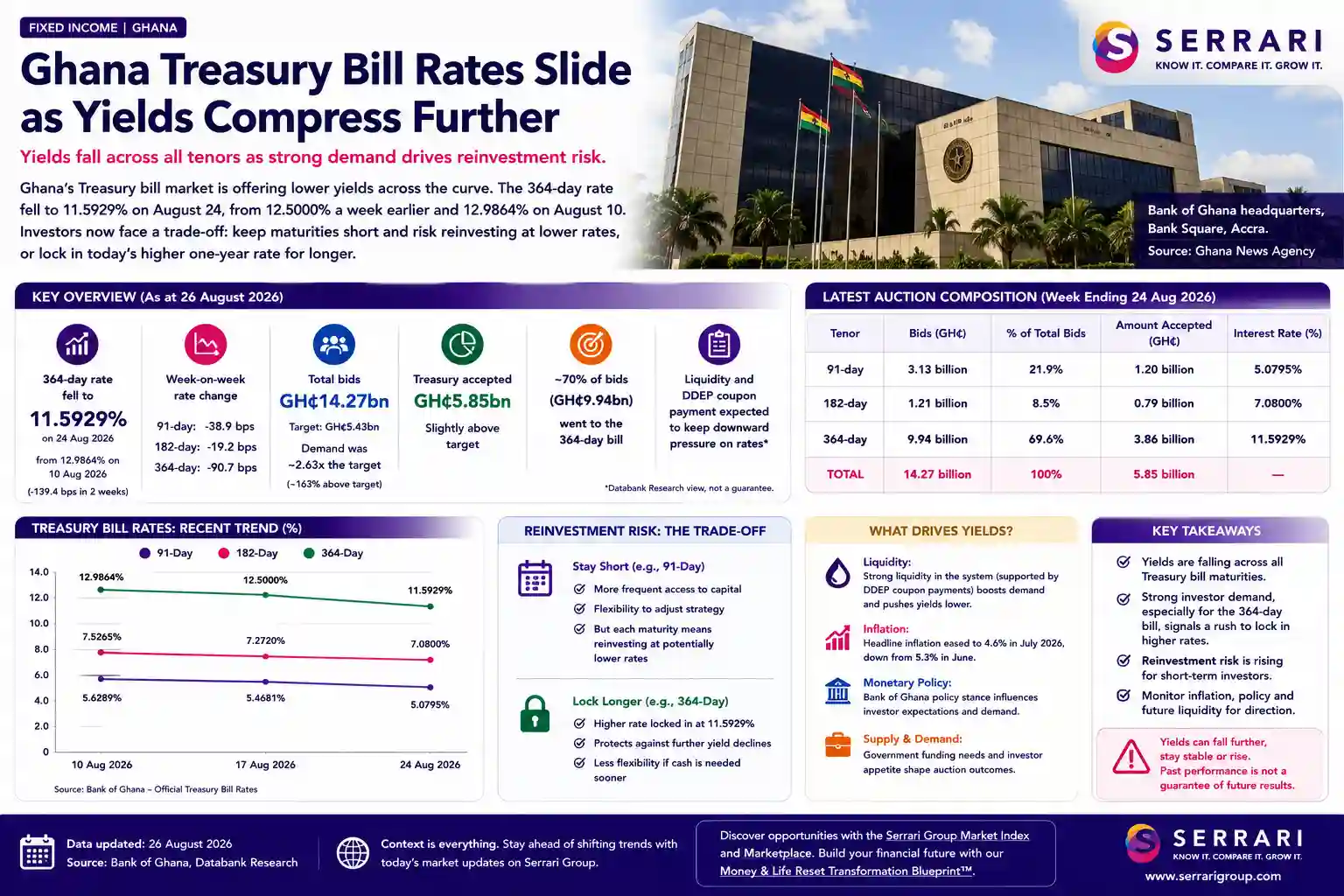
- The Bank of Ghana’s August 24 rates were 5.0795% for 91 days, 7.0800% for 182 days and 11.5929% for 364 days.
- The 364-day rate has fallen from 12.9864% on August 10 to 12.5000% on August 17 and 11.5929% on August 24 — a two-week decline of approximately 139.4 basis points.
- Week-on-week, the 91-day rate fell about 38.9 basis points, the 182-day rate about 19.2 basis points, and the 364-day rate about 90.7 basis points.
- The latest auction attracted about GH¢14.27 billion of bids against a GH¢5.43 billion target, meaning demand was roughly 2.63 times the target. Treasury accepted about GH¢5.85 billion.
- Approximately GH¢9.94 billion, or close to 70% of submitted bids, was directed toward the 364-day bill.
- Databank Research expects strong liquidity to continue putting downward pressure on Treasury-bill rates and links part of the current liquidity backdrop to the recent DDEP coupon payment.
- Ghana’s headline inflation slowed to 4.6% in July 2026, from 5.3% in June.
Ghana’s One-Year Rate Has Fallen Fast
The speed of the adjustment is the first important signal.
Bank of Ghana’s official series shows the 364-day bill at 12.9864% on August 10, 12.5000% on August 17 and 11.5929% on August 24. BoG publishes latest bill rates
The latest weekly move alone was roughly 90.7 basis points.
For the 91-day bill, the rate moved from 5.6289% on August 10 to 5.4681% on August 17 and 5.0795% on August 24. The 182-day bill fell from 7.5265% to 7.2720% and then 7.0800% over the same period.
That is a broad repricing rather than an isolated move in one maturity.
For holders of Ghana T-bill rates 2026, the question is therefore becoming increasingly time-sensitive: how much future yield is an investor willing to sacrifice in exchange for keeping maturities short?
Investors Crowded Into the 364-Day Bill
The auction composition provides an important clue.
Total bids reached about GH¢14.27 billion, compared with the government’s GH¢5.43 billion funding target. Rather than describing that as simply “162.9% subscription,” the cleaner interpretation is that bids were roughly 2.63 times the target, or about 163% above it.
The government did not accept the entire book. It took approximately GH¢5.85 billion, only modestly above its target.
More revealingly, the 364-day bill attracted about GH¢9.94 billion of bids, compared with approximately GH¢3.13 billion for the 91-day and GH¢1.21 billion for the 182-day securities.
That means close to seven cedis out of every ten tendered were directed toward the one-year instrument.
Databank Research’s interpretation is that investors are increasingly trying to secure the comparatively attractive longer T-bill rate before additional compression occurs. Databank expects further yield compression
That is a research view, not a guarantee that yields will continue falling.
Rolling 91 Days Has a Cost
Short maturities have an obvious advantage: flexibility.
A 91-day investor gets another opportunity to reassess inflation, Bank of Ghana policy, market liquidity and competing investments within roughly three months.
But that flexibility creates reinvestment risk.
Suppose rates continue falling over the next several auctions. The investor receives maturity proceeds quickly, but must then place those funds into a new bill carrying a lower rate.
Repeatedly rolling short-dated bills can therefore produce a declining income stream even when every individual investment is held successfully to maturity.
The Ghana 91-day bill is currently at only 5.0795%, versus 11.5929% on the 364-day instrument. That unusually wide gap gives cash investors a significant trade-off between liquidity and locking a longer return.
A 364-Day Bill Has Different Risks
Extending to one year reduces the frequency with which an investor must reinvest.
For an investor able to hold until maturity, that can protect against the possibility that short-term rates fall further over the coming months.
But locking a rate also creates opportunity cost.
If inflation unexpectedly rises, monetary policy tightens or government financing requirements force Treasury rates materially higher again, an investor already committed to the 364-day security cannot simply capture the new rate without first dealing with the existing position.
Longer maturity can also expose an investor to more price sensitivity if the bill needs to be sold before maturity.
The decision is therefore not that 364 days is automatically “better” because 11.5929% is larger than 5.0795%.
It is a duration decision.
Context is everything. Stay ahead of shifting trends with today’s market updates, and uncover emerging opportunities using the Serrari Group Market Index and Marketplace. Then, take control of your own financial future by exploring our Money & Life Reset Transformation Blueprint ™ to build stronger habits, create better systems, and design a path toward lasting wealth.
DDEP Cash May Be Feeding Market Liquidity
The timing also matters.
Ghana’s Ministry of Finance announced this month that the government had paid GH¢10.8168 billion in Domestic Debt Exchange Programme coupon obligations in full and in cash. Government made full DDEP payment
Databank Research links the resulting liquidity environment with stronger Treasury-bill demand, arguing that some funds released through the coupon settlement have rotated into short-term government paper.
That is a plausible market mechanism rather than proof that the DDEP payment caused the entire rally.
Banks, pension funds, asset managers and other investors can all influence weekly demand, while government acceptance decisions themselves affect clearing rates.
Still, the combination of additional cash, very large bids and falling yields is consistent with an unusually liquid primary market.
Lower Inflation Changes the Context
Inflation provides another reason investors may currently tolerate lower nominal T-bill rates.
Ghana Statistical Service reports that annual consumer-price inflation fell to 4.6% in July, down from 5.3% in June and 12.1% a year earlier. Ghana inflation eased in July
The gap between the July inflation reading and the latest 364-day Treasury rate is therefore close to seven percentage points.
But investors should not simply subtract 4.6% from 11.5929% and call the result a guaranteed real return.
The Treasury bill covers a future holding period, whereas 4.6% is a backward-looking annual inflation reading for July. Inflation can change materially before a one-year bill matures.
The comparison is useful as macro context, not as a promised inflation-adjusted payoff.
Lower Rates Also Help the Government
Yield compression has a second side.
Investors receive lower returns, but the government’s marginal short-term borrowing cost falls.
With the Treasury accepting approximately GH¢5.85 billion from the latest auction, lower clearing rates reduce interest expense compared with issuing the same amount at earlier August levels.
The next auction will provide another test.
Treasury is expected to target roughly GH¢5.15 billion against about GH¢5.08 billion of maturing bills.
If demand again materially exceeds supply, downward pressure could persist.
If liquidity tightens or investors resist lower rates, the compression could slow or reverse.
Conclusion
Ghana’s latest Treasury-bill auction matters because the market is repricing rapidly.
The 364-day interest rate has fallen from 12.9864% to 11.5929% in just two weeks, while the latest auction attracted GH¢14.27 billion of bids and almost GH¢10 billion was directed toward the one-year security.
That creates a genuine portfolio decision.
Investors who stay short retain flexibility but face the possibility of rolling their money into progressively lower rates.
Those extending to 364 days can reduce near-term reinvestment risk, but they also accept less flexibility if yields subsequently rise.
For Ghanaian cash investors, the central question is no longer simply whether Treasury bills remain attractive.
It is which maturity best balances today’s yield against tomorrow’s reinvestment risk.
FAQs
What are Ghana’s latest Treasury bill rates?
Bank of Ghana’s official August 24, 2026 issue data show interest rates of 5.0795% for the 91-day Treasury bill, 7.0800% for the 182-day bill and 11.5929% for the 364-day bill. The central bank separately reports discount rates because Treasury bills are discount instruments, so investors should ensure they are comparing the same rate measure across sources.
How much has the Ghana 364-day Treasury bill rate fallen?
The official interest rate fell from 12.9864% on August 10 to 12.5000% on August 17 and 11.5929% on August 24. That is a decline of approximately 1.3935 percentage points, or 139.35 basis points, in two weeks. The largest weekly move occurred in the latest period, when the one-year rate dropped about 90.7 basis points.
What is reinvestment risk in Treasury bills?
Reinvestment risk is the possibility that an investor’s security matures and the proceeds must then be invested at a lower prevailing rate. It is particularly relevant to investors continually rolling 91-day bills during a falling-rate environment. Shorter maturities provide flexibility, but they force the investor back into the market more often. A 364-day bill reduces the number of reinvestment decisions but ties up the investment for longer.
Why was demand concentrated in the 364-day bill?
About GH¢9.94 billion of the GH¢14.27 billion total bids was directed toward the 364-day bill. Databank Research argues that investors are attempting to lock the relatively higher one-year rate before yields potentially compress further, with strong system liquidity supporting demand. That is an analytical interpretation rather than proof that every bidder had the same motivation.
Does Ghana’s 4.6% inflation mean the 364-day bill guarantees a 7% real return?
No. The comparison between July inflation of 4.6% and the August 24 one-year bill rate of 11.5929% produces a current nominal spread of about seven percentage points, but the figures refer to different periods. July inflation is historical, while the Treasury bill matures in the future. Inflation over the investor’s actual holding period can rise or fall, so the difference should not be presented as a guaranteed real return.
Sources: Bank of Ghana, MyJoyOnline, Mansa Markets, Ghana Ministry of Finance, Ghana Statistical Service, Ghana News Agency
Your financial future isn’t something you wait for—it’s something you build.
The real question is: when do you begin?
Move beyond simply staying informed.
Navigate the markets with clarity—track trends through the Serrari Group Market Index, uncover opportunities in the Serrari Marketplace, and build practical knowledge with our Curated Wealth Builder Platform.
Stay connected to what truly matters.
Get daily insights on macro trends and financial movements across Kenya, Africa, and global markets—delivered through the Serrari Newsletter.
Growth opens doors.
Advance your career through professional programs including ACCA, HESI A2, ATI TEAS 7 , HESI EXIT , NCLEX – RN and NCLEX – PN, Financial Literacy!🌟—designed to move you forward with confidence.
See where money is flowing—clearly and in real time.
Track Money Market Funds, Treasury Bills, Treasury Bonds, Green Bonds, and Fixed Deposits, alongside global and African indexes, key economic indicators, and the evolving Crypto and stablecoin landscape—all within Serrari’s Market Index.