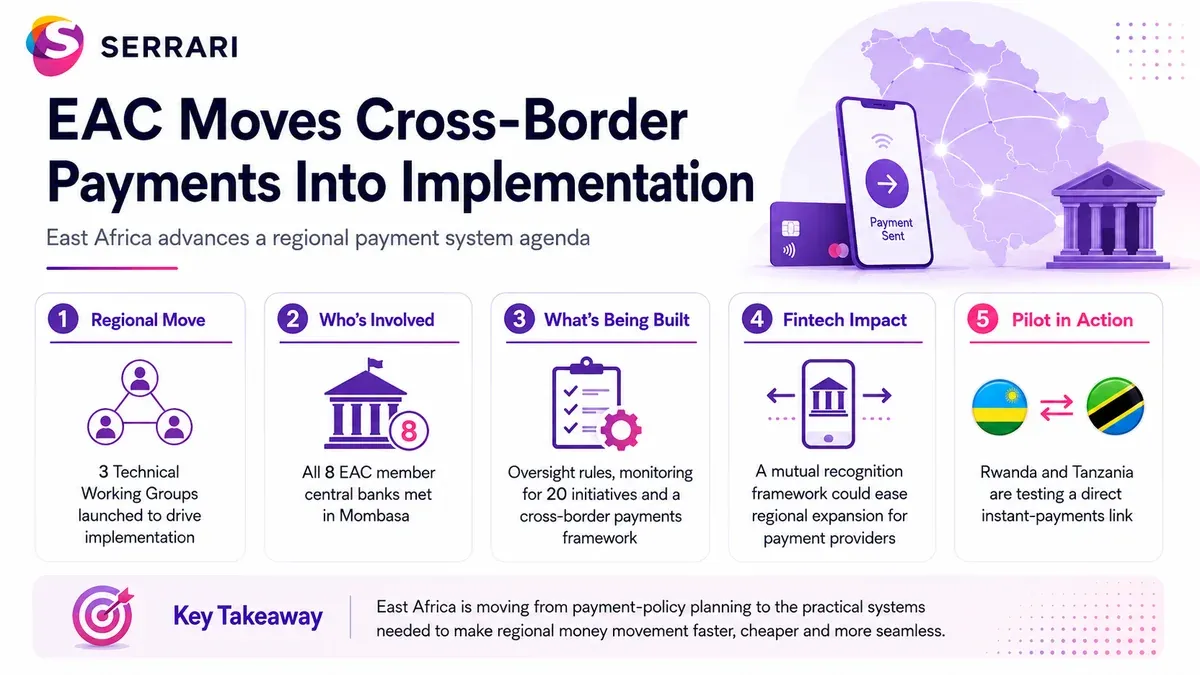
The East African Community has moved its regional payments agenda from policy design into implementation after inaugurating three Technical Working Groups tasked with advancing the Cross-Border Payment System Masterplan.
The groups met in Mombasa from August 18 to 22, bringing together central-bank representatives from all eight EAC partner states alongside development partners. Their work focuses on turning the regional blueprint into practical rules, oversight structures and interoperable payment infrastructure that could make sending money across East African borders faster, cheaper and more secure.
Key Overview
- The EAC has established three Technical Working Groups to support implementation of its regional cross-border payments masterplan.
- The masterplan contains 20 strategic initiatives covering governance, infrastructure, inclusivity and capacity building.
- A proposed Mutual Recognition Framework could allow licensed payment providers to operate more easily across multiple EAC markets.
- Regulators are developing a shared oversight model for supervision, information exchange, crisis management and dispute resolution.
- Rwanda and Tanzania are already testing direct interconnection between their national instant payment systems.
- The wider objective is to reduce payment costs, improve interoperability and support regional trade and financial inclusion.
The Masterplan Moves Into Execution
The shift follows the May 2025 approval of the EAC Cross-Border Payment System Masterplan, which established a roadmap for an integrated regional payment environment.
The strategy is built around four areas: governance and regulation, infrastructure, inclusion and institutional capacity. Its 20 initiatives are intended to improve the speed, security and affordability of cross-border transactions while encouraging greater use of local currencies and reducing dependence on foreign intermediaries.
At the latest meeting, the new technical groups reviewed a monitoring and reporting framework that introduces measurable indicators, baselines and targets. The framework is also aligned with broader G20 goals for making cross-border payments faster, cheaper, more accessible and more transparent.
Context is everything. Stay ahead of shifting trends with today’s market updates, and uncover emerging opportunities using the Serrari Group Market Index and Marketplace. Then, take control of your own financial future by exploring our Money & Life Reset Transformation Blueprint ™ to build stronger habits, create better systems, and design a path toward lasting wealth.
Regional Passporting Could Reshape Fintech Expansion
One of the most commercially significant proposals is a Mutual Recognition Framework for payment service providers.
Under the proposal, a provider properly licensed in one EAC country could gain a pathway to offer authorised services in other partner states without recreating the entire licensing process in every market, subject to local requirements.
This form of regional passporting could reduce a major barrier facing fintech companies. Today, expanding from one East African market into another can require separate regulatory approvals, compliance systems, technical integrations and local partnerships.
A more coordinated framework could therefore lower expansion costs for payment companies while making it easier for banks, mobile-money operators and fintech platforms to build services across the bloc.
The groups are also developing a Regional Cooperative Oversight Framework to clarify how national regulators share responsibilities. Proposed areas include information exchange, home-and-host supervision, crisis management and dispute resolution for systems operating across national borders.
Rwanda and Tanzania Provide the First Practical Test
The regional ambition is already being tested through a bilateral project linking Tanzania’s Instant Payment System with Rwanda’s National Payment Switch.
The Rwanda–Tanzania proof of concept is designed to determine the functional, technical, operational and regulatory requirements for directly interconnecting the two systems, initially focusing on person-to-person transfers.
If successfully implemented, customers could eventually transfer funds between participating bank accounts and mobile-money wallets across the border in real time without relying on the longer chains of intermediaries often associated with international payments.
Technical teams are also examining foreign-exchange conversion, transaction pricing, revenue sharing, liquidity, settlement, fraud controls, cybersecurity and regulatory reporting before the model can be expanded.
Lower Payment Costs Could Support Regional Trade
The commercial case for integration is significant. Low-value cross-border payments in Africa have been estimated to cost roughly 6% to 8% of transaction value on average, creating disproportionate costs for small businesses, informal traders and households.
Regional interoperability could reduce some of those frictions by connecting systems that consumers already use domestically. That could make it easier for a merchant in Kampala to receive payment from a customer in Kigali, or for a business in Nairobi to settle a supplier invoice in Dar es Salaam.
The broader plan also supports cross-border mobile-money interoperability and the modernization of the East African Payment System, while seeking to create common regulatory and technical standards across the bloc.
Implementation will still require difficult decisions around cybersecurity, data protection, consumer safeguards, foreign exchange and the division of supervisory responsibility between national regulators. But establishing dedicated technical groups means the integration agenda is now moving beyond broad political commitments toward the detailed systems needed to make regional payments work in practice.
For East Africa, that transition matters because regional trade cannot become seamless while moving money across borders remains expensive or operationally difficult. The payments masterplan is now entering the stage where that gap can begin to close.
Sources: East African Community / TradeMark Africa / World Bank / GIZ / FSD Network / Financial Stability Board
Your financial future isn’t something you wait for—it’s something you build.
The real question is: when do you begin?
Move beyond simply staying informed.
Navigate the markets with clarity—track trends through the Serrari Group Market Index, uncover opportunities in the Serrari Marketplace, and build practical knowledge with our Curated Wealth Builder Platform.
Stay connected to what truly matters.
Get daily insights on macro trends and financial movements across Kenya, Africa, and global markets—delivered through the Serrari Newsletter.
Growth opens doors.
Advance your career through professional programs including ACCA, HESI A2, ATI TEAS 7 , HESI EXIT , NCLEX – RN and NCLEX – PN, Financial Literacy!🌟—designed to move you forward with confidence.
See where money is flowing—clearly and in real time.
Track Money Market Funds, Treasury Bills, Treasury Bonds, Green Bonds, and Fixed Deposits, alongside global and African indexes, key economic indicators, and the evolving Crypto and stablecoin landscape—all within Serrari’s Market Index.