
Nigeria’s National Institute of Credit Administration has called on the Federal Government to inject N2 trillion into the Nigerian Credit Guarantee Company, arguing that stronger bank balance sheets alone will not deliver faster economic growth unless businesses can access affordable financing.
Registrar and Chief Executive Prof. Chris Onalo said in the latest NICA credit reform proposal that manufacturing, agriculture, housing and education continue to face expensive and restricted financing. His proposal would substantially expand the resources available to the government-backed guarantee company, which was established to share lending risks and improve credit access for businesses.
Key Overview
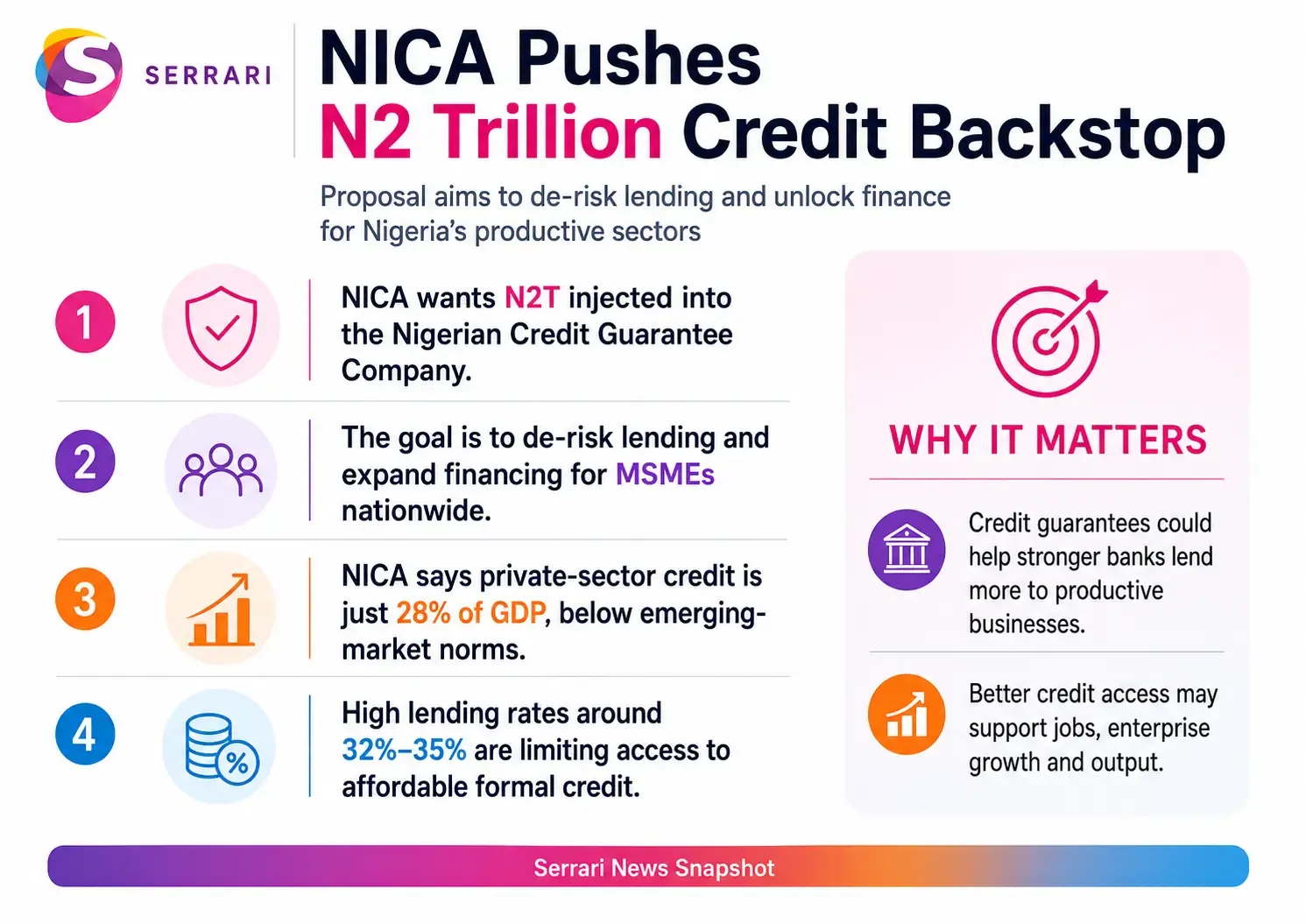
- NICA wants N2 trillion injected into the NCGC to expand credit guarantees for MSMEs and other productive businesses.
- Private-sector credit was estimated by NICA at 28% of GDP as of June 2026, which the institute considers too low for Nigeria’s growth ambitions.
- Business lending rates of about 32% to 35% are making formal financing difficult for several productive sectors, according to NICA.
- The NCGC began with N100 billion in initial capital and is designed to reduce lender risk through partial credit guarantees.
- NICA is proposing wider reforms, including single-digit intervention finance, improved credit reporting and stronger collateral infrastructure.
- The recommendations come after Nigeria’s bank recapitalisation programme, which was designed to create stronger and more resilient lenders.
NICA Wants Stronger Banks to Translate Into More Lending
NICA’s argument centres on what it describes as a disconnect between stronger financial institutions and the availability of credit in the wider economy. Onalo said private-sector credit stood at approximately 28% of GDP in June 2026, while lending rates of around 32% to 35% were restricting access for companies that cannot generate returns high enough to absorb such financing costs.
The concern has become more significant following Nigeria’s banking recapitalisation programme. The reforms increased minimum capital requirements for banks, including N500 billion for internationally authorised commercial banks, N200 billion for national banks and N50 billion for regional lenders, with the measures intended to improve resilience and increase lending capacity.
NICA argues that extra banking capital does not automatically translate into loans for smaller businesses when lenders remain concerned about defaults, weak collateral enforcement and recovery risks. The institute therefore wants the government to focus on mechanisms that can directly reduce those risks.
N2 Trillion Proposal Would Scale Up Credit Guarantees
At the centre of the proposal is the Nigerian Credit Guarantee Company’s risk-sharing model. Instead of lending directly in the same way as a commercial bank, the NCGC provides guarantees covering part of a qualifying loan, reducing the amount a participating financial institution could lose if a borrower defaults.
The company was established with N100 billion in initial capital in 2025 and was created to support MSMEs, manufacturers, consumers and other underserved borrowers. Its shareholders include government-backed institutions such as the Ministry of Finance Incorporated, Nigeria Sovereign Investment Authority, Bank of Industry and Nigerian Consumer Credit Corporation.
Current NCGC products include partial guarantees capable of covering up to 60% of qualifying loan exposure. NICA believes a much larger capital base would allow the institution to support more lending nationwide and give banks greater confidence to finance businesses they might otherwise consider too risky.
Context is everything. Stay ahead of shifting trends with today’s market updates, and uncover emerging opportunities using the Serrari Group Market Index and Marketplace. Then, take control of your own financial future by exploring our Money & Life Reset Transformation Blueprint ™ to build stronger habits, create better systems, and design a path toward lasting wealth.
Wider Credit Reforms Target Structural Barriers
NICA’s proposal extends beyond funding the guarantee company. Onalo called for single-digit intervention financing targeting agriculture, manufacturing, housing and the creative economy, sectors where high commercial borrowing costs can limit investment.
The institute also wants mandatory credit reporting by fintech companies, cooperatives and other lenders so that financial institutions have a fuller picture of borrowers’ existing obligations and repayment histories. Stronger information-sharing could improve risk assessment while making it easier for borrowers with good repayment records to demonstrate creditworthiness.
Another recommendation is fuller digitisation of the National Collateral Registry, alongside improvements in collateral enforcement and debt recovery. NICA also proposed creating an Office of the National Chief Credit Officer to coordinate federal credit policies, guarantees and intervention programmes.
The institute has separately advocated reforms that would make it easier for pension and insurance assets to support corporate bonds and infrastructure debt while encouraging Nigeria’s 36 states to establish dedicated credit-access departments.
Credit Access Could Determine Recapitalisation Payoff
The Federal Government has already positioned the NCGC as a mechanism for expanding MSME financing, including by sharing credit risk with participating financial institutions. NICA’s latest recommendation would move that strategy onto a much larger scale.
The key policy question is whether additional guarantees can encourage significantly more lending without creating excessive credit losses or weakening underwriting standards. Effective guarantees require careful borrower assessment, clear eligibility rules and disciplined risk management alongside greater capital.
Nigeria’s banking reforms have created institutions with stronger capital positions. NICA’s case is that the next stage should focus on ensuring that financial strength reaches businesses capable of investing, producing goods and creating employment. If policymakers adopt that approach, credit guarantees could become an important link between financial-sector reform and growth in the productive economy.
Sources: News Agency of Nigeria / National Institute of Credit Administration / National Credit Guarantee Company / Federal Ministry of Finance / Reuters
Your financial future isn’t something you wait for—it’s something you build.
The real question is: when do you begin?
Move beyond simply staying informed.
Navigate the markets with clarity—track trends through the Serrari Group Market Index, uncover opportunities in the Serrari Marketplace, and build practical knowledge with our Curated Wealth Builder Platform.
Stay connected to what truly matters.
Get daily insights on macro trends and financial movements across Kenya, Africa, and global markets—delivered through the Serrari Newsletter.
Growth opens doors.
Advance your career through professional programs including ACCA, HESI A2, ATI TEAS 7 , HESI EXIT , NCLEX – RN and NCLEX – PN, Financial Literacy!🌟—designed to move you forward with confidence.
See where money is flowing—clearly and in real time.
Track Money Market Funds, Treasury Bills, Treasury Bonds, Green Bonds, and Fixed Deposits, alongside global and African indexes, key economic indicators, and the evolving Crypto and stablecoin landscape—all within Serrari’s Market Index.