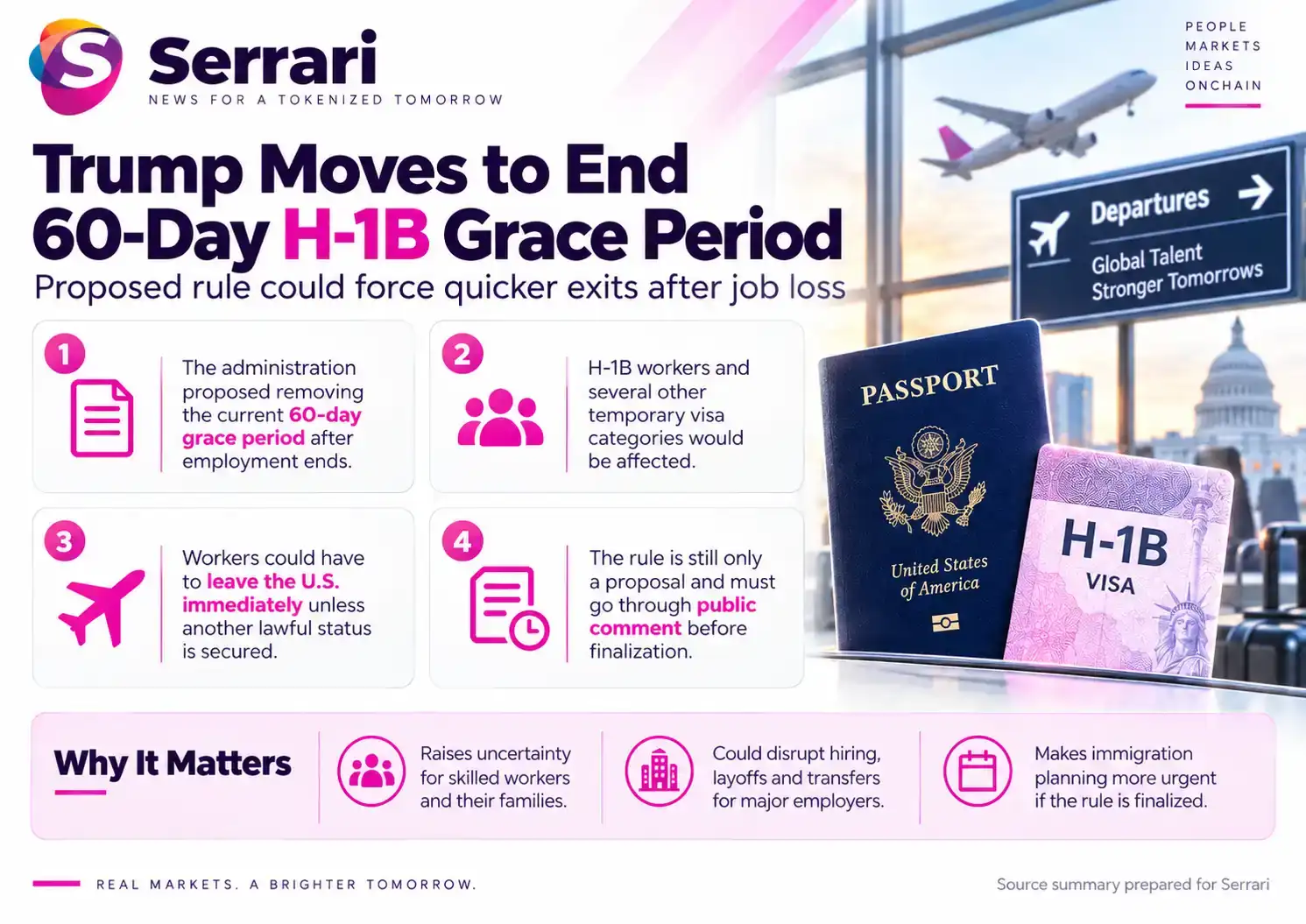
The Trump administration has proposed eliminating the up-to-60-day grace period that currently gives H-1B and several other temporary foreign workers time to remain in the United States after their employment ends. Under the proposal, affected workers would generally need to leave the country when the employment or activity supporting their immigration status ends, unless they have another lawful basis to remain.
The change would affect H-1B workers as well as people in E-1, E-2, E-3, H-1B1, L-1, O-1 and TN classifications, together with certain dependents. The proposal is not yet final, meaning the existing grace period remains in force while the rule goes through the federal rulemaking process.
Key Overview
The proposed rule would remove the current grace-period provision in 8 CFR 214.1(l)(2). That provision currently allows eligible workers whose employment ends before the expiry of their authorized stay to be treated as maintaining status for up to 60 consecutive days, or until the end of their authorized validity period, whichever comes first.
Federal immigration authorities argue that removing the grace period would reconnect temporary immigration status more directly to the specific employment that justified the worker’s admission to the United States. The proposal is open to a 60-day public-comment process before authorities can move toward issuing a final rule.
What the Current 60-Day Rule Allows
The grace period has been available since 2017 and serves as a transition window when employment ends unexpectedly. It does not automatically authorize a person to work for another employer, but it can give the worker time to find a new sponsor, file for another immigration status or prepare to leave the United States.
For H-1B workers, the rules also include an important portability provision. Certain H-1B employees can begin working for a new employer once a qualifying Form I-129 petition is filed, without waiting for final approval. The 60-day window can therefore be critical because it gives laid-off workers time to secure a new employer and get that petition filed.
If the grace period disappears, that transition becomes much harder. Workers could need a new immigration arrangement in place before their prior employment ends, or they may have to leave the country and pursue further processing from abroad.
More Visa Categories Would Be Affected
Although much of the attention has focused on H-1B workers, the proposal is broader. It would also apply to E-1 treaty traders, E-2 treaty investors, E-3 specialty workers from Australia, H-1B1 workers from Chile and Singapore, L-1 intracompany transferees, O-1 workers with extraordinary ability and TN professionals from Canada and Mexico.
Dependents whose status is linked to the principal worker could also be affected. That means a sudden job loss could create an immigration deadline not only for the employee but also for spouses and children whose ability to remain in the United States depends on that worker’s status.
The government notice says the grace period currently applies across these classifications, making the potential impact much wider than the technology sector alone.
Context is everything. Stay ahead of shifting trends with today’s market updates, and uncover emerging opportunities using the Serrari Group Market Index and Marketplace. Then, take control of your own financial future by exploring our Money & Life Reset Transformation Blueprint ™ to build stronger habits, create better systems, and design a path toward lasting wealth.
Tech and Professional Services Could Feel the Pressure
H-1B visas are particularly important to technology, consulting, engineering and other specialist industries. Large employers and professional-services firms routinely use the program to recruit workers with technical and specialized skills.
The proposed change could make layoffs and employee transitions more complicated for companies with foreign workers. Human-resources teams may have less time to coordinate immigration options when positions are eliminated, while companies trying to hire an H-1B worker from another employer could face greater pressure to complete sponsorship steps before the worker’s existing employment ends.
The administration acknowledges that employers could experience disruption but argues that some positions may instead be filled by qualified U.S. workers. The proposal is part of a wider effort to tighten legal immigration rules and reshape how employment-based visa programs operate.
Workers Could Face Much Faster Decisions After Layoffs
For visa holders, the most immediate consequence would be the loss of time after an unexpected termination. Under the current system, a worker can use the grace period to search for another sponsor, assess whether a change of status is possible, make travel arrangements or manage family and financial obligations before departing.
Without that buffer, a job loss could trigger immigration consequences immediately. Long-term residents may need to make rapid decisions involving housing, schools, family arrangements and future employment while also determining whether another immigration option is available.
This could also weaken the bargaining position of some foreign workers because their ability to remain in the country would be even more closely tied to continuous employment.
The Rule Has Not Taken Effect Yet
The most important point for affected workers and employers is that the 60-day grace period has not been abolished. The administration has issued a notice of proposed rulemaking, which begins a formal process rather than creating an immediate legal change.
The proposal carries regulatory identifier RIN 1615-AD22 and completed White House regulatory review in August before moving toward publication and public comment. Authorities must consider comments before deciding whether to issue a final rule, and the final version could differ from the proposal.
For now, eligible workers who lose employment can still rely on the existing up-to-60-day framework. The risk is that this protection may disappear if the proposal is finalized, making employment continuity and immigration planning considerably more important for foreign workers and the companies that employ them.
Sources: Federal Register / U.S. Citizenship and Immigration Services / Reuters / Office of Information and Regulatory Affairs
Your financial future isn’t something you wait for—it’s something you build.
The real question is: when do you begin?
Move beyond simply staying informed.
Navigate the markets with clarity—track trends through the Serrari Group Market Index, uncover opportunities in the Serrari Marketplace, and build practical knowledge with our Curated Wealth Builder Platform.
Stay connected to what truly matters.
Get daily insights on macro trends and financial movements across Kenya, Africa, and global markets—delivered through the Serrari Newsletter.
Growth opens doors.
Advance your career through professional programs including ACCA, HESI A2, ATI TEAS 7 , HESI EXIT , NCLEX – RN and NCLEX – PN, Financial Literacy!🌟—designed to move you forward with confidence.
See where money is flowing—clearly and in real time.
Track Money Market Funds, Treasury Bills, Treasury Bonds, Green Bonds, and Fixed Deposits, alongside global and African indexes, key economic indicators, and the evolving Crypto and stablecoin landscape—all within Serrari’s Market Index.