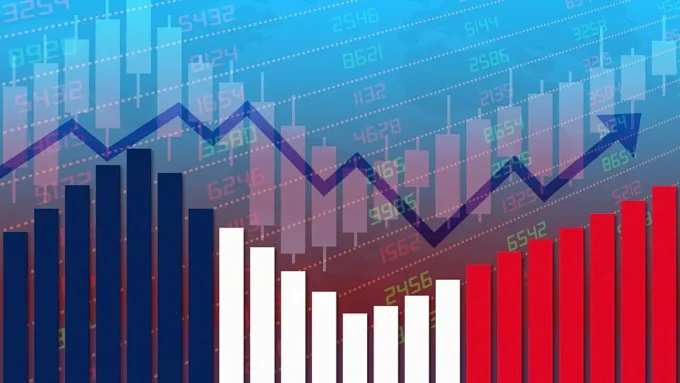
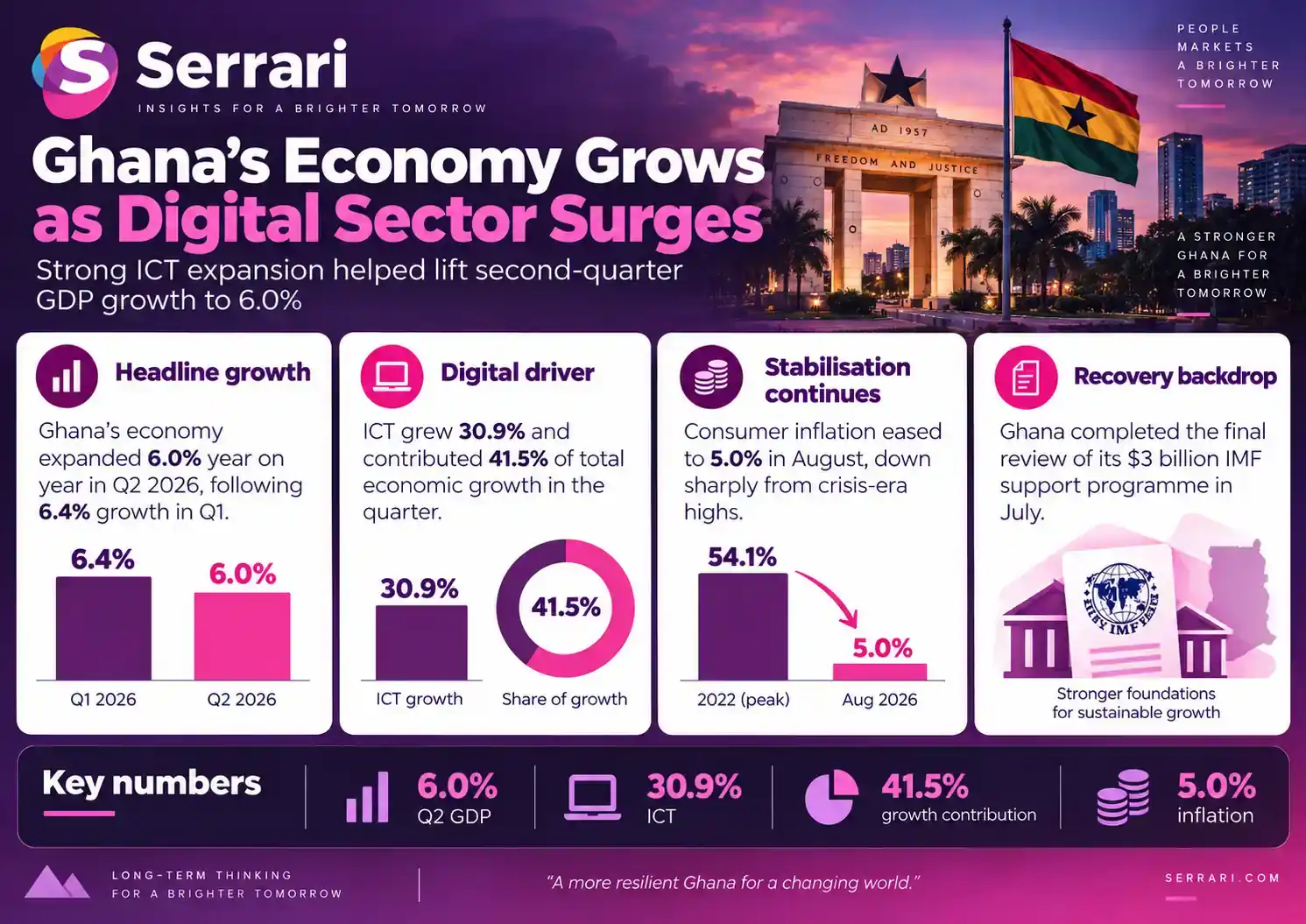
Ghana’s economy expanded by 6.0% year on year in the second quarter of 2026, maintaining strong momentum as the country continues to recover from the severe debt and inflation crisis that disrupted growth earlier in the decade.
The standout driver was information and communication technology. The sector expanded by 30.9% and generated 41.5% of total economic growth during the quarter, according to the latest second-quarter GDP figures. The performance is increasingly making digital activity a central pillar of Ghana’s economic expansion rather than a secondary growth sector.
Growth nevertheless moderated from 6.6% in the same quarter of 2025, while first-half expansion came in at approximately 6.2%.
Key Overview
- Ghana’s real GDP grew 6.0% year on year in the second quarter of 2026.
- ICT expanded 30.9%, compared with 21.3% a year earlier.
- The ICT sector alone contributed 41.5% of total Q2 economic growth.
- Services remained the largest growth engine, expanding by 8.0%.
- Non-oil GDP grew by 5.4% during the quarter.
- Annual consumer inflation stood at 5.0% in August 2026.
- Ghana completed the final review of its $3 billion IMF Extended Credit Facility programme in July.
Ghana’s Growth Story Becomes Increasingly Digital
The scale of ICT’s contribution marks an important change in the structure of Ghana’s economy. Digital connectivity, mobile services, financial technology and communications activity are now accounting for an increasingly large portion of additional output.
ICT growth accelerated to 30.9% from 21.3% a year earlier and accounted for more than four out of every ten cedis of new economic growth in the quarter. Government Statistician Alhassan Iddrisu said the sector has recorded double-digit expansion in every quarter for the past three years, suggesting the performance is more structural than temporary.
The wider services sector also remained dominant. Detailed second-quarter economic estimates show services expanding by 8.0% and contributing 57.6% of overall growth, while accounting for about 45.9% of the economy.
Transport and storage also performed strongly, while manufacturing growth provided additional support outside the digital economy.
Non-Oil Growth Remains Solid but Slows
The non-oil economy expanded by 5.4% in the second quarter. That remains a relatively strong rate but represents a moderation from the much faster growth recorded during the corresponding period of 2025.
Industry performed better overall, supported partly by oil and gas activity. This means Ghana’s current expansion is broader than ICT alone, even though the communications sector is responsible for an unusually large share of the headline growth figure.
The economy had already expanded by 6.4% in the first quarter, leaving first-half growth at roughly 6.2%. That puts the economy ahead of the government’s full-year real GDP growth target of at least 4.8%.
Context is everything. Stay ahead of shifting trends with today’s market updates, and uncover emerging opportunities using the Serrari Group Market Index and Marketplace. Then, take control of your own financial future by exploring our Money & Life Reset Transformation Blueprint ™ to build stronger habits, create better systems, and design a path toward lasting wealth.
Inflation Collapse Strengthens the Recovery
Growth is occurring alongside a dramatic reduction in inflation. Ghana’s annual consumer inflation rate stood at 5.0% in August 2026, compared with 54.1% in December 2022 during the height of the country’s economic crisis.
Inflation increased slightly from 4.6% in July, but the wider decline over the past several years has helped stabilise household purchasing power, reduce uncertainty and create room for monetary policy to become less restrictive.
The improvement reflects a combination of tighter economic policy, cedi appreciation, stronger food supply conditions and wider macroeconomic stabilisation measures.
Low inflation does not mean prices have returned to their pre-crisis levels. Instead, it means the pace at which prices are increasing has slowed sharply, making sustained income and job creation increasingly important if households are to feel the benefits of headline economic recovery.
IMF Programme Ends With Stronger Economic Buffers
Ghana completed the sixth and final review of its $3 billion Extended Credit Facility programme in July. The final programme assessment unlocked a final disbursement of about $371 million and concluded that substantial progress had been made in macroeconomic stabilisation and debt sustainability.
International reserves nearly doubled to $11.9 billion by the end of 2025, while the primary fiscal balance moved into surplus. Ghana’s risk of external and overall debt distress was also upgraded to moderate, earlier than originally expected when the programme began.
The country is now moving toward a 36-month non-financing Policy Coordination Instrument intended to maintain reform discipline after the lending programme ends.
Government Keeps 2026 Targets Unchanged
Despite stronger-than-expected growth during the first half of the year, authorities maintained their major macroeconomic targets during the 2026 mid-year budget review.
The government continues to target at least 4.8% real GDP growth, non-oil growth of at least 4.9%, a primary fiscal surplus of 1.5% of GDP and international reserves covering at least three months of imports.
Holding those targets instead of sharply raising spending expectations suggests policymakers are prioritising consolidation and stability after the debt crisis.
The next challenge is converting Ghana’s improved macroeconomic indicators into broader living-standard gains. ICT can continue driving headline growth, but sustainable recovery will depend on whether expansion creates productive jobs, strengthens private investment and spreads beyond high-growth digital industries into manufacturing, agriculture and other labour-intensive sectors.
Sources: Ghana Statistical Service / Reuters / International Monetary Fund / Parliament of Ghana / Citi Newsroom
Your financial future isn’t something you wait for—it’s something you build.
The real question is: when do you begin?
Move beyond simply staying informed.
Navigate the markets with clarity—track trends through the Serrari Group Market Index, uncover opportunities in the Serrari Marketplace, and build practical knowledge with our Curated Wealth Builder Platform.
Stay connected to what truly matters.
Get daily insights on macro trends and financial movements across Kenya, Africa, and global markets—delivered through the Serrari Newsletter.
Growth opens doors.
Advance your career through professional programs including ACCA, HESI A2, ATI TEAS 7 , HESI EXIT , NCLEX – RN and NCLEX – PN, Financial Literacy!🌟—designed to move you forward with confidence.
See where money is flowing—clearly and in real time.
Track Money Market Funds, Treasury Bills, Treasury Bonds, Green Bonds, and Fixed Deposits, alongside global and African indexes, key economic indicators, and the evolving Crypto and stablecoin landscape—all within Serrari’s Market Index.