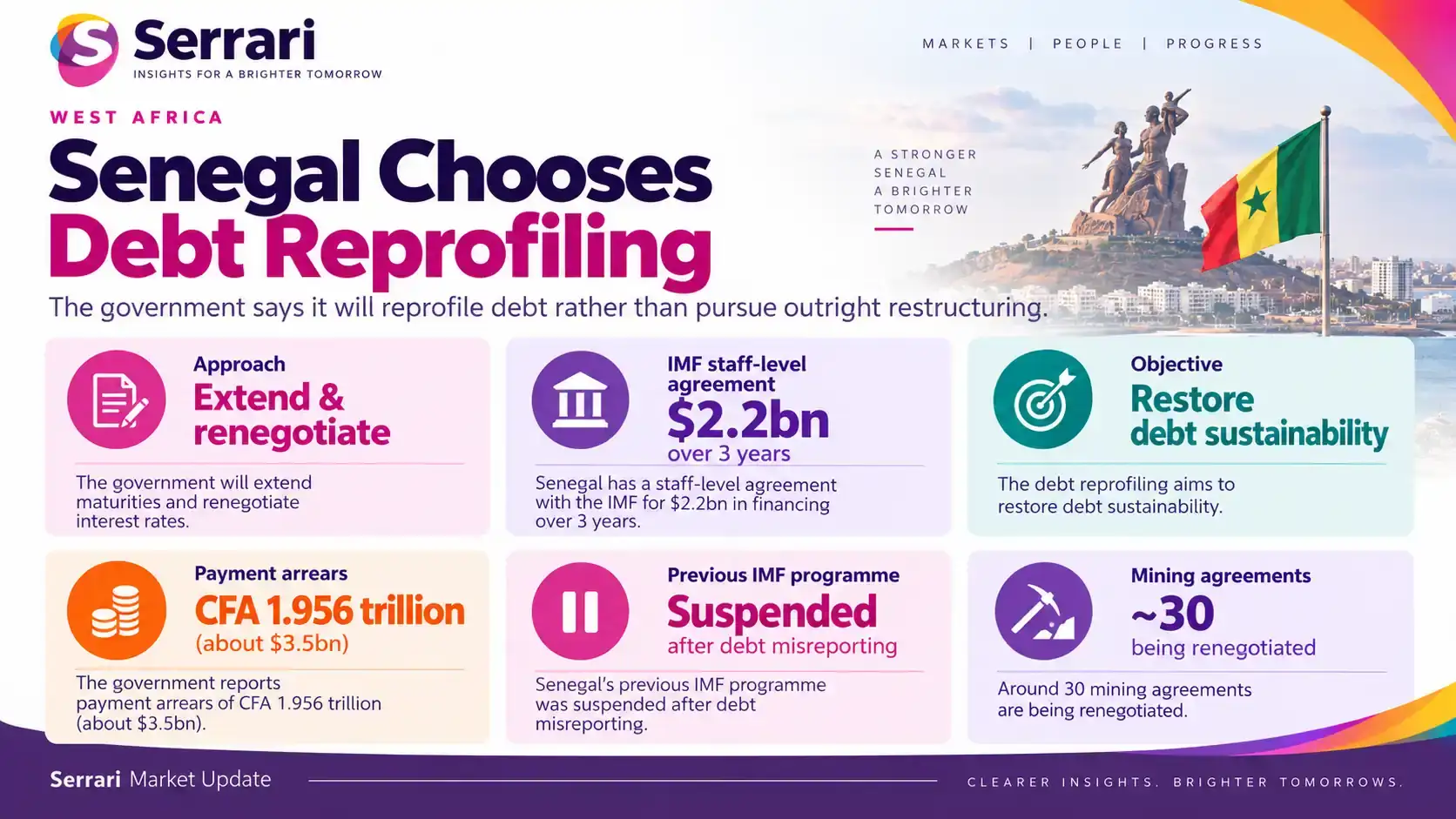
Senegal says it will pursue debt reprofiling rather than a conventional restructuring as it attempts to restore debt sustainability and unlock a new $2.2 billion programme with the International Monetary Fund.
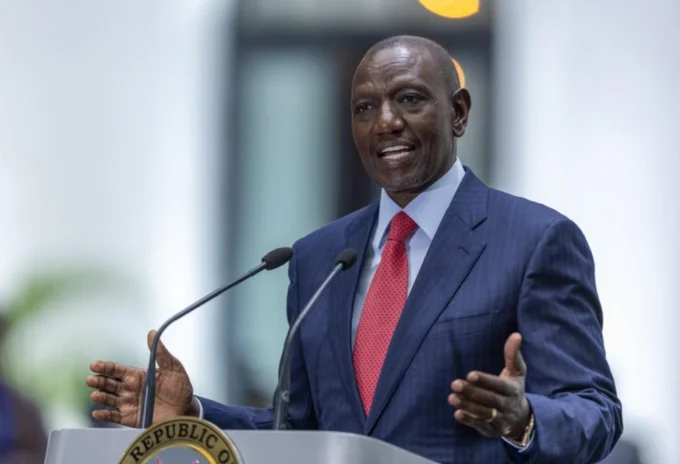
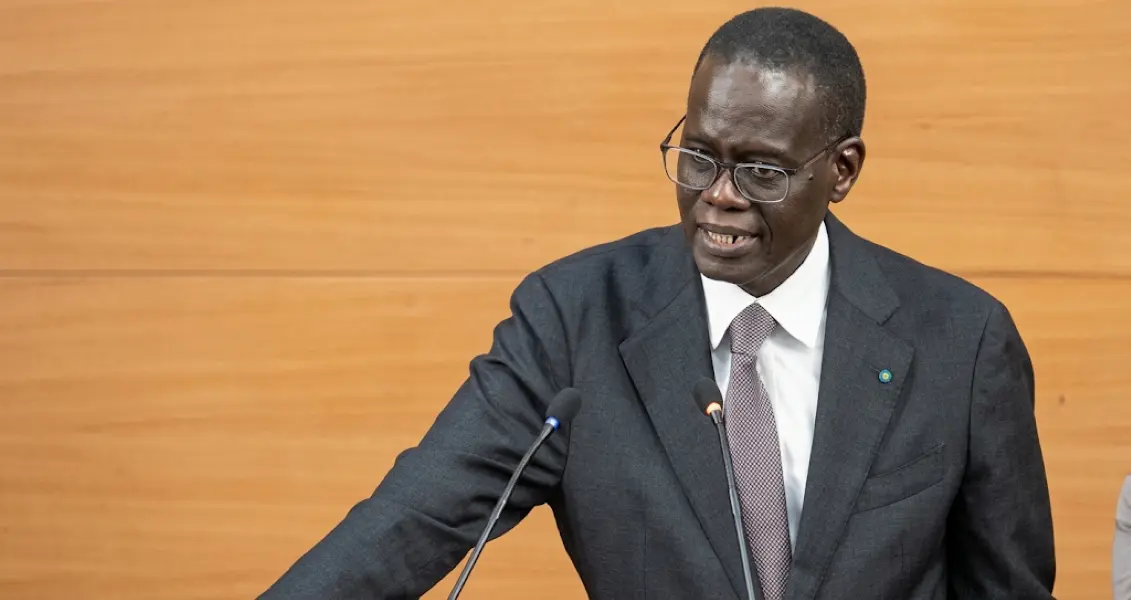
Prime Minister Ahmadou Al Aminou Lo told lawmakers that the strategy would involve extending debt maturities and renegotiating interest rates. The announcement comes days after Senegal and the IMF reached a staff-level agreement on a three-year financing programme aimed at stabilising public finances following the discovery of billions of dollars in previously unreported government liabilities.
Key Overview
- Senegal says it will reprofile rather than restructure its public debt.
- Reprofiling will involve extending maturities and renegotiating interest rates.
- Senegal and the IMF have reached a staff-level agreement for about $2.2 billion over 36 months.
- The IMF arrangement still requires management and Executive Board approval.
- Senegal had approximately CFA1.956 trillion ($3.5 billion) in payment arrears as of March 2025.
- Previously undisclosed liabilities dramatically increased the country’s reported debt burden.
- CFA franc-denominated debt is expected to be excluded from the proposed debt treatment.
- The government is also renegotiating roughly 30 mining agreements.
Senegal Draws a Line Between Reprofiling and Restructuring
Prime Minister Lo has sought to distinguish the government’s approach from a traditional sovereign debt restructuring, which can involve creditors accepting reductions in principal or other losses.
Instead, he said Senegal would seek to change the timing and cost of its obligations by extending repayment periods and renegotiating interest rates. The government hopes that spreading payments over a longer period can ease near-term financing pressure without pursuing outright reductions in the amount of principal owed.
However, the distinction may be less clear from an investor perspective. Changes to contractual maturities or interest payments can still be treated as a restructuring if creditors receive less favourable terms than originally promised. After Senegal unveiled its debt-treatment plans, foreign-currency bonds came under renewed pressure as markets assessed the possibility of losses or delayed payments.
S&P subsequently cut Senegal’s long-term foreign-currency sovereign rating to CC, saying a distressed exchange or default on commercial foreign-currency debt had become extremely likely.
IMF Deal Offers a Route Back to International Support
The new IMF agreement represents an important step toward restoring Senegal’s access to international financial support after its previous programme was frozen following revelations of inaccurate debt reporting.
Under the proposed arrangement, Senegal would receive approximately $2.2 billion over three years through an Extended Credit Facility. The programme is designed to restore macroeconomic stability and debt sustainability while improving fiscal transparency, public debt management and oversight of state-owned enterprises.
The agreement is not yet final. The IMF has made clear that Senegal must undertake corrective measures linked to the earlier debt misreporting before the programme can proceed to final approval.
The previous programme, worth about $1.8 billion, had effectively stalled after the new administration disclosed liabilities that had not been reflected accurately in official fiscal accounts.
Context is everything. Stay ahead of shifting trends with today’s market updates, and uncover emerging opportunities using the Serrari Group Market Index and Marketplace. Then, take control of your own financial future by exploring our Money & Life Reset Transformation Blueprint ™ to build stronger habits, create better systems, and design a path toward lasting wealth.
Hidden Debt Transformed Senegal’s Fiscal Position
The scale of the problem became clearer following audits and debt-reconciliation exercises covering the previous administration.
An IMF review found that Senegal’s central government debt for the end of 2023 had to be revised dramatically from earlier reported levels because of previously undisclosed liabilities. A later reconciliation exercise placed central government debt at 118.8% of GDP by the end of 2024 before some additional obligations were considered.
Broader estimates incorporating liabilities linked to public entities and arrears have put Senegal’s debt burden at around 130% of GDP, making the country one of Africa’s most heavily indebted sovereign borrowers.
The immediate challenge extends beyond long-term debt. Prime Minister Lo said Senegal had accumulated CFA1.956 trillion, or roughly $3.5 billion, in payment arrears as of March 2025. Unpaid government obligations can weaken private businesses by depriving contractors and suppliers of cash, potentially delaying investment and threatening employment.
CFA Debt Could Be Shielded From the Reprofiling
One of the most important features of Senegal’s proposed approach is its intention to exclude CFA franc-denominated liabilities from the debt treatment.
A substantial part of Senegal’s financing comes from domestic and regional investors operating within the West African Economic and Monetary Union. Reworking these obligations could transmit financial stress into regional banks, pension funds and other institutions that hold Senegalese government securities.
Senegal instead plans to pursue what its authorities have called an “enhanced common framework” for restoring debt sustainability, although the precise mechanics have not yet been disclosed.
This approach leaves an important question for foreign creditors: if regional CFA debt is protected, a greater share of the adjustment could fall on external lenders and holders of Senegal’s international bonds.
Government Targets Broader Fiscal Reforms
Debt negotiations form only part of Senegal’s effort to improve its finances. Lo also said the government is renegotiating about 30 mining agreements, continuing a broader review of arrangements covering the country’s natural resources.
The objective is to strengthen government revenues while the authorities simultaneously improve tax collection, control expenditure and resolve arrears.
For Senegal, successful reprofiling could provide additional time to manage an unusually heavy debt burden without pursuing the deeper principal reductions associated with some sovereign restructurings. But whether creditors, rating agencies and the IMF ultimately view the operation as simple reprofiling will depend on the final terms offered to lenders.
The next major milestone will be securing final approval for the $2.2 billion IMF programme and clarifying exactly how Senegal intends to alter its external debt obligations while protecting the regional CFA debt market.
Sources
Reuters / International Monetary Fund
Your financial future isn’t something you wait for—it’s something you build.
The real question is: when do you begin?
Move beyond simply staying informed.
Navigate the markets with clarity—track trends through the Serrari Group Market Index, uncover opportunities in the Serrari Marketplace, and build practical knowledge with our Curated Wealth Builder Platform.
Stay connected to what truly matters.
Get daily insights on macro trends and financial movements across Kenya, Africa, and global markets—delivered through the Serrari Newsletter.
Growth opens doors.
Advance your career through professional programs including ACCA, HESI A2, ATI TEAS 7 , HESI EXIT , NCLEX – RN and NCLEX – PN, Financial Literacy!🌟—designed to move you forward with confidence.
See where money is flowing—clearly and in real time.
Track Money Market Funds, Treasury Bills, Treasury Bonds, Green Bonds, and Fixed Deposits, alongside global and African indexes, key economic indicators, and the evolving Crypto and stablecoin landscape—all within Serrari’s Market Index.