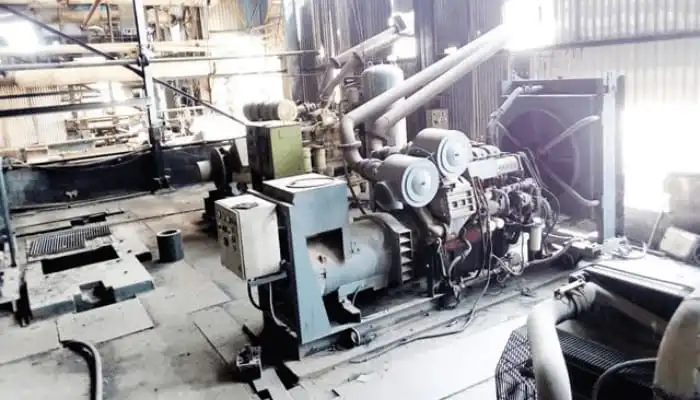
KIA Africa Group says it has regained full ownership and operational control of Bacita Sugar Company in Kwara State after resolving outstanding financing and redevelopment issues with Keystone Bank. The conciliation agreement ends a receivership period that followed a court-backed debt recovery process and clears the way for the company to restart its long-delayed rehabilitation programme.
The turnaround has also attracted fresh capital. KIA says an unnamed institutional investor has already provided an initial injection, although neither the investor’s identity nor the amount invested has been publicly disclosed.
Key Overview
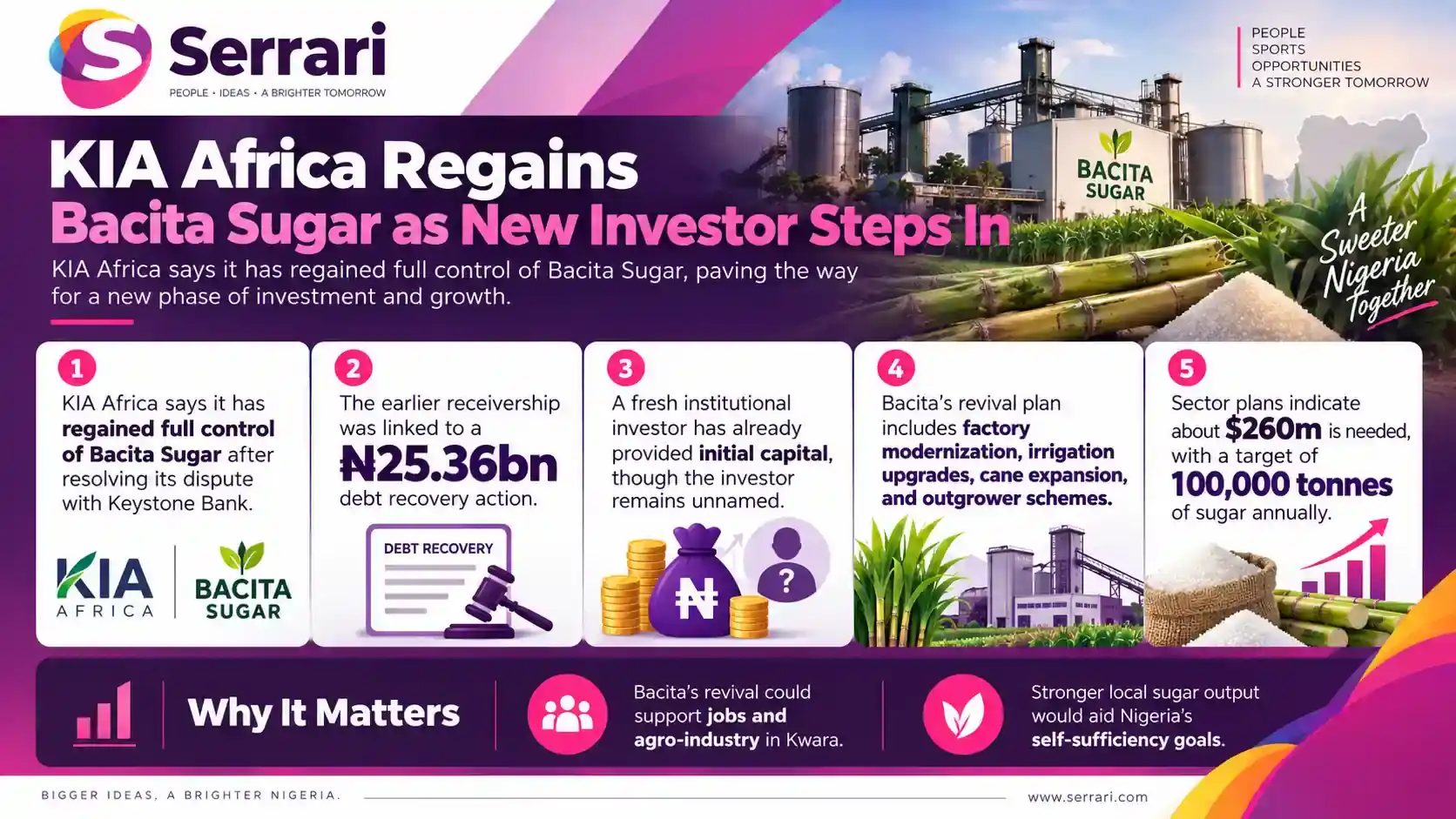
- KIA Africa says full ownership and operational control of Bacita Sugar have been restored after its dispute with Keystone Bank was resolved.
- The settlement follows a receivership linked to a ₦25.36 billion debt recovery action reported in 2025.
- A new institutional investor has supplied initial capital, but its name and investment amount remain undisclosed.
- Planned redevelopment covers factory modernisation, irrigation, sugarcane expansion, outgrower schemes and modern farming technology.
- Current industry planning identifies Bacita as requiring about $260 million of investment to return to full production.
- The estate is targeted to produce 100,000 metric tonnes of sugar annually through a planned 7,000-tonnes-cane-per-day factory.
Receivership Exit Clears a Major Financial Obstacle
Bacita’s latest reset follows a difficult financing period for KIA Africa. In March 2025, a Federal High Court-backed action placed the sugar business under a receiver-manager after Keystone Bank moved to recover approximately ₦25.36 billion in outstanding debt.
KIA had acquired the former Josepdam Sugar Company after an earlier Asset Management Corporation of Nigeria process, with Keystone Bank providing financing support for the acquisition. The 2025 enforcement action placed the company’s assets under receivership while the financing dispute remained unresolved.
The latest agreement changes that position. KIA says the dispute was settled through a constructive conciliation process and that ownership and operating authority have now returned to the company and its shareholders. The resolution allows management to focus again on operations, investment and rehabilitation rather than the ownership dispute.
Fresh Capital Backs Bacita’s Planned Revival
KIA’s announcement of new institutional backing is important because Bacita’s recovery requires substantial capital. The company says the initial investment has already helped it meet key financial milestones and strengthen the foundation for the estate’s revival.
The redevelopment plan includes modernising processing facilities, rehabilitating estate infrastructure, increasing sugarcane cultivation, improving irrigation and developing large-scale outgrower programmes. KIA also plans to introduce newer agricultural technologies intended to raise farm productivity and processing efficiency.
The scale of the funding requirement remains significant. Nigeria’s sugar-sector investment programme currently identifies Bacita as a major brownfield project, with an indicative investment requirement of about $260 million, comprising roughly $78 million in equity and $182 million in debt.
That programme envisages bringing the estate back to full production with a new 7,000-tonnes-cane-per-day factory and annual sugar output of about 100,000 metric tonnes. The institutional investor announced by KIA therefore appears to be an early part of a much larger capital requirement rather than the final funding needed for the turnaround.
Context is everything. Stay ahead of shifting trends with today’s market updates, and uncover emerging opportunities using the Serrari Group Market Index and Marketplace. Then, take control of your own financial future by exploring our Money & Life Reset Transformation Blueprint ™ to build stronger habits, create better systems, and design a path toward lasting wealth.
Revival Could Strengthen Nigeria’s Domestic Sugar Supply
Bacita has strategic importance because Nigeria still produces only a small share of the sugar it consumes. Current sector data estimates annual domestic consumption at around 1.8 million metric tonnes, while average local production is about 35,000 tonnes, or less than 3% of consumption.
The government’s National Sugar Master Plan seeks to narrow that gap by expanding local cane cultivation, processing capacity and backward integration. The programme was extended in 2023 with a target of achieving sugar self-sufficiency by 2033.
Bacita has long been part of that policy. The estate, established in 1961 as the former Nigerian Sugar Company, was Nigeria’s first integrated industrial sugar factory. KIA joined the country’s major backward-integration operators after acquiring the Bacita assets and announcing plans to restore commercial production.
A successful revival could therefore contribute more than factory output. KIA’s strategy includes large-scale outgrower schemes that could connect farmers to the estate’s supply chain while creating direct and indirect employment in cultivation, processing, transport and supporting services.
KIA Plans a Broader Agro-Industrial Platform
KIA’s longer-term ambitions extend beyond refined sugar. The group says Bacita could eventually support ethanol production, renewable energy, logistics and community-development projects, creating a broader agro-industrial ecosystem around the Kwara estate.
That diversification could improve the economics of sugarcane processing because cane by-products can be converted into energy, fuel and other commercial products. However, execution will depend on the company securing the full investment required, restoring production infrastructure and rebuilding a reliable cane supply base.
Exiting receivership removes one of the largest immediate uncertainties surrounding Bacita. The next test is whether fresh capital and the restored ownership structure can translate into functioning mills, expanded sugarcane acreage and sustained commercial production.
Sources: The Sun / Vanguard / The Nation / National Sugar Development Council / The Guardian Nigeria
Your financial future isn’t something you wait for—it’s something you build.
The real question is: when do you begin?
Move beyond simply staying informed.
Navigate the markets with clarity—track trends through the Serrari Group Market Index, uncover opportunities in the Serrari Marketplace, and build practical knowledge with our Curated Wealth Builder Platform.
Stay connected to what truly matters.
Get daily insights on macro trends and financial movements across Kenya, Africa, and global markets—delivered through the Serrari Newsletter.
Growth opens doors.
Advance your career through professional programs including ACCA, HESI A2, ATI TEAS 7 , HESI EXIT , NCLEX – RN and NCLEX – PN, Financial Literacy!🌟—designed to move you forward with confidence.
See where money is flowing—clearly and in real time.
Track Money Market Funds, Treasury Bills, Treasury Bonds, Green Bonds, and Fixed Deposits, alongside global and African indexes, key economic indicators, and the evolving Crypto and stablecoin landscape—all within Serrari’s Market Index.