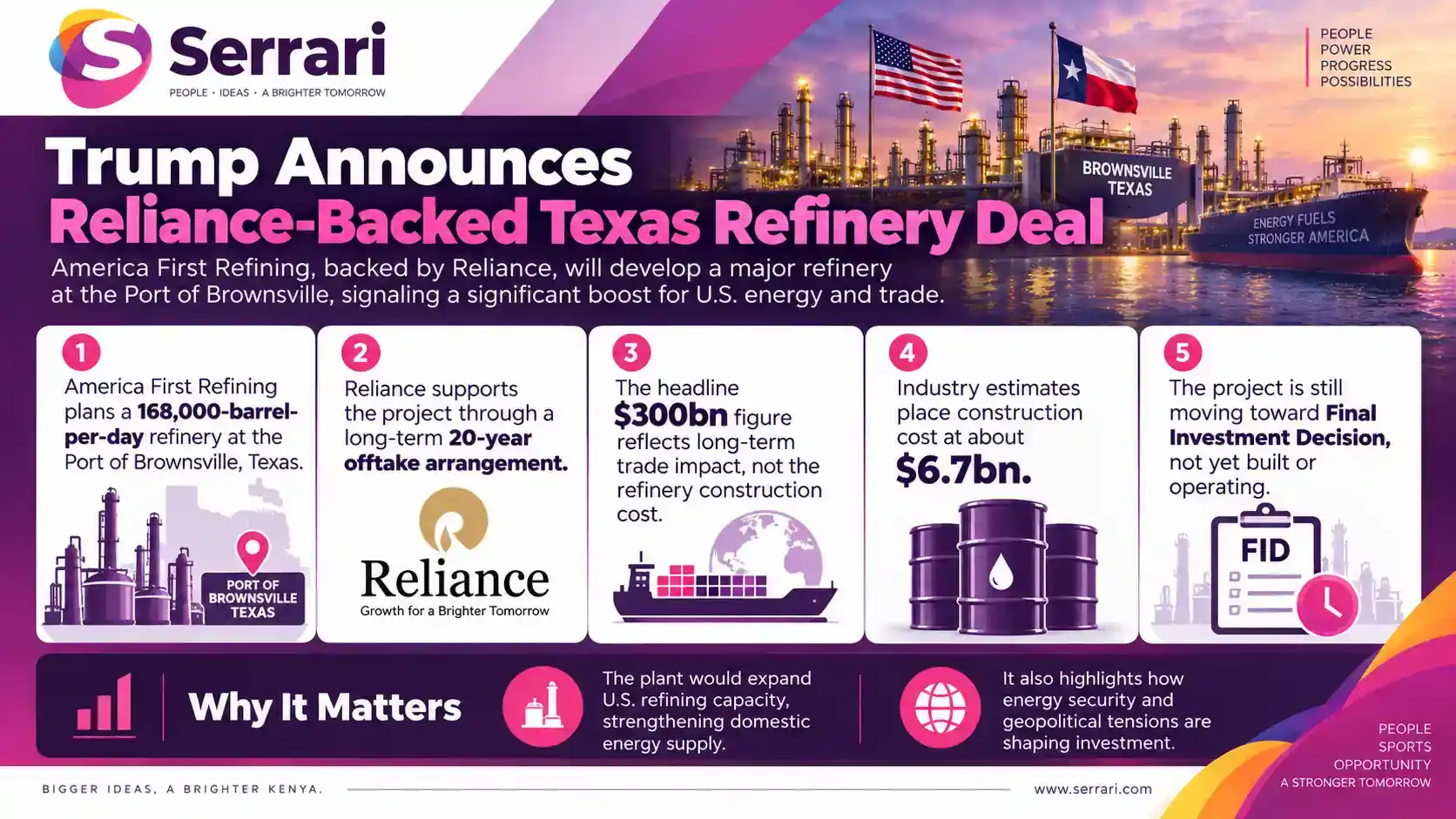
President Donald Trump has highlighted a Reliance-backed refinery planned for the Port of Brownsville, Texas, as part of his push to expand U.S. refining capacity. The project announced in March 2026 (Reuters) is being developed by America First Refining and is designed to process about 168,000 barrels of U.S. light shale crude per day.
However, the widely cited $300 billion figure is not the refinery’s construction cost or Reliance Industries’ direct investment. Instead, Brownsville officials describe it as the project’s estimated long-term contribution to the U.S. trade balance through crude purchases and refined-product sales, with the municipal breakdown (Brownsville, TX) putting the combined value at roughly $300 billion. Industry estimates suggest a refinery of the planned capacity could cost about $6.7 billion to construct.
Key Overview
- America First Refining plans a 168,000-barrel-per-day refinery at the Port of Brownsville, Texas.
- Trump identified Reliance Industries as the investor behind a nine-figure capital commitment to the project.
- Reliance has a binding 20-year offtake term sheet covering products produced by the refinery.
- The $300 billion headline represents projected trade activity, not project construction expenditure.
- The project is intended to process 100% U.S. light shale oil, particularly crude from the Permian Basin.
- As of September 2026, engineering work is advancing, but the project is still moving toward a Final Investment Decision.
What the $300 Billion Figure Actually Represents
Trump described the project as a $300 billion deal when he announced the refinery in March. The number is significant, but it should not be interpreted as Reliance writing a $300 billion cheque or America First Refining spending that amount on construction.
According to official project details, the 20-year arrangement is expected to support the purchase and processing of approximately 1.2 billion barrels of U.S. light shale oil, valued at about $125 billion, while producing as much as 50 billion gallons of refined petroleum products valued at roughly $175 billion.
Those two figures together produce the $300 billion estimate, which officials describe as an expected improvement to the U.S. trade balance over the life of the arrangement.
The physical refinery itself is dramatically smaller in capital terms. Based on recent U.S. refinery construction costs, industry analysis estimated that a 168,000-bpd plant could require around $6.7 billion.
Reliance Brings Capital and a Long-Term Buyer
America First Refining initially disclosed that an unnamed global energy company had made a nine-figure investment at a ten-figure valuation. Trump subsequently identified that investor as Reliance Industries, India’s largest private-sector company and operator of the giant Jamnagar refining complex.
Reliance also signed a 20-year offtake arrangement to buy products produced by the Texas facility. That long-term purchasing commitment is important because it gives the proposed refinery a large anchor customer before commercial operations begin.
The planned plant will primarily process light, sweet shale crude. Many older Gulf Coast refineries were designed around heavier, higher-sulphur crude, leaving the developers to argue that a purpose-built plant can better match the characteristics of growing U.S. shale production.
The Port of Brownsville says the refinery will occupy more than 240 acres and could create about 500 direct full-time jobs, alongside thousands of indirect jobs during construction, logistics and long-term operations. The port’s project announcement describes it as the first new Gulf Coast refinery of its scale in nearly five decades.
Context is everything. Stay ahead of shifting trends with today’s market updates, and uncover emerging opportunities using the Serrari Group Market Index and Marketplace. Then, take control of your own financial future by exploring our Money & Life Reset Transformation Blueprint ™ to build stronger habits, create better systems, and design a path toward lasting wealth.
Project Advances but Has Not Reached Final Investment Decision
The project has moved beyond the original announcement into engineering and design. In April, America First Refining selected Fluor to conduct front-end engineering and design for the facility.
That work expanded in September when Matrix Service Company received the storage tank farm design contract as part of the next engineering phase. The September award (Matrix Service Company Investors) described the work as a major step toward Final Investment Decision, indicating the project remains in development rather than being a completed or operating refinery.
This distinction matters because large refinery projects face substantial permitting, financing, construction and market risks even after engineering contracts have been awarded.
Hormuz Disruptions Strengthen the Energy-Security Argument
The project is advancing during an unusually volatile period for global energy markets. Renewed U.S.-Iran hostilities have disrupted maritime traffic around the Strait of Hormuz, one of the world’s most important oil corridors.
By September 7, shipping through the Strait had fallen to its lowest level since May, with the latest market reporting (Reuters) also showing Brent crude around $97 a barrel and U.S. West Texas Intermediate around $92.
That backdrop strengthens the political argument for more domestic refining capacity and greater use of U.S.-produced crude. It does not, however, eliminate the commercial risks. U.S. Gulf Coast refining capacity is already substantial, and analysts have questioned whether a completely new refinery will generate better returns than expanding existing plants.
Trump and the project’s developers have also promoted the Brownsville facility as exceptionally clean, pointing to hydrogen-powered systems and advanced refining technology. Those environmental performance claims will ultimately need to be measured against the plant’s actual emissions and operations once the project is built.
For now, the Reliance-backed refinery represents a significant attempt to pair U.S. shale production with new domestic refining capacity and long-term international demand. Its progress will depend less on the $300 billion headline and more on whether the developers can reach final investment approval, secure financing and successfully move from engineering into construction.
Sources: Reuters / City of Brownsville / Port of Brownsville / Matrix Service Company / Fluor / America First Refining
Your financial future isn’t something you wait for—it’s something you build.
The real question is: when do you begin?
Move beyond simply staying informed.
Navigate the markets with clarity—track trends through the Serrari Group Market Index, uncover opportunities in the Serrari Marketplace, and build practical knowledge with our Curated Wealth Builder Platform.
Stay connected to what truly matters.
Get daily insights on macro trends and financial movements across Kenya, Africa, and global markets—delivered through the Serrari Newsletter.
Growth opens doors.
Advance your career through professional programs including ACCA, HESI A2, ATI TEAS 7 , HESI EXIT , NCLEX – RN and NCLEX – PN, Financial Literacy!🌟—designed to move you forward with confidence.
See where money is flowing—clearly and in real time.
Track Money Market Funds, Treasury Bills, Treasury Bonds, Green Bonds, and Fixed Deposits, alongside global and African indexes, key economic indicators, and the evolving Crypto and stablecoin landscape—all within Serrari’s Market Index.