
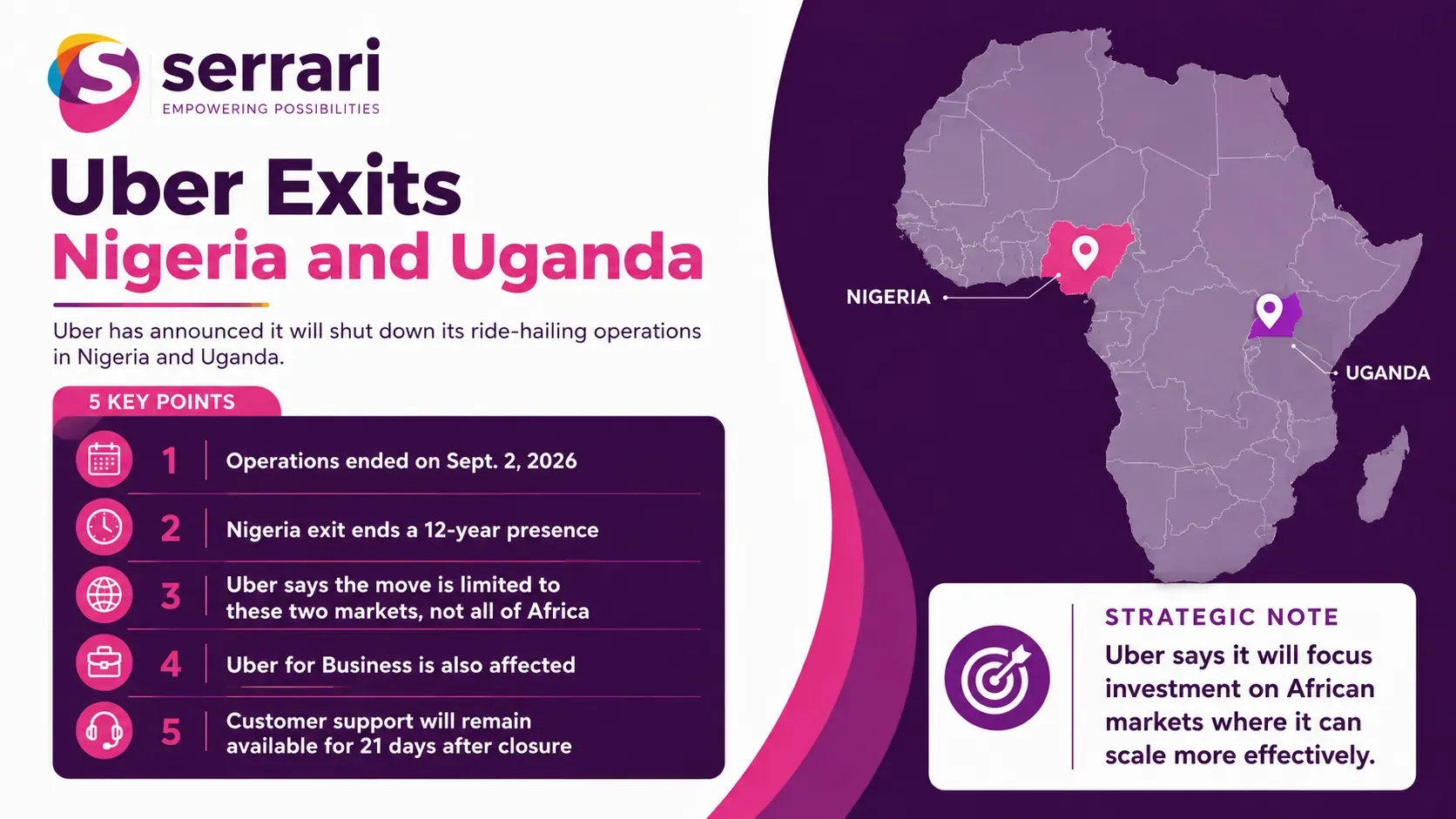
Uber has ended ride-hailing operations in Nigeria and Uganda effective September 2, 2026, marking a significant pullback from two long-standing African markets. The company described the exits as the result of a review of its business priorities and investment focus rather than a retreat from Africa as a whole.
Nigeria’s shutdown ends a 12-year presence that began in Lagos in 2014, while Uber’s Uganda business closes roughly a decade after its 2016 launch in Kampala. The company says it will now direct investment toward African markets where it believes its platform can operate at greater scale and create stronger value for drivers and riders.
Key Overview
- Uber ended ride-hailing operations in Nigeria and Uganda on September 2, 2026.
- The Nigeria exit ends 12 years of operations, while Uber had operated in Uganda for about a decade.
- The shutdown also includes Uber for Business in both countries.
- Customer support will remain available for 21 days after closure, taking Nigeria’s support period through September 23.
- Uber says the exits are limited to Nigeria and Uganda and do not represent a withdrawal from the rest of Africa.
- The company has not disclosed the number of drivers, riders or employees directly affected.
- Uber says its Nigeria exit is unrelated to the recent airport e-hailing dispute involving FAAN.
Uber Ends Long Runs in Nigeria and Uganda
Uber’s departure from Nigeria closes one of its longest-running operations in Sub-Saharan Africa. The company entered Lagos in 2014 before expanding into additional Nigerian cities as app-based transport became a major part of urban mobility.
The company told customers it had made the decision after reviewing its Nigerian operations, without identifying a single financial, regulatory or competitive factor responsible for the closure.
Nigeria’s ride-hailing environment has nevertheless become increasingly demanding. Rising fuel prices, inflation, currency volatility and vehicle operating costs have placed pressure on drivers while platforms compete to keep fares affordable for passengers.
Uganda’s exit follows a similar timeline. Uber launched in Kampala in 2016 and spent roughly a decade competing in a market that includes both conventional ride-hailing cars and locally popular motorcycle-based transport services.
Uber informed Ugandan customers that operations would end immediately on September 2 following what it described as a broader business review.
Uber Says It Is Not Leaving Africa
Despite withdrawing from two countries simultaneously, Uber has stressed that the decision does not extend to the rest of its African operations.
The company said the shutdown was limited specifically to Nigeria and Uganda and reiterated that it continues to see long-term opportunities across Sub-Saharan Africa.
Its strategy now appears more selective. Rather than maintaining a presence in every market where demand exists, Uber says investment will increasingly be directed toward countries where it can achieve sufficient scale, maintain reliable services for passengers and support sustainable driver earnings.
The exits follow other African withdrawals. Uber left Côte d’Ivoire in September 2025 and Tanzania in early 2026, meaning four African market exits in roughly a year as the company reassesses where its model can operate most effectively.
It continues operating in several major African markets, including Kenya, South Africa, Ghana, Egypt and Morocco.
Context is everything. Stay ahead of shifting trends with today’s market updates, and uncover emerging opportunities using the Serrari Group Market Index and Marketplace. Then, take control of your own financial future by exploring our Money & Life Reset Transformation Blueprint ™ to build stronger habits, create better systems, and design a path toward lasting wealth.
Drivers and Business Customers Face Immediate Changes
Uber has not disclosed how many employees, drivers or riders will be affected in Nigeria and Uganda. Active driver-partners have been contacted directly, and the company says they will receive what it described as a token of appreciation during the transition.
The closure also extends to Uber for Business accounts in both countries, with affected corporate clients being contacted about the termination of service.
Support will not disappear immediately. Customers will retain access to assistance for 21 days following the shutdown, allowing outstanding account and service issues to be resolved. In Nigeria, the help centre will remain available until September 23 before the transition period ends.
Uber also says customer information will continue to be processed according to applicable privacy and data-protection requirements, with information retained where legally necessary.
Uber Rejects Link Between Exit and Airport Dispute
The Nigerian withdrawal arrived shortly after controversy surrounding how e-hailing companies operate at the country’s airports, creating speculation that regulatory restrictions contributed directly to Uber’s decision.
In August, aviation authorities clarified that their approach was not intended as a blanket prohibition on e-hailing but instead sought a formal operating framework covering security, vehicle oversight, accountability and passenger pick-ups.
Uber has explicitly rejected a connection. The company said its decision was unrelated to the airport directive and resulted from its wider review of investment priorities across Africa.
That distinction is important because Uber has not publicly attributed the Nigeria or Uganda exits to any specific government action.
A More Selective African Ride-Hailing Market
Uber’s departure creates new opportunities for competing mobility platforms to capture passengers and drivers in both countries. In Nigeria, rival operators including Bolt and inDrive remain active, while Uganda’s ride-hailing market includes providers such as SafeBoda and Faras.
More broadly, the closures demonstrate the challenge of converting Africa’s rapidly growing demand for urban transport into sustainable platform economics. Passengers want lower fares, drivers need earnings that compensate for fuel and vehicle costs, while ride-hailing companies require sufficient commissions and trip volumes to support their operations.
Uber’s latest move suggests the company is prioritising depth over geographical breadth in Africa. Whether that strategy ultimately strengthens its position will depend on how effectively it can grow the markets it retains while local and international competitors pursue the users it leaves behind.
Sources: Reuters / TechBuild Africa / BusinessDay / Premium Times / Pulse Uganda / Business Post Nigeria / Federal Airports Authority of Nigeria
Your financial future isn’t something you wait for—it’s something you build.
The real question is: when do you begin?
Move beyond simply staying informed.
Navigate the markets with clarity—track trends through the Serrari Group Market Index, uncover opportunities in the Serrari Marketplace, and build practical knowledge with our Curated Wealth Builder Platform.
Stay connected to what truly matters.
Get daily insights on macro trends and financial movements across Kenya, Africa, and global markets—delivered through the Serrari Newsletter.
Growth opens doors.
Advance your career through professional programs including ACCA, HESI A2, ATI TEAS 7 , HESI EXIT , NCLEX – RN and NCLEX – PN, Financial Literacy!🌟—designed to move you forward with confidence.
See where money is flowing—clearly and in real time.
Track Money Market Funds, Treasury Bills, Treasury Bonds, Green Bonds, and Fixed Deposits, alongside global and African indexes, key economic indicators, and the evolving Crypto and stablecoin landscape—all within Serrari’s Market Index.