Egypt and Abu Dhabi Future Energy Company (Masdar) are accelerating cooperation on renewable energy and battery storage projects as Egypt works to increase the share of renewables in its electricity mix to 45% by 2028. Discussions covered solar, wind and battery storage projects, including major developments in Ras Ghareb, Minya, Benban and the Gulf of Suez.
Key Overview
- Egypt and Masdar reviewed progress on solar, wind and battery storage projects.
- A 1,000MW wind project is being developed in Ras Ghareb.
- A 1,000MW solar project in Minya is planned alongside 600MWh of battery storage.
- A 200MW solar project in Benban includes 120MWh of battery storage.
- The Gulf of Suez wind project is scheduled for grid connection in December 2026.
- Egypt aims to increase renewable energy’s contribution to 45% of the electricity mix by 2028.
- The government is using energy storage to support grid stability and reduce fossil fuel consumption.
Egypt and Masdar Review Renewable Energy Projects
Egyptian Minister of Electricity and Renewable Energy Mahmoud Esmat met with a delegation from Abu Dhabi Future Energy Company (Masdar), led by CEO Mohamed Jameel Al Ramahi, in Cairo to review progress on renewable energy projects and opportunities to expand cooperation.
According to Egypt’s Ministry of Electricity and Renewable Energy, the discussions covered the implementation of joint solar, wind, and battery energy storage projects under existing agreements.
The meeting focused on accelerating construction and commissioning, connecting new generation capacity to Egypt’s national grid and increasing the contribution of renewable energy to the country’s electricity mix.
Esmat also reviewed developments in Masdar’s solar and wind projects, as well as battery energy storage systems (BESS).
Major Solar, Wind and Battery Storage Projects
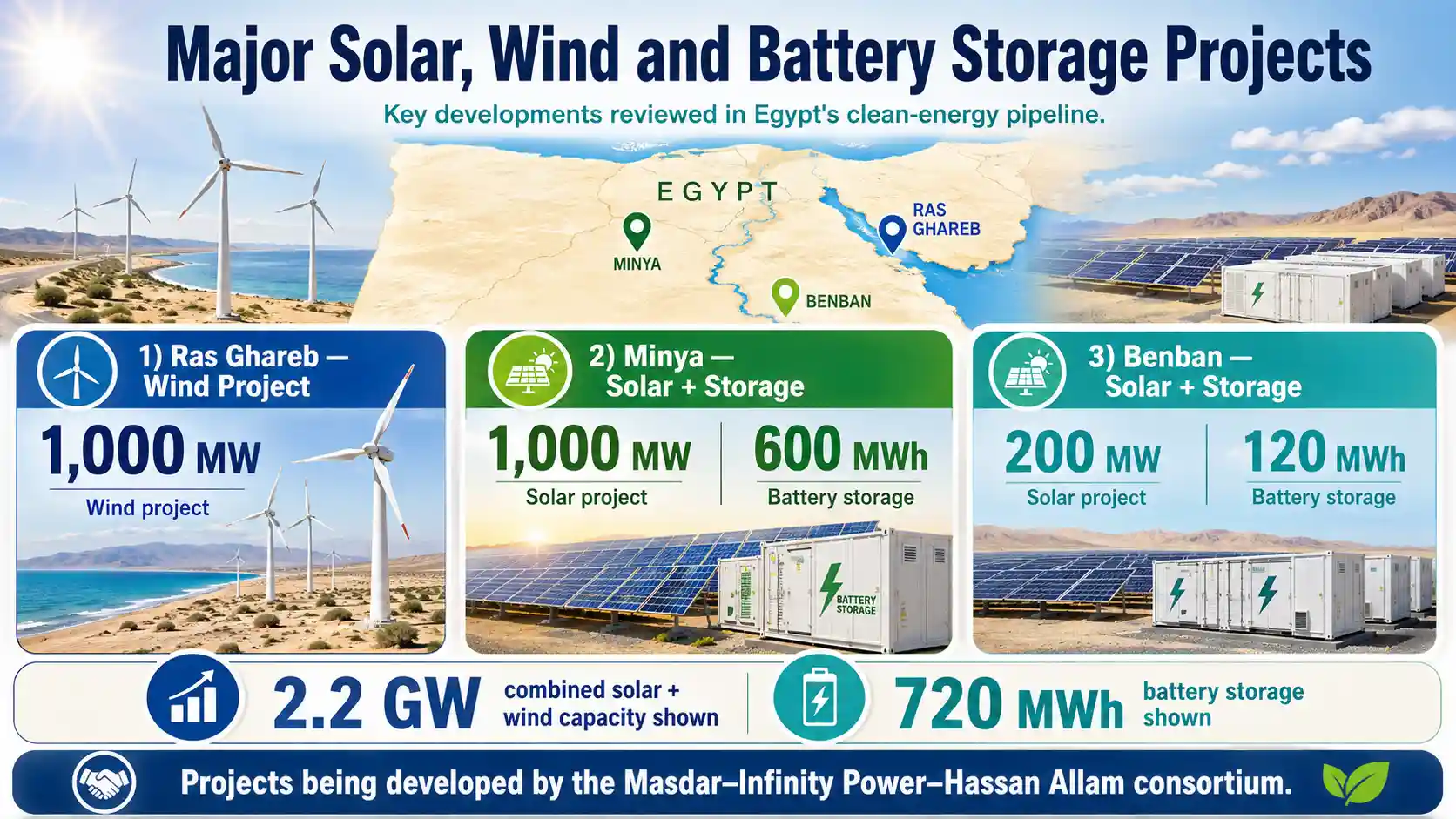
The discussions covered several large-scale renewable energy projects being developed by the consortium involving Masdar, Infinity Power and Hassan Allam.
These include a 1,000 MW wind project in Ras Shukeir, a 1,000 MW solar project in Minya with 600 MWh of battery storage.
The consortium is also developing a 200MW solar project in Benban, supported by 120 MWh of battery storage. Grid connection for the project is scheduled by the end of 2026.
In addition, Masdar has been involved in Egypt’s Benban Solar Park. In September 2020, the company acquired the stake previously held by German renewable energy company ib vogt in the 64.1 Megawatt Peak (MWp) Infinity 50 solar photovoltaic project.
The projects form part of Egypt’s broader effort to increase renewable generation while strengthening the country’s electricity infrastructure.
Gulf of Suez Wind Project Nears Grid Connection
Esmat also followed up on the progress of the wind power project in the Gulf of Suez, which is scheduled to be connected to Egypt’s national electricity grid in December 2026.
The project is part of the country’s growing pipeline of wind and solar developments aimed at adding new clean generation capacity.
Egypt has been expanding renewable energy projects while seeking to integrate additional generation into the national grid.
Battery Storage to Support Grid Stability
Energy storage was a key part of the discussions, reflecting the government’s focus on combining renewable generation with both connected and standalone battery storage systems.
According to Esmat, adding storage capacity alongside renewable generation will help Egypt reduce fossil fuel consumption, secure electricity supplies and maintain stability across the unified grid.
Battery storage can also support the integration of variable renewable sources such as solar and wind by providing additional flexibility to the electricity system.
Context is everything. Stay ahead of shifting trends with today’s market updates, and uncover emerging opportunities using the Serrari Group Market Index and Marketplace. Then, take control of your own financial future by exploring our Money & Life Reset Transformation Blueprint ™ to build stronger habits, create better systems, and design a path toward lasting wealth.
Egypt Targets 45% Renewable Energy by 2028
Esmat highlighted Egypt’s national target of increasing the share of renewable energy in the electricity mix to 45% by 2028.
The government considers cooperation with domestic and international private-sector companies essential to achieving the target.
Esmat said meetings with renewable energy companies are part of the government’s efforts to advance Egypt’s energy transition and increase reliance on clean and sustainable energy sources.
He also described Masdar as a “partner in success,” highlighting the company’s role in supporting Egypt’s renewable energy ambitions.
The strategy involves adding new renewable generation capacity while developing the transmission and storage infrastructure needed to integrate that power into the national electricity system.
Private Sector Plays Key Role
Egypt is relying heavily on private sector partnerships to accelerate renewable energy development.
The collaboration with Masdar, alongside other international and domestic companies, is intended to increase investment in clean power generation and related infrastructure.
The government expects these partnerships to help expand renewable generation while reducing dependence on fossil fuels and improving electricity supply reliability.
Outlook
Egypt’s renewable energy pipeline is expected to expand as the country works toward its 45% renewable energy target by 2028.
The combination of large-scale solar and wind projects with battery storage could help the country add clean generation while improving grid flexibility and stability.
The progress of projects in the Gulf of Suez, Ras Ghareb, Minya and Benban will therefore remain important to Egypt’s energy transition. Continued cooperation between the government, Masdar and other private-sector investors will be central to bringing new renewable capacity online and reducing fossil fuel consumption.
FAQs
1. What renewable energy target has Egypt set for 2028?
Egypt aims to increase renewable energy’s share of its electricity mix to 45% by 2028.
2. What renewable projects are Egypt and Masdar developing?
The projects include wind and solar developments in the Gulf of Suez, Ras Ghareb, Minya and Benban, alongside battery storage systems.
3. How much battery storage is planned in the Minya solar project?
The 1,000MW Minya solar project is planned with 600MWh of battery storage.
4. Why is Egypt adding battery storage to renewable projects?
Battery storage is intended to support grid stability, electricity supply reliability and the integration of renewable generation, while helping reduce fossil fuel consumption.
Sources: Fast Company Middle East, Zawya, Egypt Oil & Gas, MEP Middle East
Your financial future isn’t something you wait for—it’s something you build.
The real question is: when do you begin?
Move beyond simply staying informed.
Navigate the markets with clarity—track trends through the Serrari Group Market Index, uncover opportunities in the Serrari Marketplace, and build practical knowledge with our Curated Wealth Builder Platform.
Stay connected to what truly matters.
Get daily insights on macro trends and financial movements across Kenya, Africa, and global markets—delivered through the Serrari Newsletter.
Growth opens doors.
Advance your career through professional programs including ACCA, HESI A2, ATI TEAS 7 , HESI EXIT , NCLEX – RN and NCLEX – PN, Financial Literacy!🌟—designed to move you forward with confidence.
See where money is flowing—clearly and in real time.
Track Money Market Funds, Treasury Bills, Treasury Bonds, Green Bonds, and Fixed Deposits, alongside global and African indexes, key economic indicators, and the evolving Crypto and stablecoin landscape—all within Serrari’s Market Index.