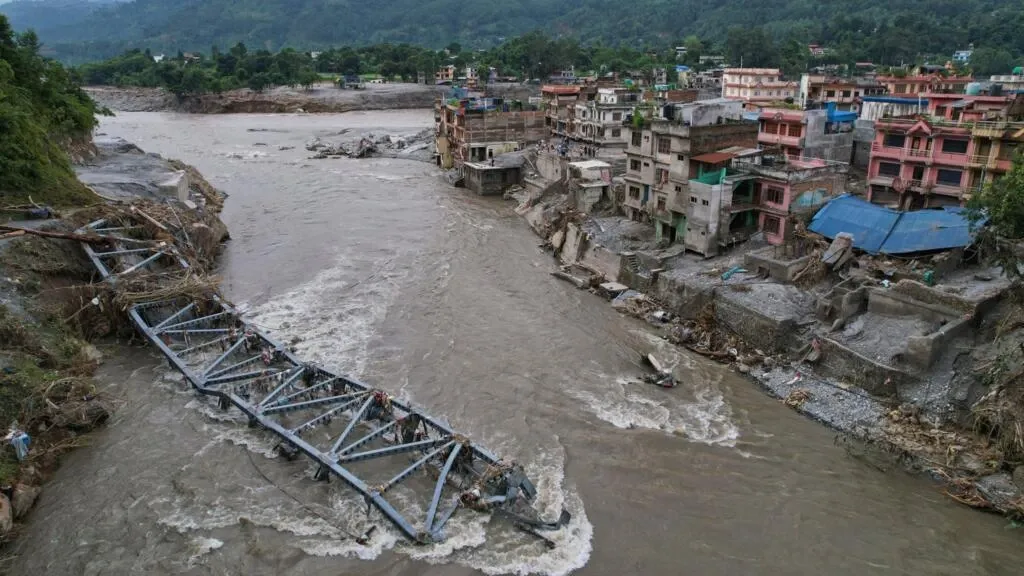
Nepal and the United Nations have warned of growing climate risks to the Himalayan region following deadly flooding near Nepal’s border with China. The disaster, which followed a glacial collapse, left hundreds confirmed dead and thousands missing. Officials called for stronger climate research, real-time hydrological data sharing and international action to protect vulnerable Himalayan communities.
Key Overview
- A glacial collapse triggered torrential flooding and debris flows near the Nepal-China border.
- Nearly 3,000 people were reported missing, with 682 confirmed dead.
- Nepal and China agreed to strengthen the sharing of real-time hydrological data.
- Himalayan glaciers provide critical water resources to nearly 2 billion people.
- Nepal says it contributes only about 0.01% of global greenhouse gas emissions but faces significant climate impacts.
- The UN warned that a warming climate is making climate-related disasters more likely, frequent and severe.
- Melting glaciers and thawing permafrost can destabilise mountain slopes and increase the risk of landslides.
Deadly Floods Highlight Himalayan Climate Risks
Nepal and the United Nations have warned of growing climate threats to the Himalayas following deadly flooding near Nepal’s border with China.
The warning came as rescuers continued searching for thousands of people missing after torrential flooding along the high-altitude border.
According to the US Geological Survey, the disaster on Wednesday was caused by a glacial collapse that sent a torrent of debris downstream, with nearly 3,000 people missing and 682 confirmed dead .
Although the exact cause of the glacial collapse remains unclear, the disaster has renewed concerns about the vulnerability of Himalayan communities as climate change accelerates glacier melt.
Nepal Calls for Greater Himalayan Research
Nepalese Foreign Minister Shisir Khanal said the country needs greater research to understand the changing dynamics of the Himalayan ecosystem and the risks they pose.
He said the risks extend beyond Nepal and affect downstream communities as well as neighbouring China.
“We always highlight that Nepal contributes less than or just about 0.01 per cent of greenhouse gases but we, the people of Nepal, are one of the major victims of the changing climate and its impact,” Khanal said.
He called on the international community to work together to preserve the Himalayan ecosystem.
The Himalayas are particularly important because their glaciers provide critical water resources to nearly 2 billion people. Faster glacier melting is increasing concerns over water availability and the risk of sudden and destructive climate-related events.
Nepal and China Strengthen Data Sharing
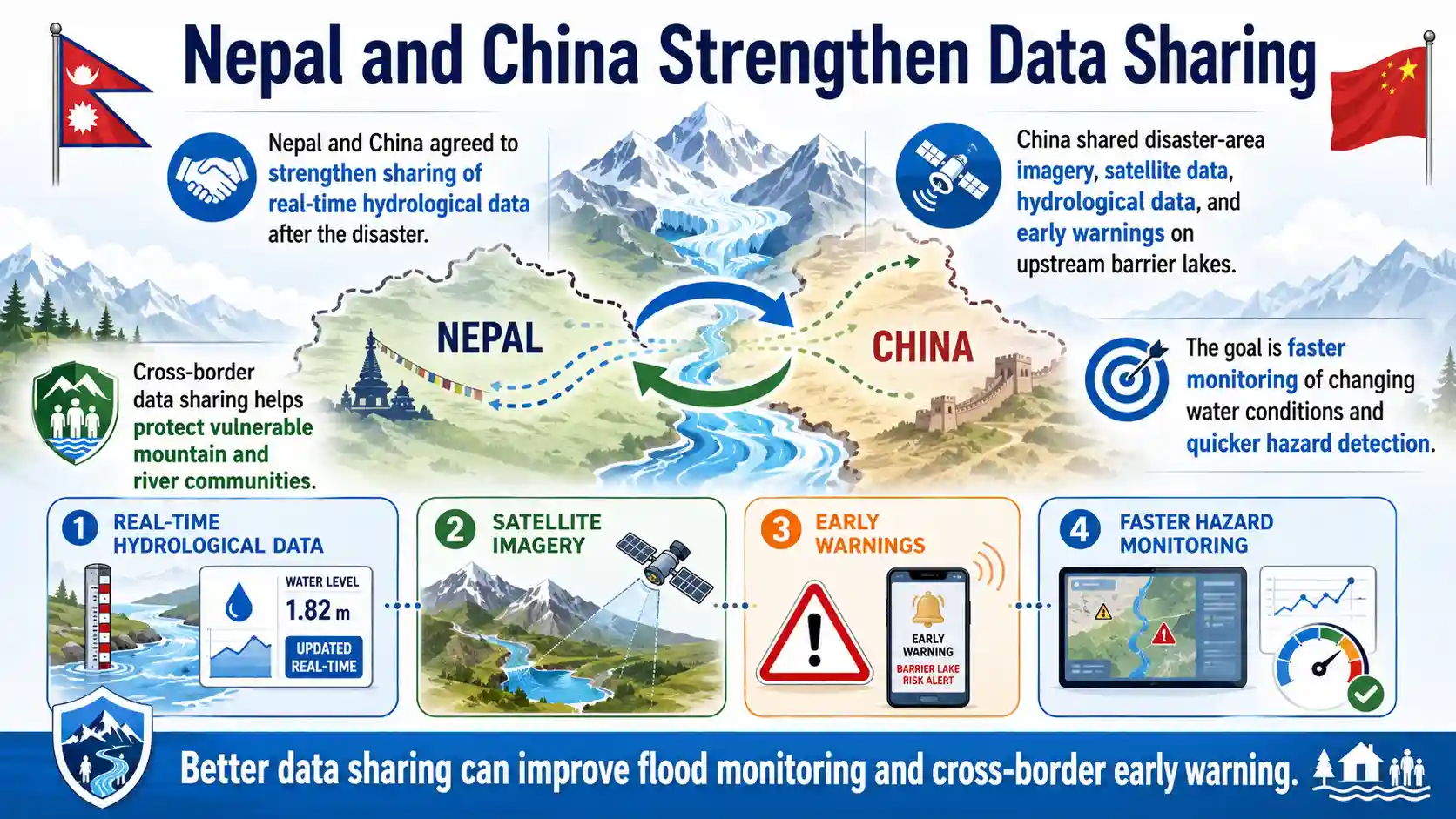
Following the disaster, Khanal said he spoke by phone with Chinese Foreign Minister Wang Yi, with both sides agreeing to increase the sharing of real-time hydrological data.
China also shared information with Nepal, including disaster-area imagery, satellite and hydrological data, as well as early warnings concerning upstream barrier lakes.
Wang said China and Nepal are connected by their mountains and rivers and share a common destiny.
Improved data sharing could help authorities monitor changing water conditions and identify potential hazards more quickly, particularly in areas where flooding, glacial lakes and other mountain risks can affect communities across borders.
UN Warns Climate Change Is Increasing Disaster Risks
UN climate chief Simon Stiell described the glacial collapse and flash flood as a devastating reminder of the vulnerability of mountain environments.
He warned that global warming is increasing the likelihood, frequency and severity of climate-related disasters.
According to Stiell, human activity, particularly the continued burning of coal, oil and gas, is driving climate change and increasing risks for vulnerable communities.
The warning highlights the growing connection between rising global temperatures and hazards in fragile mountain ecosystems.
Context is everything. Stay ahead of shifting trends with today’s market updates, and uncover emerging opportunities using the Serrari Group Market Index and Marketplace. Then, take control of your own financial future by exploring our Money & Life Reset Transformation Blueprint ™ to build stronger habits, create better systems, and design a path toward lasting wealth.
Melting Glaciers Increase Mountain Hazards
Climate change is affecting Himalayan glaciers as temperatures rise, with glacier melt contributing to changing conditions across high-altitude environments.
Melting glaciers and thawing permafrost can also weaken and destabilise mountain slopes, increasing the potential for landslides and other hazards.
For countries such as Nepal, where communities and infrastructure are exposed to mountain and river systems, these changes create significant challenges.
The recent flooding demonstrates how rapidly hazards can develop in high-altitude areas and how their impacts can cross national borders.
Climate Vulnerability Despite Low Emissions
Nepal’s government has highlighted the contrast between its relatively small contribution to global greenhouse gas emissions and its exposure to climate impacts.
Khanal said Nepal contributes approximately 0.01 percent of greenhouse gas emissions, yet its people are among those experiencing significant effects from climate change.
The country’s geography makes climate resilience particularly important, with communities exposed to changing rainfall patterns, glacier-related hazards, floods and landslides.
The government is therefore calling for greater international cooperation to protect the Himalayan ecosystem and communities that depend on it.
Outlook
The disaster is likely to increase pressure on Nepal, China and the wider international community to strengthen early-warning systems, hydrological monitoring and climate research in the Himalayas.
Greater sharing of satellite, hydrological and disaster information could help countries respond more quickly to emerging risks.
However, the UN warning also points to the wider challenge of limiting global warming. As glaciers continue to melt and mountain environments become increasingly unstable, vulnerable communities may face more frequent and severe hazards.
For Nepal, strengthening regional cooperation while securing international support for climate adaptation will remain important to protecting communities and the Himalayan ecosystem.
FAQs
1. What caused the floods in Nepal?
The US Geological Survey said the disaster was caused by a glacial collapse that sent a torrent of debris downstream.
2. How many people were affected by the disaster?
Nearly 3,000 people were reported missing, while 682 deaths had been confirmed.
3. Why are Himalayan glaciers important?
Himalayan glaciers provide critical water resources to nearly 2 billion people.
4. How is climate change increasing risks in the Himalayas?
Climate change is accelerating glacier melt and thawing permafrost, which can destabilise mountain slopes and increase risks of floods, landslides and other hazards.
Sources: Channel NewsAsia, Yahoo News, BARRON’S
Your financial future isn’t something you wait for—it’s something you build.
The real question is: when do you begin?
Move beyond simply staying informed.
Navigate the markets with clarity—track trends through the Serrari Group Market Index, uncover opportunities in the Serrari Marketplace, and build practical knowledge with our Curated Wealth Builder Platform.
Stay connected to what truly matters.
Get daily insights on macro trends and financial movements across Kenya, Africa, and global markets—delivered through the Serrari Newsletter.
Growth opens doors.
Advance your career through professional programs including ACCA, HESI A2, ATI TEAS 7 , HESI EXIT , NCLEX – RN and NCLEX – PN, Financial Literacy!🌟—designed to move you forward with confidence.
See where money is flowing—clearly and in real time.
Track Money Market Funds, Treasury Bills, Treasury Bonds, Green Bonds, and Fixed Deposits, alongside global and African indexes, key economic indicators, and the evolving Crypto and stablecoin landscape—all within Serrari’s Market Index.