




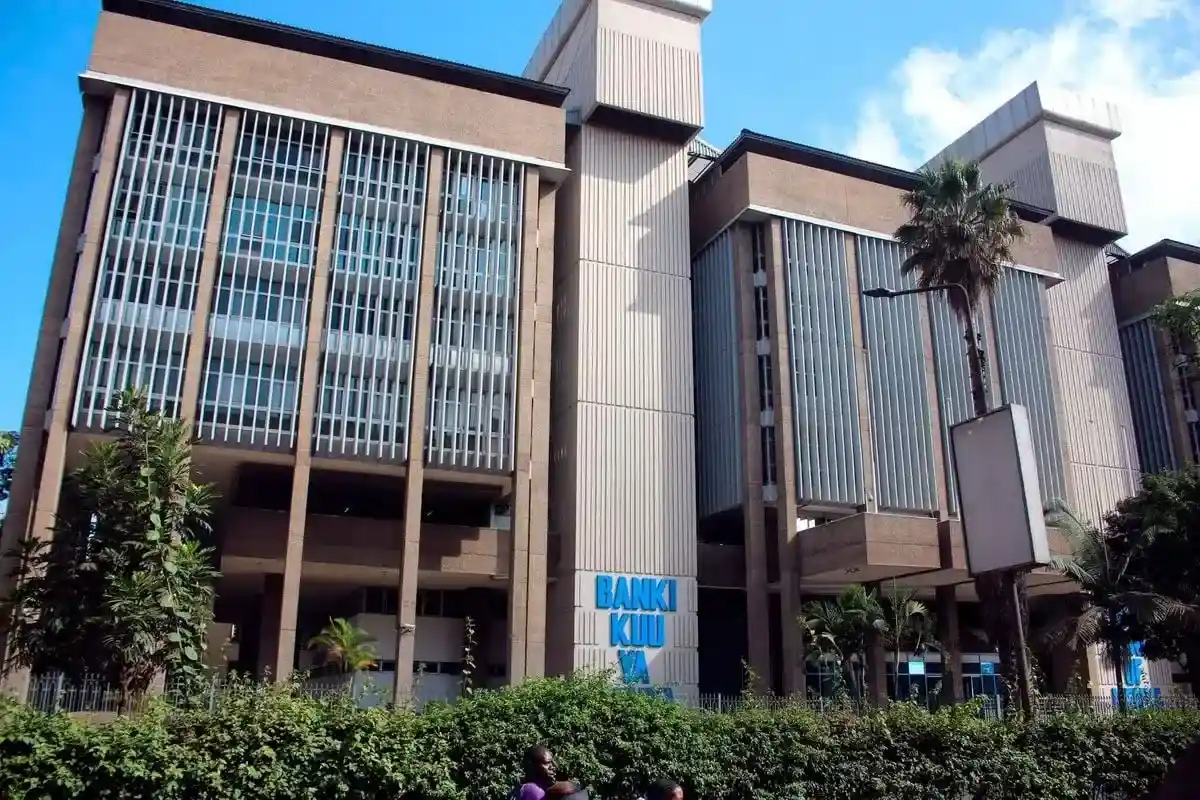
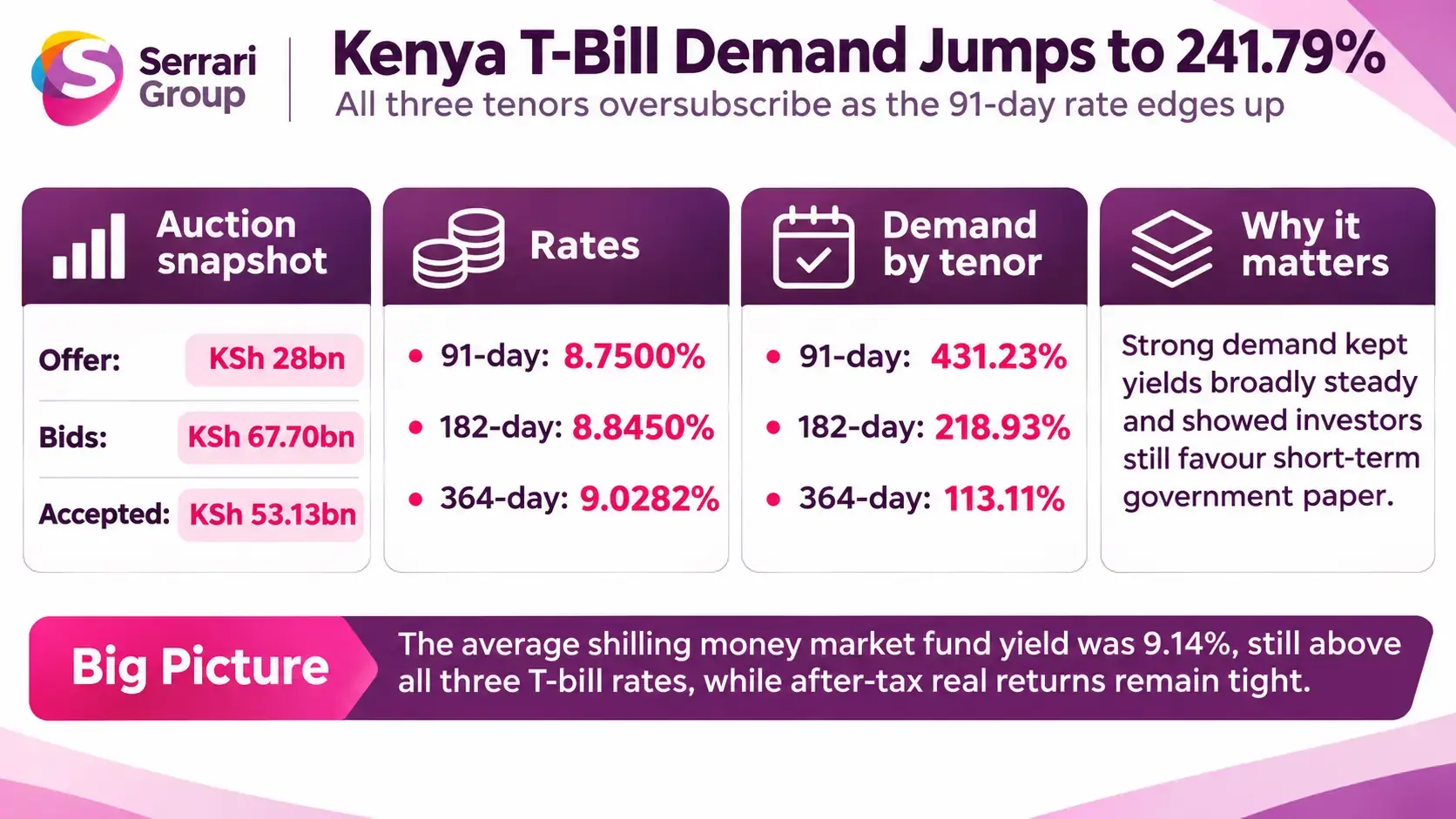
Kenya’s Treasury bill market recorded a sharp increase in investor demand during the auction held on Thursday, November 5, 2026, with total bids reaching KSh 67.70 billion against an offer of KSh 28 billion, representing a subscription rate of 241.79%.
The Central Bank of Kenya (CBK) accepted KSh 53.13 billion, largely to refinance maturing government securities, while interest rates across all three Treasury bill tenors remained relatively unchanged.
The 91-day Treasury bill yield edged higher to 8.7500%, while the 182-day and 364-day rates declined marginally to 8.8450% and 9.0282%, respectively.
The auction results point to a market increasingly characterised by substantial demand for short-term government securities, limited upward movement in interest rates and selective acceptance of bids by the central bank.
For investors, the development raises questions about the direction of government borrowing costs, the attractiveness of Treasury bills relative to money market funds and the extent to which prevailing returns can protect savings against inflation.
Key Overview
- Treasury bill demand surged: Investors submitted KSh 67.70 billion in bids against KSh 28 billion offered, pushing the subscription rate to 241.79%, compared with 185.20% in the preceding auction.
- 91-day Treasury bill yield increased marginally: The rate rose from 8.7498% to 8.7500%, with the instrument attracting KSh 34.50 billion in bids.
- 182-day and 364-day yields eased: The respective rates declined to 8.8450% and 9.0282%, indicating continued stability in short-term government borrowing costs.
- All three Treasury bills were oversubscribed: The 91-day, 182-day and 364-day securities recorded subscription rates of 431.23%, 218.93% and 113.11%, respectively.
- Government borrowing largely refinanced existing debt: CBK accepted KSh 53.13 billion against KSh 52.31 billion in maturing securities, resulting in approximately KSh 820 million in net new borrowing.
- Money market funds remained competitive: The average reported yield across 27 Kenya shilling money market funds tracked by Serrari stood at 9.14% as of November 5, 2026.
- Inflation remains a consideration: Kenya’s October inflation rate of 7.3% continues to narrow the purchasing-power gains available to investors after taxation.
Treasury Bill Auction Results: November 5, 2026
The official Treasury bill auction results for issues 2707/091, 2681/182 and 2636/364 confirmed that demand exceeded the amounts offered across all three maturities.
| Tenor | Rate (5 Nov) | Previous Rate | Change (percentage points) | Amount Offered | Bids Received | Subscription | Amount Accepted |
| 91-day | 8.7500% | 8.7498% | +0.0002 | KSh 8.00bn | KSh 34.50bn | 431.23% | KSh 34.46bn |
| 182-day | 8.8450% | 8.8508% | -0.0058 | KSh 10.00bn | KSh 21.89bn | 218.93% | KSh 7.43bn |
| 364-day | 9.0282% | 9.0288% | -0.0006 | KSh 10.00bn | KSh 11.31bn | 113.11% | KSh 11.24bn |
| Total | KSh 28.00bn | KSh 67.70bn | 241.79% | KSh 53.13bn |
The results show that, although the amount offered remained unchanged at KSh 28 billion, investor demand strengthened significantly compared with the preceding auction.
However, the increase in subscription did not translate into higher yields. Instead, rates remained virtually unchanged, highlighting the distinction between how much money investors are willing to lend and the interest rates the government is prepared to accept.
Why Treasury Bill Demand Surged Despite Stable Interest Rates
The most significant development in the November 5 auction was not the movement in interest rates but the substantial increase in demand for government securities.
Total bids rose from approximately KSh 51.86 billion in the previous auction to KSh 67.70 billion, an increase of about KSh 15.85 billion.
The overall subscription rate consequently increased by 56.59 percentage points, from 185.20% to 241.79%.
This indicates that investors were willing to commit substantially more funds to short-term government debt even though the available returns had barely changed.
Several factors may explain this behaviour, including the need to reinvest maturing securities, the attractiveness of predictable government debt returns and institutional demand for relatively liquid short-term investments.
Treasury bills remain a common investment for banks, pension schemes, asset managers and other institutions seeking to preserve capital while earning interest over defined periods.
Unlike longer-term bonds, which expose investors to greater market-price sensitivity when interest rates change, short-term bills allow investors to recover their principal at maturity within approximately three, six or twelve months.
This makes them useful for managing liquidity and reducing exposure to uncertainty over future interest rates.
However, the auction figures alone do not establish precisely which investor groups drove the increase in demand or how much of the increase reflected fresh liquidity rather than reinvestment.
What the results demonstrate is that demand for government securities remained strong at prevailing yields.
The pattern also gives CBK flexibility to manage the cost of government borrowing. When investors submit bids substantially exceeding the amount offered, the bank can reject higher-yield bids without necessarily compromising its immediate funding objectives.
That helps explain why increased demand can coincide with stable or declining interest rates rather than producing higher returns for investors.
Why the 91-Day Treasury Bill Dominated the Auction
The 91-day Treasury bill attracted the largest amount of investor interest, receiving KSh 34.50 billion against an offer of only KSh 8 billion.
This represented a subscription rate of 431.23%, meaning investors submitted more than four times the amount available.
CBK accepted KSh 34.46 billion, representing almost all the bids received for the instrument.
The strong preference for the shortest maturity suggests that investors continued to value flexibility over the relatively modest additional interest available on longer-dated Treasury bills.
At 8.7500%, the 91-day bill offered a yield only 0.2782 percentage points below the 364-day bill.
For investors concerned about future changes in monetary policy or market interest rates, the difference may not provide sufficient compensation for committing funds for nearly a full year.
The short maturity also allows investors to reinvest their proceeds sooner, potentially benefiting if market yields rise.
Nevertheless, that strategy carries reinvestment risk. If interest rates decline by the time the bill matures, investors may be forced to accept lower returns.
The 91-day bill’s subscription rate actually declined from 507.90% in the preceding auction, even as total Treasury bill demand increased.
This reveals an important shift: investor interest was no longer concentrated almost exclusively in the shortest maturity, as demand also strengthened for the six-month and one-year instruments.
Why CBK Rejected Most 182-Day Treasury Bill Bids
The 182-day Treasury bill recorded one of the most notable changes in demand.
Investors submitted KSh 21.89 billion in bids against an offer of KSh 10 billion, producing a subscription rate of 218.93%.
This was a substantial improvement from the previous auction’s 53.17%, when bids failed to cover the amount offered.
Despite the stronger demand, CBK accepted only KSh 7.43 billion, approximately 34% of the total bids submitted.
The contrast between strong subscription and relatively low acceptance is important because it illustrates how Treasury bill auctions operate.
Investors submitting competitive bids indicate the interest rate they are willing to accept. CBK then determines which bids to accept based on prevailing market conditions and government financing requirements.
The central bank is not required to accept every bid merely because demand exceeds the amount offered.
In this case, the limited acceptance suggests that a substantial portion of the submitted bids did not meet CBK’s preferred allocation or pricing conditions. The published results do not, however, disclose the precise rationale behind each rejected bid.
The 182-day weighted-average accepted rate declined from 8.8508% to 8.8450%, reinforcing the view that CBK was not under immediate pressure to raise rates to attract funds.
For investors, this means competitive bidding requires balancing the desire for higher returns against the possibility of receiving no allocation.
Government Borrowing Was Almost Entirely a Refinancing Exercise
Another important feature of the auction was the relationship between accepted bids and maturing Treasury bills.
CBK accepted KSh 53.13 billion against KSh 52.31 billion of securities reaching maturity, resulting in approximately KSh 820 million in net new borrowing.
This means the overwhelming majority of the accepted amount went towards replacing existing obligations rather than expanding the government’s stock of short-term debt.
However, the composition of borrowing changed considerably across the three maturities.
On the 91-day Treasury bill, KSh 13.32 billion matured while KSh 34.46 billion was accepted, translating into approximately KSh 21.14 billion in net new issuance.
The opposite occurred in the longer maturities.
The 182-day bill recorded KSh 15.09 billion in maturities against KSh 7.43 billion accepted, while the 364-day bill recorded KSh 23.90 billion in maturities against KSh 11.24 billion accepted.
These allocations represented net repayments of approximately KSh 7.66 billion and KSh 12.66 billion, respectively.
The result was a significant movement in the maturity composition of outstanding Treasury bills, with additional borrowing concentrated in the shortest instrument.
This matters because debt maturity determines how frequently the government must return to the market to refinance obligations.
Shorter-term borrowing provides flexibility and may reduce immediate interest expenses, but it also increases rollover exposure if the government must repeatedly refinance large amounts within relatively short periods.
Consequently, the government’s overall borrowing position cannot be assessed from subscription levels alone.
Investors must also examine maturities, accepted allocations, net borrowing and the distribution of outstanding debt across different maturities.
Context is everything. Stay ahead of shifting trends with today’s market updates, and uncover emerging opportunities using the Serrari Group Market Index and Marketplace. Then, take control of your own financial future by exploring our Money & Life Reset Transformation Blueprint ™ to build stronger habits, create better systems, and design a path toward lasting wealth.
What the Auction Means for Money Market Fund Returns
The latest Treasury bill auction also has implications for Kenya’s money market fund industry.
According to Serrari’s market dataset as of November 5, 2026, the average published yield across 27 Kenya shilling money market funds stood at 9.14%.
This was higher than the yields available on the 91-day, 182-day and 364-day Treasury bills, although the differences were relatively narrow.
Money market funds typically invest across a range of short-term instruments, including Treasury bills, bank deposits and other eligible fixed-income securities.
Their returns therefore reflect the yields earned across the underlying portfolio rather than the rate available on a single government security.
The relatively stable Treasury bill rates suggest that the latest auction alone is unlikely to produce a material immediate change in money market fund returns.
However, fund yields do not necessarily move in line with the newest Treasury bill auction. Existing holdings, portfolio maturities, bank deposit rates, fees and reinvestment decisions influence how quickly changes in market rates reach investors.
For instance, a fund holding older securities purchased at higher yields may continue reporting relatively attractive returns even when new Treasury bill rates decline.
As those securities mature and are replaced with lower-yielding investments, the fund’s published return may gradually adjust.
The reverse can occur when market interest rates rise.
Investors should also distinguish between gross portfolio returns, published fund yields and after-tax income.
The 9.14% average is a reported comparison figure and should not automatically be interpreted as the net amount an investor receives after every applicable deduction.
The distinction matters when comparing money market funds against Treasury bills, particularly because money market funds may provide more convenient access to funds while Treasury bills generally require holding the instrument until maturity to obtain the expected cash flows.
Inflation and Taxation Narrow Real Investment Returns
Although Treasury bill rates remained close to 9%, their ability to preserve purchasing power depends heavily on taxation and inflation.
Kenya’s October 2026 inflation report placed annual consumer price inflation at 7.3%, reflecting continued pressure on household expenses.
The report identified food, transportation and housing-related costs among the main contributors to the increase in consumer prices.
This is significant because an investment can generate a positive nominal return while delivering only a modest improvement in purchasing power.
Treasury bill interest is generally subject to 15% withholding tax.
Applying a simplified 15% deduction to the annualised headline rates gives the following indicative comparison:
| Treasury Bill | Published Rate | Illustrative Rate After 15% Tax |
| 91-day | 8.7500% | 7.4375% |
| 182-day | 8.8450% | 7.5183% |
| 364-day | 9.0282% | 7.6740% |
These figures illustrate the effect of withholding tax on annualised headline yields. Actual Treasury bill cash flows depend on the discounted purchase price, the bill’s maturity period and the applicable settlement calculation.
When compared with October’s 7.3% inflation rate, the indicative after-tax return on the 364-day bill offers a relatively narrow margin above inflation.
The same applies to shorter-dated securities, although their different investment periods mean that October’s annual inflation rate is not a direct measure of the inflation investors will experience over their holding periods.
The economic implication is important.
Investors are not simply competing to earn the highest nominal interest rate. They are attempting to preserve the real value of savings in an environment where food, transport, energy and other household expenses continue rising.
If inflation accelerates while Treasury bill rates remain unchanged, real returns will weaken.
Conversely, a sustained reduction in inflation could improve purchasing-power returns even without an increase in nominal Treasury bill yields.
For depositors, pension managers and other fixed-income investors, monitoring inflation is therefore just as important as following the latest auction results.
What Strong Demand Means for Kenya’s Interest Rate Outlook
The November 5 auction provides a useful indication of conditions in Kenya’s short-term government securities market.
All three Treasury bills were oversubscribed, yields showed minimal movement and the amount accepted was sufficient to cover nearly all maturing obligations.
Together, these developments suggest that the government was able to attract substantial funding without offering materially higher interest rates.
However, a single auction cannot establish the future direction of monetary policy.
Treasury bill yields respond to several influences, including central bank policy decisions, banking-sector liquidity, fiscal financing requirements, inflation expectations and investor demand.
The October monetary policy assessment provides additional context for evaluating domestic inflation risks and the direction of financial conditions.
The central bank’s policy rate stood at 8.75% following its October decision, placing the 91-day Treasury bill yield almost exactly in line with the benchmark.
This relationship is relevant because short-term government security rates tend to be influenced by expectations concerning the prevailing policy environment.
If policy rates decline in the coming months, investors may increasingly seek to secure existing returns through longer-dated securities.
If inflation pressures intensify or financing requirements increase, demand for higher Treasury bill yields could strengthen.
For now, the latest auction suggests substantial demand is helping contain borrowing costs, although the durability of that trend will depend on subsequent auction results and broader economic conditions.
Next Treasury Bill Auction Scheduled for November 12
CBK has scheduled the next Treasury bill auction for Thursday, November 12, 2026, with a combined offer of KSh 28 billion.
The planned issuance comprises KSh 8 billion in 91-day bills, KSh 10 billion in 182-day bills and KSh 10 billion in 364-day bills.
The securities will be issued under numbers 2708/091, 2682/182 and 2637/364, with a value date of November 16, 2026.
Approximately KSh 43.38 billion in existing Treasury bills will mature, meaning the new offer is below the amount falling due.
The difference implies that CBK would need to accept more than the advertised offer, draw on other financing or liquidity sources, or otherwise manage the maturities if it intends to refinance the entire amount through new issuance.
Investors wishing to participate must submit bids electronically through the approved government securities platforms before 2:00 p.m. on November 12.
The government securities investment instructions specify a minimum face value of KSh 50,000 for non-competitive bids and KSh 2 million for competitive bids.
Non-competitive bids are allocated at the weighted-average accepted rate, subject to the applicable allocation rules, with a KSh 50 million limit per investor account per tenor for investors outside the specified exemptions.
Successful bidders must complete payments within the announced settlement deadlines.
The next auction will be particularly important in determining whether the improved demand for six-month and one-year Treasury bills continues, or whether investor interest shifts back towards the 91-day instrument.
Outlook: Strong Demand Gives Government Breathing Room
Kenya’s November 5 Treasury bill auction reflects an investment environment in which demand for short-term government securities remains substantial despite limited changes in interest rates.
The 241.79% subscription rate demonstrates that investors were willing to provide significantly more funding than the government initially sought.
Yet the outcome also reveals an important feature of Kenya’s domestic debt market: strong demand does not automatically mean greater government borrowing or higher investor returns.
With almost all accepted funds replacing maturing securities, the auction mainly supported refinancing requirements while allowing CBK to maintain relatively stable interest rates.
For government finances, this provides an opportunity to manage short-term borrowing costs without offering substantially higher returns to attract investors.
For savers and institutional investors, the challenge is different.
Treasury bills continue to provide predictable returns, but taxation and inflation reduce the amount of income that translates into real purchasing-power gains.
The modest yield differences between the three maturities also make liquidity needs and reinvestment expectations increasingly important considerations.
The central question for the coming weeks is whether strong demand can continue supporting stable government borrowing costs while investors receive sufficient returns to compensate for inflation, taxation and the risks of committing funds for longer periods.
The November 12 auction will provide the next indication of how that balance is developing.
Sources: Central Bank of Kenya / Kenya National Bureau of Statistics / Kenya Revenue Authority
Your financial future isn’t something you wait for—it’s something you build.
The real question is: when do you begin?
Move beyond simply staying informed.
Navigate the markets with clarity—track trends through the Serrari Group Market Index, uncover opportunities in the Serrari Marketplace, and build practical knowledge with our Curated Wealth Builder Platform.
Stay connected to what truly matters.
Get daily insights on macro trends and financial movements across Kenya, Africa, and global markets—delivered through the Serrari Newsletter.
Growth opens doors.
Advance your career through professional programs including ACCA, HESI A2, ATI TEAS 7 , HESI EXIT , NCLEX – RN and NCLEX – PN, Financial Literacy!🌟—designed to move you forward with confidence.
See where money is flowing—clearly and in real time.
Track Money Market Funds, Treasury Bills, Treasury Bonds, Green Bonds, and Fixed Deposits, alongside global and African indexes, key economic indicators, and the evolving Crypto and stablecoin landscape—all within Serrari’s Market Index.