
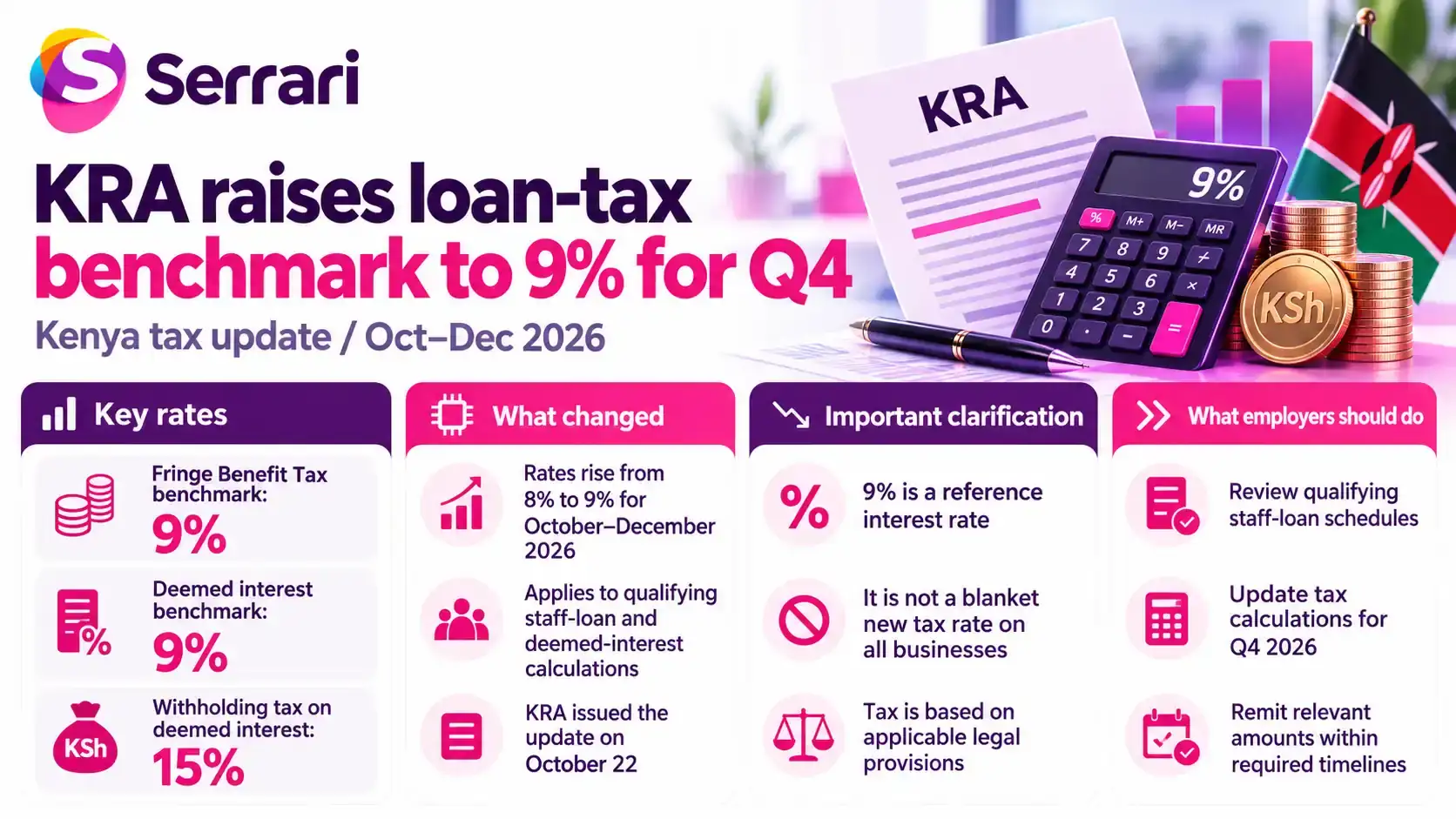
The Kenya Revenue Authority (KRA) has increased the prescribed interest rates used to calculate Fringe Benefit Tax and deemed interest from 8% to 9% for October, November and December 2026. Announced on October 22, the change affects employers offering below-market staff loans and businesses with certain qualifying financing arrangements. The 9% figure is an interest benchmark—not a blanket tax charged on employers or companies.
Key Overview
- The Fringe Benefit Tax market interest rate rises to 9% for the final three months of 2026, from 8% in July–September.
- The prescribed deemed interest rate also increases to 9% for the same period.
- Employers calculate Fringe Benefit Tax on the difference between the benchmark interest and the interest charged on qualifying staff loans.
- Withholding tax of 15% applies to deemed interest under the relevant rules, with remittance required within five working days.
- A separate 8% low-interest-benefit rate under Section 5(2A) was prescribed for July–December 2026; it should not automatically be replaced by the new quarterly benchmark.
What the New 9% Rate Means for Employee Loans
In its October 22 public notice, KRA set the market interest rate under Section 12B of the Income Tax Act at 9%. The benchmark is relevant when an employer provides a qualifying loan to an employee, director or relative at an interest rate below the prescribed market rate.
Under KRA’s Fringe Benefit Tax guidance, the taxable value is the difference between the interest calculated at the market benchmark and the interest actually paid. The employer pays tax on that benefit at the applicable corporate tax rate; the full 9% is not itself the tax due.
For example, on a constant KSh 1 million loan balance charged at 3% annually, a 9% benchmark creates a 6-percentage-point difference, equivalent to KSh 5,000 in monthly taxable benefit. At an illustrative 30% Fringe Benefit Tax rate, the employer’s monthly tax would be KSh 1,500, compared with KSh 1,250 under the previous 8% benchmark. Actual liability depends on the balance, terms and applicable rate.
Deemed Interest and the Five-Day Remittance Rule
KRA also raised the deemed interest benchmark to 9% under Section 16(2)(ja). The provision concerns qualifying interest-free financing involving non-resident connections, rather than every interest-free loan between shareholders and companies.
Where the provision applies, deemed interest can create a withholding-tax obligation even if no interest is actually paid. The October notice reiterates that withholding tax is charged at 15% of deemed interest and must be remitted within five working days. Taxpayers should establish whether the specific arrangement falls within the statutory provision before calculating liability.
Context is everything. Stay ahead of shifting trends with today’s market updates, and uncover emerging opportunities using the Serrari Group Market Index and Marketplace. Then, take control of your own financial future by exploring our Money & Life Reset Transformation Blueprint ™ to build stronger habits, create better systems, and design a path toward lasting wealth.
A Separate Low-Interest Benefit Rate Remains at 8%
One distinction matters for payroll teams. KRA’s July–December rate notice separately prescribed an 8% rate under Section 5(2A) of the Income Tax Act for the six-month period. The October announcement changes the Section 12B and Section 16(2)(ja) benchmarks, but does not expressly revise that separate Section 5(2A) rate.
Employers should therefore identify the applicable provision rather than applying 9% indiscriminately to every employee loan or payroll benefit. The Income Tax Act also provides for Fringe Benefit Tax to continue where a qualifying loan remains outstanding after employment ends.
What Businesses Should Review Before Year-End
Employers should update loan schedules and monthly tax calculations for October through December, while businesses should review cross-border interest-free financing for potential deemed interest obligations. The increase changes the value used in certain tax calculations; it does not alter Kenya’s general PAYE bands or impose a new 9% tax on all business income.
Sources: Kenya Revenue Authority / Kenya Law / People Daily
Your financial future isn’t something you wait for—it’s something you build.
The real question is: when do you begin?
Move beyond simply staying informed.
Navigate the markets with clarity—track trends through the Serrari Group Market Index, uncover opportunities in the Serrari Marketplace, and build practical knowledge with our Curated Wealth Builder Platform.
Stay connected to what truly matters.
Get daily insights on macro trends and financial movements across Kenya, Africa, and global markets—delivered through the Serrari Newsletter.
Growth opens doors.
Advance your career through professional programs including ACCA, HESI A2, ATI TEAS 7 , HESI EXIT , NCLEX – RN and NCLEX – PN, Financial Literacy!🌟—designed to move you forward with confidence.
See where money is flowing—clearly and in real time.
Track Money Market Funds, Treasury Bills, Treasury Bonds, Green Bonds, and Fixed Deposits, alongside global and African indexes, key economic indicators, and the evolving Crypto and stablecoin landscape—all within Serrari’s Market Index.