The World Bank expects global commodity prices to rise 23% in 2026 as conflict in the Middle East, disruptions to Black Sea grain shipments and strong demand for metals strain global supply. Its October 28 Commodity Markets Outlook forecasts a 7% decline in overall prices next year, but warns that further supply shocks could keep energy and food costs elevated, adding pressure on inflation and vulnerable economies.
Key Overview
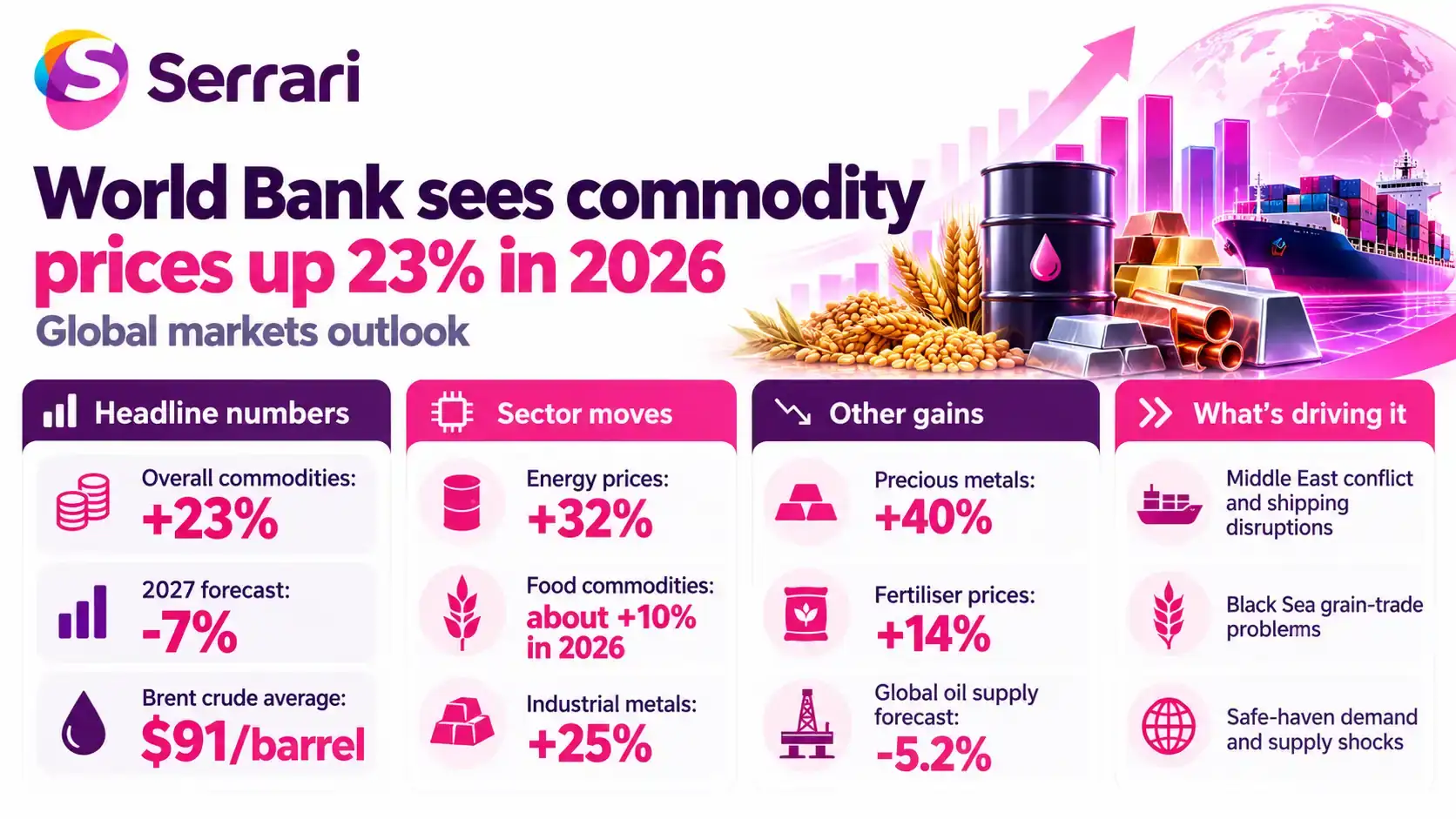
- Global commodity prices are forecast to increase 23% in 2026 before falling 7% in 2027.
- Energy prices are expected to rise 32%, with Brent crude averaging $91 per barrel this year.
- Global oil production is projected to decline 5.2% in 2026, while consumption falls 2.5%.
- Food prices are forecast to increase about 10% in 2026 and another 7% in 2027.
- Industrial metals are projected to gain 25%, precious metals 40%, and fertilisers 14% in 2026.
Middle East Conflict Drives a Historic Energy Shock
The October commodity outlook projects a 32% increase in global energy prices during 2026, reversing three consecutive years of declines. Damage to energy infrastructure and disruption to shipping have constrained supply, while declining oil inventories leave markets less able to absorb another interruption.
Worldwide oil production is expected to contract 5.2%, its largest annual decline in more than four decades outside the 2020 pandemic-related downturn. Oil consumption is also forecast to drop 2.5% as high prices curb demand and electrification changes consumption patterns.
The bank projects Brent crude will average $91 per barrel in 2026, compared with $69 in 2025, before easing to $79 in 2027. These are annual average forecasts, not current spot prices. Renewed escalation in the Middle East or continuing damage to Russian oil facilities could push the market above its baseline outlook.
Food Prices Threaten Inflation and Household Budgets
The full market assessment forecasts food commodity prices rising around 10% in 2026 and a further 7% in 2027, producing a cumulative increase of approximately 18% over the two years. Black Sea grain disruptions, rising farm input costs and an unusually strong El Niño are among the risks affecting harvests and trade.
Fertiliser prices are expected to climb 14% this year, reflecting higher urea costs, before returning toward 2025 levels next year. Higher fertiliser and fuel prices can increase agricultural production and transport expenses, although the extent to which these costs reach consumers differs by country.
In an adverse scenario combining severe weather, worsening shipping disruptions and additional energy losses, food commodity prices could be 12% above the bank’s baseline forecast. That would increase food-security risks, particularly in countries where households spend a large share of income on basic necessities.
Context is everything. Stay ahead of shifting trends with today’s market updates, and uncover emerging opportunities using the Serrari Group Market Index and Marketplace. Then, take control of your own financial future by exploring our Money & Life Reset Transformation Blueprint ™ to build stronger habits, create better systems, and design a path toward lasting wealth.
Metals and Gold Benefit From Different Demand Forces
The commodity price projections indicate a 25% rise in industrial metals prices in 2026, driven by supply disruptions and demand connected to renewable energy, electric vehicles and data-centre construction. Aluminium, copper and tin are expected to reach record price levels, before the broader metals index eases in 2027.
Precious metals are projected to rise 40% this year, supported by demand for safe-haven assets amid geopolitical and policy uncertainty. Their expected gains reflect a different driver from industrial metals: investors seeking protection against instability rather than solely manufacturing consumption.
Developing Economies Face a Difficult Policy Trade-Off
For commodity-importing countries, especially those dependent on imported fuel, grain and fertiliser, higher global prices can worsen trade balances, raise living costs and constrain public finances. Central banks may also face pressure to contain inflation while economic activity weakens.
The bank’s October 28 policy statement says $50 billion to $60 billion is available through existing support instruments, including $25 billion in pre-arranged financing. That is available financing capacity, not a declaration that the entire amount has already been disbursed.
Although commodity prices are forecast to retreat in 2027, the decline would follow an unusually sharp increase in 2026. Lower annual prices would therefore not necessarily restore costs to their pre-shock levels, leaving supply stability and food affordability central to the outlook.
Sources: World Bank / Reuters
Your financial future isn’t something you wait for—it’s something you build.
The real question is: when do you begin?
Move beyond simply staying informed.
Navigate the markets with clarity—track trends through the Serrari Group Market Index, uncover opportunities in the Serrari Marketplace, and build practical knowledge with our Curated Wealth Builder Platform.
Stay connected to what truly matters.
Get daily insights on macro trends and financial movements across Kenya, Africa, and global markets—delivered through the Serrari Newsletter.
Growth opens doors.
Advance your career through professional programs including ACCA, HESI A2, ATI TEAS 7 , HESI EXIT , NCLEX – RN and NCLEX – PN, Financial Literacy!🌟—designed to move you forward with confidence.
See where money is flowing—clearly and in real time.
Track Money Market Funds, Treasury Bills, Treasury Bonds, Green Bonds, and Fixed Deposits, alongside global and African indexes, key economic indicators, and the evolving Crypto and stablecoin landscape—all within Serrari’s Market Index.