




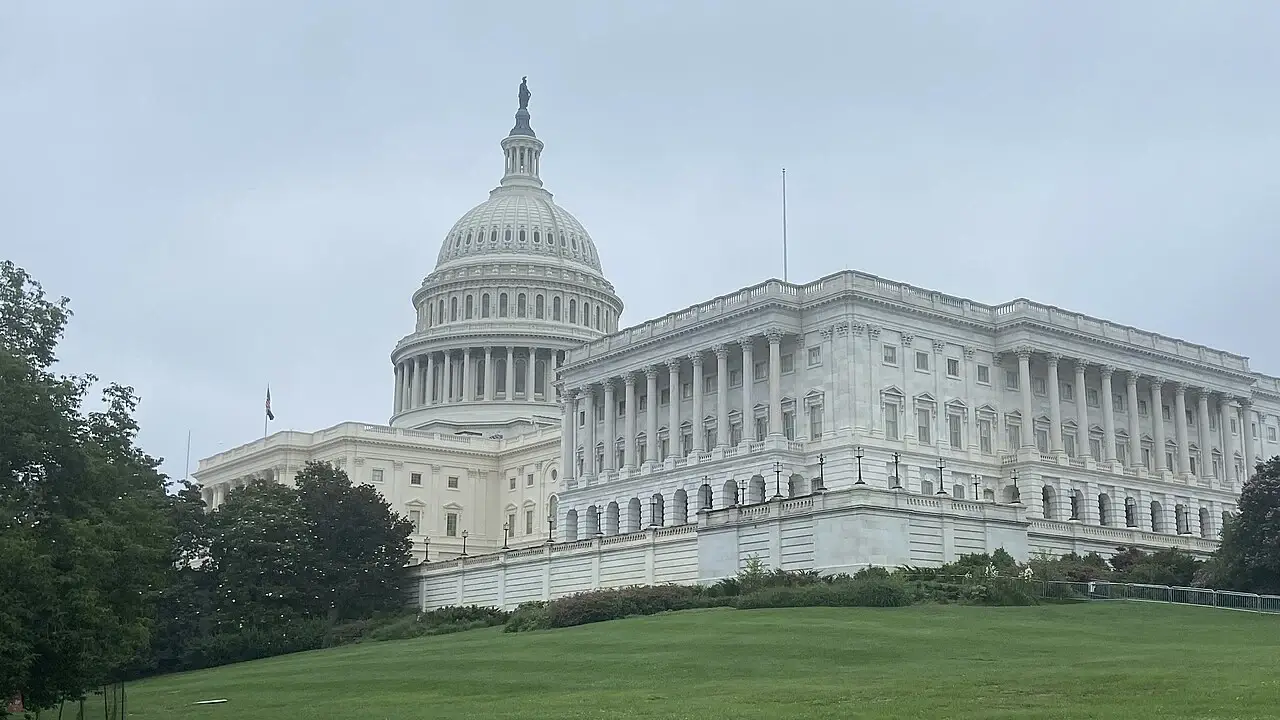
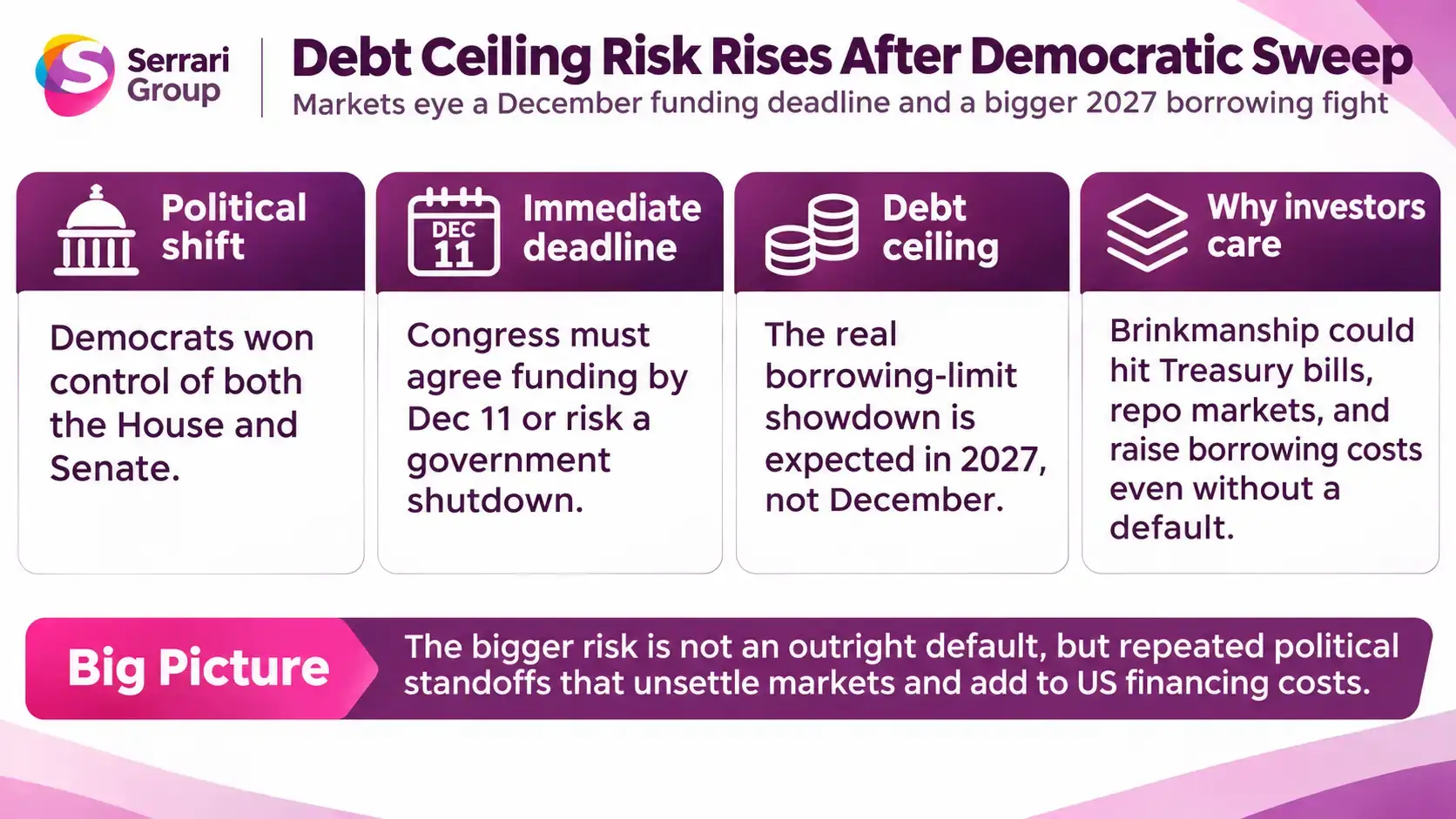
Democrats’ victory in both chambers of the US Congress in the November 3, 2026 midterm elections has reopened a familiar source of financial-market anxiety: whether rival political parties will use the federal debt ceiling as leverage in negotiations over taxes, spending and government services. Investors are now looking at two distinct deadlines. Congress must resolve a federal funding deadline by December 11, 2026, while the point at which the Treasury could exhaust its ability to meet obligations under the borrowing limit—the so-called X-date—is not expected until 2027.
An immediate federal default is considered unlikely, but markets do not need a default to incur costs. A prolonged confrontation can distort Treasury bill prices, disrupt short-term funding and raise the government’s borrowing expenses. That risk arrives as gross national debt has exceeded $40 trillion and forecasts point to persistent deficits and rising interest payments regardless of which party controls Congress.
Key Overview
- Democrats gain congressional leverage: Control of the House and Senate gives the party a stronger position in negotiations with President Donald Trump’s Republican administration when the new Congress convenes in January 2027.
- December 11 is the immediate deadline: Lawmakers face a deadline to continue funding federal operations; failure could cause a partial government shutdown, not automatically a debt default.
- The debt ceiling is a separate 2027 risk: Analysts expect the government’s borrowing-limit constraints to become more acute next year, although any precise X-date remains uncertain.
- US debt exceeds $40 trillion: Heavy existing obligations mean prolonged disputes may affect the perceived reliability and pricing of Treasury securities.
- History shows real financial costs: A federal audit estimated the 2011 debt-limit confrontation added approximately $1.3 billion to Treasury borrowing costs during that fiscal year.
- Divided government cuts both ways: Democrats could restrain new tax cuts or spending plans, but negotiations could also produce costly concessions and higher deficits.
Why the Democratic Sweep Changes the Debt-Ceiling Calculus
The November 5 assessment of political and market risks describes how Democrats’ control of both congressional chambers transforms Washington’s negotiating balance. Republicans retain the White House, but once the incoming Congress takes office in January they will no longer be able to assume their own party can advance legislation through the legislature.
That matters because changes to the statutory borrowing limit require congressional action. The Treasury cannot simply ignore the cap to pay all bills, and the White House cannot rely on political agreement alone. The new majority may demand compromises on domestic spending, healthcare programmes or taxation in return for supporting a debt-limit increase.
The political incentive to bargain is particularly strong because raising the debt ceiling is often portrayed as an endorsement of government borrowing, even though it mainly permits the Treasury to finance obligations already incurred. The Treasury’s explanation of the statutory limit distinguishes it from the legislation that authorises taxes and public spending.
For Democrats, the borrowing deadline offers leverage over policies they oppose. For the Trump administration, securing an increase before the new Congress takes office could remove one avenue of pressure. But a lame-duck agreement is politically difficult after a sweeping electoral defeat, leaving uncertainty over whether lawmakers will act before year-end.
The financial significance is that the market must price not only the eventual policy agreement but the path toward one. Even when investors expect Congress to avoid default, repeated threats and last-minute compromises can create large changes in the prices of bonds maturing around a possible payment disruption.
December 11 Funding Deadline Is Not the Debt Ceiling
The nearest test comes on December 11, when existing arrangements for federal government funding require congressional action. If lawmakers fail to approve further appropriations or a temporary spending measure, agencies that lack funding may have to suspend some operations and furlough affected employees.
This is different from reaching the debt ceiling. A shutdown arises from a lapse in legal authority to spend on some government activities. A debt-limit crisis arises when the Treasury cannot borrow enough to meet the government’s existing payment obligations. A shutdown can disrupt public services, contractors and federal workers, but it does not in itself establish that Treasury securities will go unpaid.
The two issues nevertheless overlap politically. Leaders may attach conditions to funding legislation, combine negotiations or use one deadline to pressure opponents over the other. That creates the possibility of a short-term budget dispute becoming a rehearsal for a larger 2027 debt-ceiling confrontation.
The timing also matters. The outgoing Congress still has a short opportunity to address the borrowing limit before Democrats assume their new majority, but there is no guarantee that a divided and politically weakened legislature can agree on a preventive settlement. Investors will therefore watch whether the December negotiations produce a durable funding arrangement, another temporary extension or broader fiscal bargaining.
Why an Unlikely Default Can Still Damage Markets
US Treasury securities are foundational to global finance. They provide collateral for lending, reference rates for other borrowing and a major reserve asset for central banks. Their role depends heavily on the expectation that scheduled payments will be made on time.
When a possible X-date approaches, investors may avoid Treasury bills scheduled to mature near or after that date. Those bills can fall in price relative to securities maturing just before the risk window, even if investors continue regarding the United States as creditworthy over the long term.
The 2026 federal audit of earlier debt-limit impasses found that past confrontations increased borrowing costs, depressed the value of some affected securities and disrupted money markets. An earlier investigation into the 2011 dispute estimated about $1.3 billion in additional Treasury borrowing costs in fiscal 2011 alone.
Such costs can persist beyond the political confrontation. Debt issued at an elevated yield can leave taxpayers paying more interest over the life of the security. Meanwhile, money market funds and banks may adjust their holdings to avoid concentrated exposure to maturing obligations, placing pressure on short-term liquidity.
The repurchase agreement, or repo, market is especially relevant because Treasury securities are widely pledged as collateral for overnight borrowing. If uncertainty makes certain securities less attractive as collateral, lenders may demand different terms or market participants may need to substitute other instruments. The disruption can spread beyond Washington into ordinary financial transactions.
A full federal payment default would be far more serious, but the central investment lesson from earlier episodes is that the economic cost of brinkmanship can arrive well before that extreme outcome.
A $40 Trillion Debt Burden Limits the Room for Political Compromise
The United States enters the next funding cycle with gross federal debt above $40 trillion, a figure that includes both debt held by investors and obligations within government accounts. It should not be confused with debt held by the public, which is a narrower measure used in many long-term fiscal projections.
The February 2026 federal budget outlook projected a $1.9 trillion deficit in fiscal 2026, widening to $3.1 trillion in fiscal 2036 under the assumptions used in that forecast. Debt held by the public was projected to rise from 101% of gross domestic product in 2026 to 120% by 2036.
Interest costs are a central reason the arithmetic is becoming harder. The same outlook projected net interest payments rising from approximately $1 trillion in 2026 to $2.1 trillion in 2036. Higher debt increases the amount on which interest must be paid, while elevated refinancing rates can gradually raise the average cost of servicing existing obligations.
This is why the election outcome cannot by itself repair the fiscal trajectory. Major spending pressures arise from ageing-related programmes, healthcare and interest expenses, while tax receipts depend on the economy and legislative choices. These pressures persist under either party.
Divided government may make expensive new programmes and tax reductions harder to pass. But it can also encourage negotiations that exchange additional spending or tax concessions for votes needed to prevent disruption. The net impact on deficits depends on what legislation is ultimately adopted, rather than the party composition of Congress alone.
Context is everything. Stay ahead of shifting trends with today’s market updates, and uncover emerging opportunities using the Serrari Group Market Index and Marketplace. Then, take control of your own financial future by exploring our Money & Life Reset Transformation Blueprint ™ to build stronger habits, create better systems, and design a path toward lasting wealth.
What the Standoff Means for Households and Investors
A debt-ceiling fight can reach consumers through borrowing costs and financial confidence. Treasury yields underpin the pricing of mortgages, corporate bonds and other credit instruments. If investors demand a higher risk premium because of political uncertainty, financing costs elsewhere can rise, although market interest rates will also respond to economic growth, inflation and Federal Reserve policy.
For pension funds and retail investors, a period of volatile Treasury pricing can create temporary losses in bond funds. Money market funds may alter their holdings to avoid Treasury bill maturities near a potential X-date, potentially affecting yields and liquidity management. None of those outcomes requires an actual default.
Businesses dependent on federal contracts face a different channel of risk from a funding lapse. Delayed agency operations and payments can interrupt cash flow, while consumers affected by furloughs may reduce discretionary spending. If Washington repeatedly extends funding for only short periods, uncertainty can also delay business planning and investment decisions.
International investors are exposed because US government bonds are held globally and the dollar anchors trade and financial markets. Stress in US Treasury trading can affect cross-border funding, currency markets and portfolio valuations, including in emerging economies. That does not mean every debt-ceiling dispute causes a global crisis, but it explains why a domestic political deadline attracts worldwide attention.
Will Political Gridlock Restrain Spending or Increase Deficits?
There are two credible—and competing—fiscal scenarios. In the first, Democratic control of Congress blocks unfunded tax reductions and major new spending favoured by the White House, slowing the growth of deficits relative to what might otherwise occur. Oversight and legislative bargaining could limit further fiscal expansion.
In the second, lawmakers trade policy concessions to secure essential legislation. Democrats could seek changes to healthcare, housing and other domestic priorities as the price of supporting a debt-limit agreement. Republicans could demand their own tax or spending provisions. The resulting compromise could push deficits above the baseline forecast, even if it successfully avoids a market-threatening confrontation.
Neither scenario is settled by the election result. The Congressional Budget Office’s projections are conditional on existing legislation and the economic assumptions used when they were prepared. The political outcome determines who negotiates; it does not determine the final size of future deficits.
For markets, the more immediate issue is predictability. Investors can evaluate an expensive but clearly articulated fiscal programme more easily than a sequence of missed deadlines, temporary extensions and threats to interrupt government payments.
What Investors Should Watch Before 2027
The first signal will be the outcome of December 11 funding negotiations. A multi-month or full-year agreement would reduce the immediate shutdown risk, whereas a brief extension would keep the next confrontation close. Any attempt to raise or suspend the debt ceiling during the outgoing Congress would materially change the 2027 political timetable.
The second signal will be updated Treasury cash and borrowing projections. The precise X-date depends on tax receipts, spending patterns, cash balances and the extraordinary measures available to Treasury, rather than a fixed date that can be reliably identified more than a year in advance.
The third will be market pricing. Unusual yield differences among Treasury bills with nearby maturities, changes in repo financing conditions and signs of money market fund reallocations may reveal rising concern before headline political negotiations reach their most contentious stage.
Finally, the contents of any fiscal compromise matter as much as the deadline. An agreement that removes default risk but substantially raises projected deficits could leave long-term interest costs and concerns about debt sustainability unresolved.
Outlook: Political Certainty Is Becoming a Market Asset
The Democratic sweep has not created the United States’ fiscal imbalance, nor does it make default inevitable. It has altered the negotiating framework around a debt burden that was already rising and a federal budget increasingly exposed to interest expenses.
That is why markets are looking beyond the election result itself. The December 11 deadline tests whether lawmakers can maintain routine government operations, while a potential 2027 debt-ceiling confrontation could test confidence in the reliability of US public debt. History demonstrates that delays and uncertainty can impose meaningful costs even when Congress eventually acts.
The larger risk is a repeated cycle in which temporary political victories take priority over predictable financing and durable budget decisions. For households, businesses and investors, the consequence is not just another Washington confrontation: it is the possibility that avoidable political uncertainty increases the cost of capital across the economy.
The central question is whether divided government will impose fiscal discipline through negotiation or make the world’s most important sovereign debt market repeatedly absorb the costs of political brinkmanship.
Sources: Reuters / US Department of the Treasury / Congressional Budget Office / US Government Accountability Office / Congressional Research Service
Your financial future isn’t something you wait for—it’s something you build.
The real question is: when do you begin?
Move beyond simply staying informed.
Navigate the markets with clarity—track trends through the Serrari Group Market Index, uncover opportunities in the Serrari Marketplace, and build practical knowledge with our Curated Wealth Builder Platform.
Stay connected to what truly matters.
Get daily insights on macro trends and financial movements across Kenya, Africa, and global markets—delivered through the Serrari Newsletter.
Growth opens doors.
Advance your career through professional programs including ACCA, HESI A2, ATI TEAS 7 , HESI EXIT , NCLEX – RN and NCLEX – PN, Financial Literacy!🌟—designed to move you forward with confidence.
See where money is flowing—clearly and in real time.
Track Money Market Funds, Treasury Bills, Treasury Bonds, Green Bonds, and Fixed Deposits, alongside global and African indexes, key economic indicators, and the evolving Crypto and stablecoin landscape—all within Serrari’s Market Index.