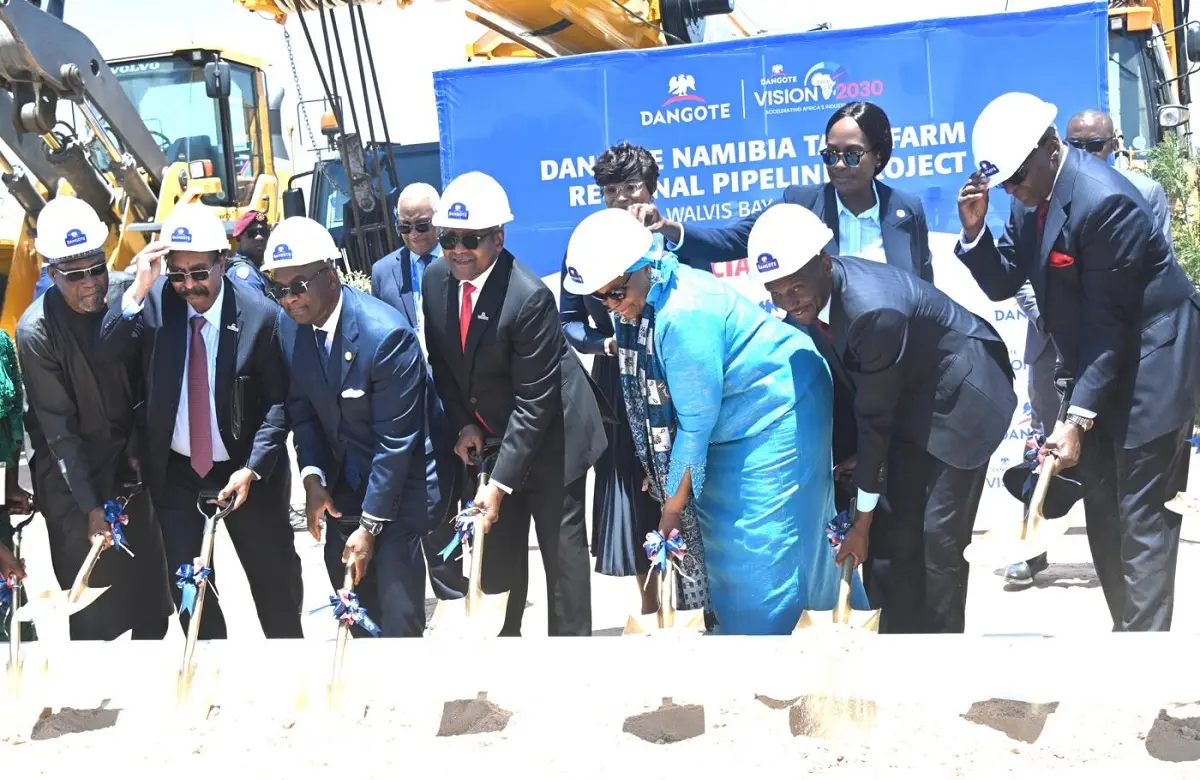
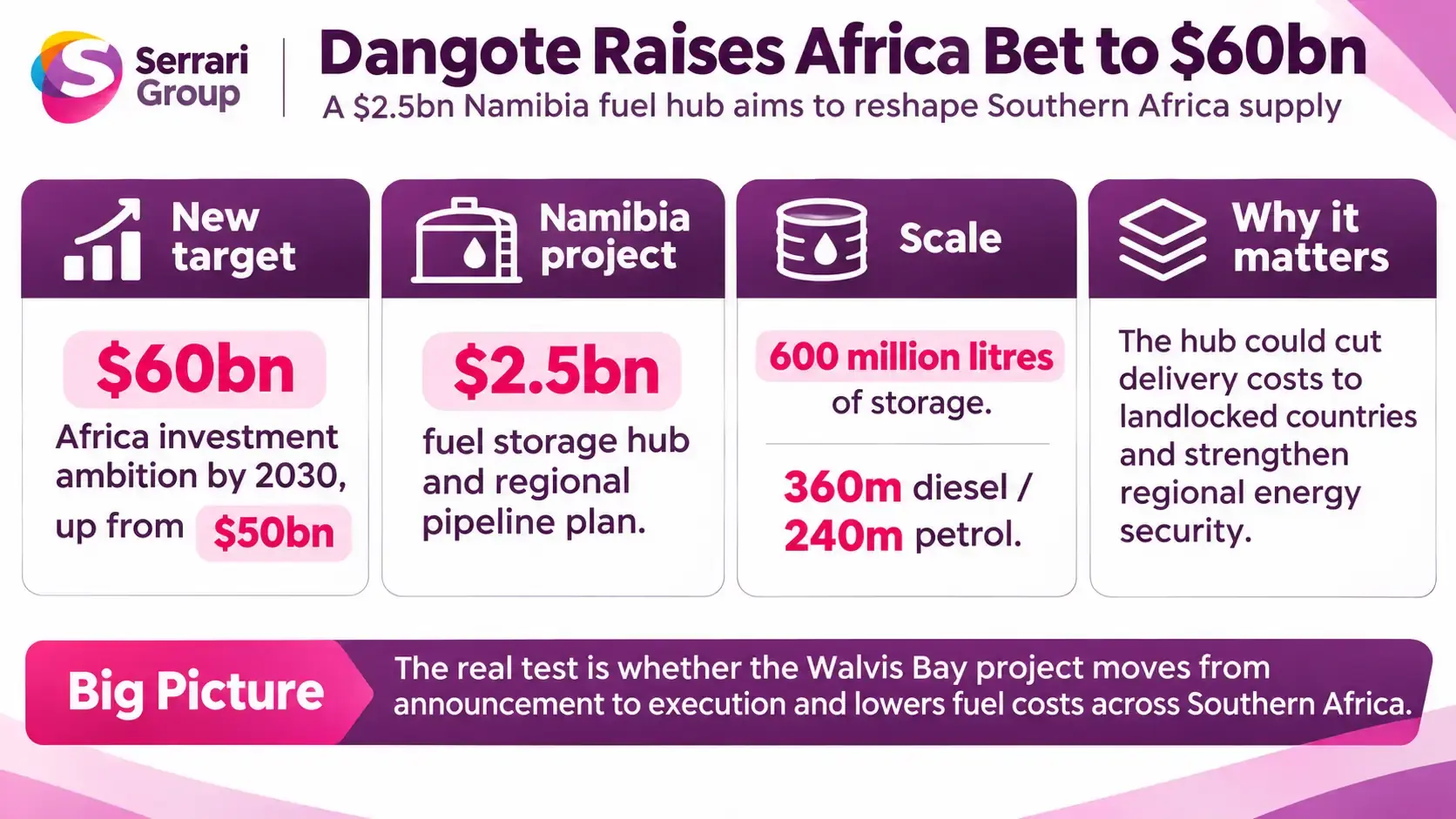
Nigerian industrialist Aliko Dangote has raised his Africa-wide investment ambition from $50 billion to $60 billion by 2030, a 20% increase, while launching a $2.5 billion fuel storage and regional pipeline project near Walvis Bay, Namibia, on November 4, 2026. The development envisages 600 million litres of fuel storage and a pipeline network potentially extending about 1,700 kilometres into Southern Africa.
The investment is more than a new storage site. It is a bid to address a persistent weakness in Africa’s fuel economy: countries may have access to petroleum on international markets but still pay heavily to transport, store and distribute it inland. By placing a large terminal at a coastal gateway to landlocked economies, Dangote aims to combine fuel production, shipping, storage and distribution into a wider African network. Whether that ambition reduces costs for businesses and households will depend on financing, regulatory approvals, infrastructure access and competition—not just the scale of the announcement.
Key Overview
- Investment ambition rises: Dangote increased his stated Africa investment target by 20%, from $50 billion to $60 billion by 2030.
- Namibia hub launched: The proposed $2.5 billion programme combines a Walvis Bay tank farm with wider regional pipeline ambitions.
- Large storage capacity: The proposed terminal would hold 600 million litres—360 million litres of diesel and 240 million litres of petrol—about eight times Namibia’s existing 75-million-litre national storage facility.
- Landlocked markets targeted: Botswana, Zambia, Zimbabwe, Malawi and parts of the Democratic Republic of Congo are among the potential destinations for a wider distribution network.
- Construction and routing differ: The tank farm has an indicated construction period of roughly 18–20 months, while the regional pipeline’s final route and timetable remain subject to engineering and approvals.
- Larger commercial strategy: The hub could open new markets for fuel from Dangote’s Nigerian refinery, but promised savings are not yet guaranteed at the pump.
Why Dangote Is Increasing His African Investment Target
Dangote announced the higher target during the Walvis Bay project launch, moving beyond his previous $50 billion commitment. Raising the ambition by $10 billion signals an attempt to accelerate an industrial strategy centred on controlling more of the infrastructure required to get essential products to market.
The underlying economic problem is fragmentation. Much of Africa imports refined petroleum, while production, storage, port handling and inland distribution are frequently handled by different operators across borders. Each transfer can add a fee, delay, financing requirement or supply risk. Even when the underlying fuel is competitively priced, the final delivered cost may be high.
That creates a reason for an industrial group with a large refinery to invest beyond its factory gates. Producing fuel is only one part of the business. Without efficient export terminals, inland depots and reliable delivery corridors, the producer may struggle to reach customers at a competitive cost or guarantee supply during disruptions.
Dangote’s expanded target therefore reflects a commercial calculation as well as a wider industrial vision. More connected infrastructure could support sales volumes, diversify revenue and reduce dependence on individual routes or destination markets. Yet the $60 billion figure is an investment ambition, not proof that every project has been fully financed or completed. Investors should distinguish announced commitments from cash spent and assets already operational.
Why Walvis Bay Matters to Southern Africa’s Fuel Supply
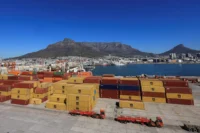
Walvis Bay is positioned on the Atlantic coast and serves established transport corridors linking Namibia with neighbouring economies. Its regional road and rail connections make it a logical candidate for distributing imported goods inland, particularly to markets that do not have direct access to the sea.
The planned tank farm would sit on approximately 70 hectares at Farm 58, around 10 kilometres east of Walvis Bay. As described in the project specifications disclosed at the launch, its 600-million-litre capacity would be split between 360 million litres of diesel and 240 million litres of petrol, supported by loading and dispensing infrastructure.
Scale is important because storage helps absorb disruptions in shipping schedules and seasonal demand. A larger tank farm may allow operators to receive substantial cargoes, hold strategic stocks and dispatch smaller quantities to different markets. It could also reduce the need to source emergency shipments at higher costs when local inventories run low.
But storage capacity alone does not equal energy security. Actual protection depends on fuel availability, inventory turnover, terminal access arrangements, pricing and the ability to move products away from the port. A terminal that holds large volumes but lacks sufficient road or pipeline connections can simply relocate the logistical bottleneck.
This is why the broader project includes a proposed pipeline network. The announced concept would extend from Namibia towards Botswana and other regional markets, potentially creating a more direct channel for delivering fuel inland. The final route, however, has not been settled, and proposals for additional branches should not be mistaken for approved construction contracts.
Will the $2.5 Billion Project Lower Fuel Prices?
For consumers, the most consequential claim is that improved distribution could lower the cost of fuel in landlocked economies. Road transport over long distances adds expenses for drivers, trucks, maintenance, insurance and border crossings. Pipelines can reduce some of those costs when volumes are sufficiently high and operations are efficient.
A regional storage and pipeline system could also make supply more predictable. Importers and distributors may be better able to maintain inventories, reducing the economic disruption caused by fuel shortages. Businesses dependent on diesel-powered freight, generators, mining equipment and agricultural machinery would benefit if delivered fuel costs and interruptions declined.
Nevertheless, there is no automatic relationship between the investment and retail petrol prices. Pump prices also reflect international petroleum prices, exchange rates, taxes, regulations, financing costs and the margins earned throughout the supply chain. Pipeline tariffs could offset part of the transport savings, especially if volumes are lower than expected.
Competition will matter too. If multiple suppliers can access the terminal and its transport infrastructure under commercially reasonable terms, the project may support a more competitive distribution market. If access is concentrated, infrastructure efficiency might improve without all savings reaching end users.
The potential benefits are therefore substantial but conditional. The correct test will be what businesses and households actually pay for reliably delivered fuel after the project enters operation—not the nominal investment amount announced at groundbreaking.
Why Namibia’s Presidency Is Overseeing the Development
Namibian President Netumbo Nandi-Ndaitwah attended the groundbreaking and placed the development under the direct oversight of her office to help prevent administrative delays. The presidential oversight arrangement reflects how seriously the government views the project’s potential contribution to trade and investment.
Large cross-border infrastructure faces a more complicated approval process than a conventional warehouse. A terminal needs land, environmental permissions, safety approvals and access to port infrastructure. Pipelines additionally require detailed surveys, rights of way and agreements among several jurisdictions.
A central government coordinating role could make agencies more responsive and help resolve competing requirements. That may increase the project’s chances of proceeding on schedule. But direct oversight does not remove the need for environmental assessment, transparent procurement where applicable, community consultation and regulatory compliance.
For Namibia, the economic opportunity extends beyond fuel storage fees. Construction may generate demand for contractors, transport services and equipment, while an operational logistics hub could attract complementary warehousing and distribution businesses. The permanent employment effect, however, cannot yet be quantified from the launch announcement, and forecasts of job creation should be treated cautiously until detailed plans emerge.
Context is everything. Stay ahead of shifting trends with today’s market updates, and uncover emerging opportunities using the Serrari Group Market Index and Marketplace. Then, take control of your own financial future by exploring our Money & Life Reset Transformation Blueprint ™ to build stronger habits, create better systems, and design a path toward lasting wealth.
The Pipeline Is the Most Ambitious—and Uncertain—Part
The project has been described as including a roughly 1,700-kilometre regional pipeline. The outlined corridor and possible market connections include Botswana and potentially Zambia, Zimbabwe, Malawi and the southern Democratic Republic of Congo.
The engineering challenge is considerable. A pipeline crossing national borders must navigate difficult terrain, land rights, technical standards and different regulatory systems. It also needs long-term customer demand sufficient to justify the construction and operating costs. Governments and commercial operators must reach agreement on access, transit arrangements, tariffs and liability.
The announced $2.5 billion represents the proposed programme’s overall investment value; a detailed public breakdown between the storage terminal, pipeline and other supporting works has not been established. Similarly, the indicated 18–20-month completion window should not be assumed to cover every proposed cross-border pipeline extension.
These distinctions matter because initial announcements frequently combine a construction-ready component with infrastructure concepts that require further development. The storage site could progress while elements of the wider network remain in planning or negotiation. Investors and regional governments will need to assess the milestones separately.
How the Hub Fits Dangote’s Refining and Capital-Raising Strategy
The Namibia initiative sits alongside the group’s substantial investment in refining capacity in Nigeria. Its Lagos refinery has helped change the scale of African petroleum processing, and the group has outlined plans to increase capacity towards 1.4 million barrels a day. The refinery expansion and flotation plans illustrate the size of the capital requirements involved.
An offshore distribution network could give the refinery more ways to sell output across Africa. That becomes especially relevant if production grows faster than domestic Nigerian demand or if international export opportunities change. A producer with reliable inland distribution can compete on delivered supply rather than refinery-gate prices alone.
Capital funding is equally important. The refinery’s public offer officially closed on October 27, with applications undergoing the allotment and regulatory process. Reports have discussed a potential listing timetable and valuation, but the listing had not yet become a completed transaction as of November 6. The proposed expansion in Namibia should likewise be evaluated separately from the refinery’s share offering: the projects may support the same corporate strategy without sharing an identical funding structure.
The combined approach could produce economies of scale across production and distribution. It also creates execution and financial risks. Running a refinery, building tank farms and financing cross-border pipelines require different skills, long investment horizons and disciplined capital allocation. The larger the programme becomes, the more important transparency on project financing, debt commitments and expected returns will be.
What the Investment Means for Regional Integration
The project also tests whether Africa’s ambitions for cross-border economic integration can be translated into functioning infrastructure. Landlocked countries do not simply need trade agreements; they need efficient routes to ports, predictable customs processes and infrastructure capable of moving essential goods.
A regional fuel corridor could complement existing transport links and potentially support more resilient supply chains. If fuel reaches inland markets at a lower cost, transport-intensive sectors such as agriculture, mining and manufacturing may benefit. More competitive logistics can also make it easier for businesses to plan production and investment.
Yet integration requires cooperation beyond a single developer. Cross-border infrastructure needs compatible rules, coordinated border processes and predictable regulation. Disagreements about tariffs, control or access could erode the savings that a pipeline is intended to deliver.
There is also a longer-term strategic question. Governments want affordable and reliable petroleum supplies today, while global investment gradually shifts towards cleaner technologies and electrification. A major fuel pipeline must therefore be assessed against demand over decades, not only current consumption. The project could strengthen near-term energy security, but its ultimate commercial return will depend partly on how future fuel demand develops.
Outlook: A Major Bet That Must Deliver Beyond the Groundbreaking
Dangote’s higher $60 billion ambition and Namibia’s $2.5 billion fuel project mark a significant effort to reshape where African fuel is stored and how it reaches consumers. The logic is clear: building a connected supply chain could reduce avoidable transport costs, improve availability and open new markets for African refining output.
The immediate milestones are more concrete than the long-range promise. Progress at the Walvis Bay storage site, publication of a detailed financing structure, approval of the pipeline’s final route and agreements with neighbouring countries will show whether the wider vision is turning into operating infrastructure.
The real measure of success will not be how much investment is announced, but whether the completed network delivers reliable fuel at lower total cost while earning sustainable returns. That is why the project matters now: it could help shift Southern Africa from fragmented fuel logistics towards a more coordinated regional market, but only if ambitious plans are matched by execution and competitive access.
Sources: Reuters / Bloomberg / Moneyweb / TheCable / The Namibian / Erongo Regional Council / Dangote Petroleum Refinery / Voice of Nigeria
Your financial future isn’t something you wait for—it’s something you build.
The real question is: when do you begin?
Move beyond simply staying informed.
Navigate the markets with clarity—track trends through the Serrari Group Market Index, uncover opportunities in the Serrari Marketplace, and build practical knowledge with our Curated Wealth Builder Platform.
Stay connected to what truly matters.
Get daily insights on macro trends and financial movements across Kenya, Africa, and global markets—delivered through the Serrari Newsletter.
Growth opens doors.
Advance your career through professional programs including ACCA, HESI A2, ATI TEAS 7 , HESI EXIT , NCLEX – RN and NCLEX – PN, Financial Literacy!🌟—designed to move you forward with confidence.
See where money is flowing—clearly and in real time.
Track Money Market Funds, Treasury Bills, Treasury Bonds, Green Bonds, and Fixed Deposits, alongside global and African indexes, key economic indicators, and the evolving Crypto and stablecoin landscape—all within Serrari’s Market Index.