Russia’s largest lender, Sberbank, expects between 3.5 trillion and 4 trillion rubles ($46.43 billion) of cryptocurrency trading to take place on regulated exchanges during the first year of Russia’s new crypto trading framework. The rules taking effect on September 1, 2026, will allow retail investors to access selected cryptocurrencies through regulated intermediaries while imposing annual purchase limits. Qualified investors will have broader access without the retail cap.
Key Overview
- Country: Russia
- Institution: Sberbank
- Projected first-year regulated crypto volume: 3.5–4 trillion rubles
- Approximate dollar value: $46.43 billion
- New framework: Effective September 1, 2026
- Retail limit: 300,000 rubles per year per intermediary
- Qualified investors: No purchase limit
- Domestic crypto payments: Remain prohibited
- Cross-border trade: Crypto settlements are permitted under the new framework
Russia’s Regulated Crypto Market Could Reach $46 Billion
Russia’s regulated cryptocurrency market could record up to 4 trillion rubles ($46.43 billion) in trading during its first year, according to a projection from Sberbank.
The estimate was given by Sberbank Deputy Chairman Anatoly Popov ahead of the Eastern Economic Forum. It represents the volume that the bank expects to move onto regulated exchanges after Russia’s new cryptocurrency trading framework takes effect on September 1.
The projection is significantly smaller than Russia’s estimated overall cryptocurrency transaction activity, suggesting that a large share of existing crypto trading could initially remain outside the newly regulated market.
Sberbank Expects Only a Portion of Crypto Activity to Move Onshore
According to the figures cited by Popov, Russia’s Finance Ministry estimated daily cryptocurrency transaction volumes in the country at around 50 billion rubles, equivalent to approximately 18 trillion rubles ($218 billion) per year.
SberCIB Investment Research estimates that around 20% of this existing activity could shift to regulated exchanges during the first year. That translates to approximately 3.5-4 trillion rubles.
Sberbank expects the regulated market to grow further, potentially reaching between 4.75 and 5.25 trillion rubles by 2028 and around 7.5 trillion rubles by 2029, according to Popov’s forecast.
This means the projected $46 billion figure should not be interpreted as the total size of Russia’s cryptocurrency market. Instead, it represents the portion of existing activity that Sberbank expects to migrate to regulated trading venues.
Retail Investors Face Crypto Purchase Limits
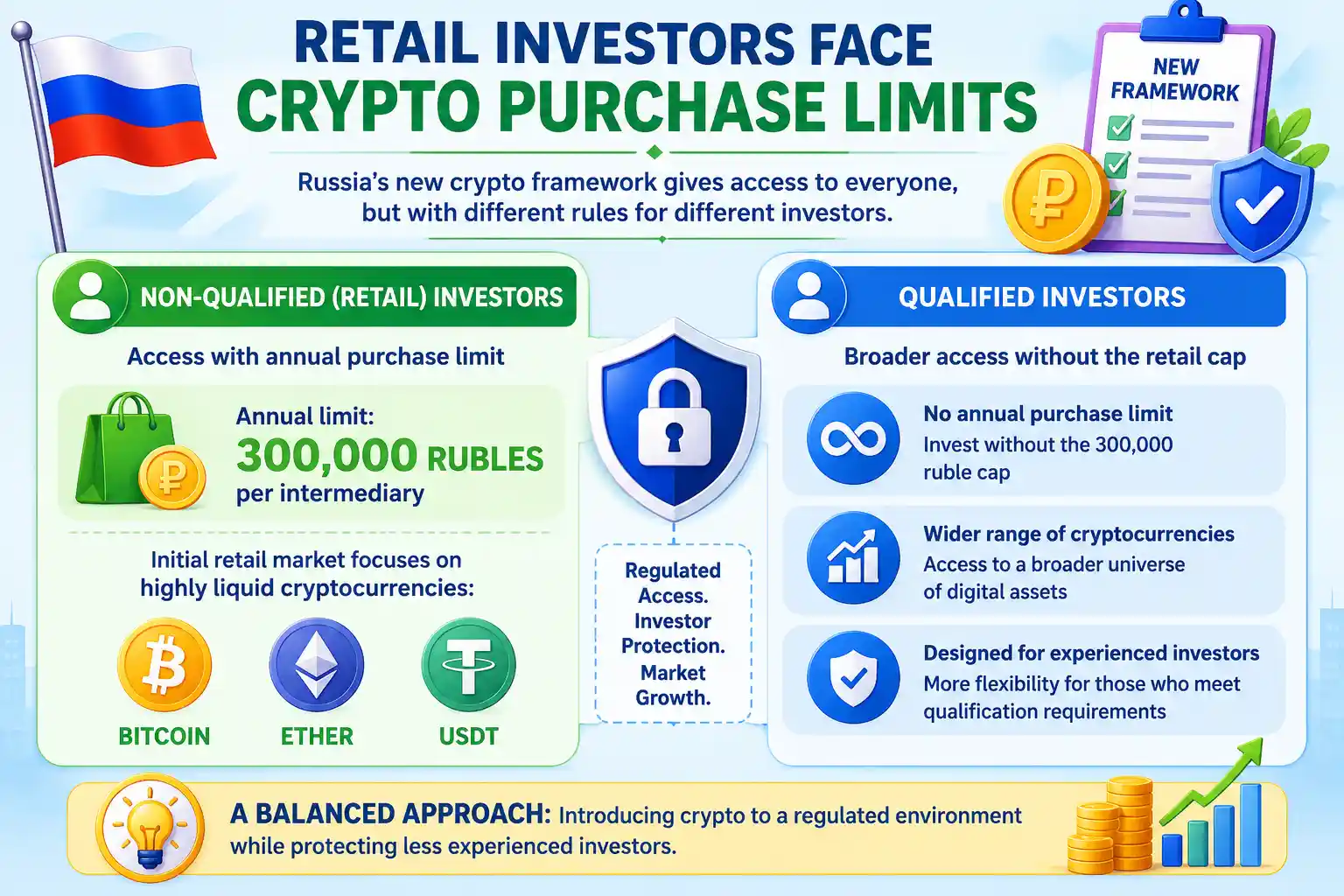
Russia’s new framework will provide retail investors with regulated access to cryptocurrencies but impose restrictions on their purchases.
Non-qualified investors will be able to purchase approved cryptocurrencies through licensed intermediaries, with an annual limit of 300,000 rubles per intermediary. The initial retail market is expected to focus on highly liquid cryptocurrencies including Bitcoin, Ether and USDT.
Qualified investors will have substantially broader access. They will not be subject to the 300,000-ruble annual purchase limit and will be able to invest in a wider range of cryptocurrencies.
The framework is designed to introduce cryptocurrency into a regulated investment environment while limiting exposure for less experienced investors.
Russia Keeps Ban on Domestic Crypto Payments
Legalizing regulated crypto trading does not make cryptocurrency legal tender for everyday payments in Russia.
The country will continue to prohibit the use of cryptocurrency to pay for goods and services domestically. At the same time, the new framework allows cryptocurrency to be used for cross-border settlements under foreign trade contracts between Russian residents and non-residents.
The distinction creates a system in which cryptocurrency can function as an investment asset and, in specified circumstances, a cross-border settlement instrument, while remaining prohibited as a domestic payment method.
Context is everything. Stay ahead of shifting trends with today’s market updates, and uncover emerging opportunities using the Serrari Group Market Index and Marketplace. Then, take control of your own financial future by exploring our Money & Life Reset Transformation Blueprint ™ to build stronger habits, create better systems, and design a path toward lasting wealth.
Sberbank Plans Crypto Trading and Custody Infrastructure
Sberbank is also positioning itself to participate directly in Russia’s emerging regulated cryptocurrency market.
The lender plans to develop infrastructure for crypto trading, custody, and digital asset depositories. It has also announced plans to introduce cryptocurrency wallets and digital asset custody services through its Sber and Sber Investments applications.
The development highlights the growing role of traditional financial institutions in Russia’s digital-asset infrastructure as regulators establish rules for exchanges, brokers, asset managers and digital depositories.
Regulated Market Could Grow Gradually
The first-year forecast indicates that Russia’s cryptocurrency market is likely to transition gradually rather than move entirely into regulated venues immediately.
The extent of that migration will depend on licensing, investment in market infrastructure and whether existing cryptocurrency users choose regulated Russian platforms over offshore venues.
Sberbank’s projection therefore provides an early indication of the potential size of Russia’s regulated crypto investment market rather than a forecast for the country’s entire cryptocurrency economy.
Overview
Russia’s new cryptocurrency framework is creating a regulated market for digital-asset investment while maintaining restrictions on domestic crypto payments. Sberbank’s projection of 3.5–4 trillion rubles in first-year regulated trading suggests that the market could become substantial, but still represent only a fraction of Russia’s overall cryptocurrency activity.
The development also places Sberbank at the center of Russia’s emerging crypto infrastructure as the country moves toward regulated trading, custody and digital-asset services.
FAQs
1. How large could Russia’s regulated crypto market be?
Sberbank estimates that regulated crypto exchanges could handle approximately 3.5–4 trillion rubles ($46.43 billion) during the first year of the new framework.
2. When will Russia’s new crypto trading rules take effect?
The new cryptocurrency trading framework is scheduled to take effect on September 1, 2026.
3. How much cryptocurrency can Russian retail investors buy?
Non-qualified investors will face an annual purchase limit of 300,000 rubles per intermediary for approved cryptocurrencies. Qualified investors will not face this limit.
4. Can Russians use cryptocurrency to pay for goods and services?
No. Domestic cryptocurrency payments for goods and services remain prohibited. However, cryptocurrency can be used for certain cross-border foreign-trade settlements under the new framework.
Sources: FinanceFeeds, Bitcoin Foundation, Bitcoin News
Your financial future isn’t something you wait for—it’s something you build.
The real question is: when do you begin?
Move beyond simply staying informed.
Navigate the markets with clarity—track trends through the Serrari Group Market Index, uncover opportunities in the Serrari Marketplace, and build practical knowledge with our Curated Wealth Builder Platform.
Stay connected to what truly matters.
Get daily insights on macro trends and financial movements across Kenya, Africa, and global markets—delivered through the Serrari Newsletter.
Growth opens doors.
Advance your career through professional programs including ACCA, HESI A2, ATI TEAS 7 , HESI EXIT , NCLEX – RN and NCLEX – PN, Financial Literacy!🌟—designed to move you forward with confidence.
See where money is flowing—clearly and in real time.
Track Money Market Funds, Treasury Bills, Treasury Bonds, Green Bonds, and Fixed Deposits, alongside global and African indexes, key economic indicators, and the evolving Crypto and stablecoin landscape—all within Serrari’s Market Index.