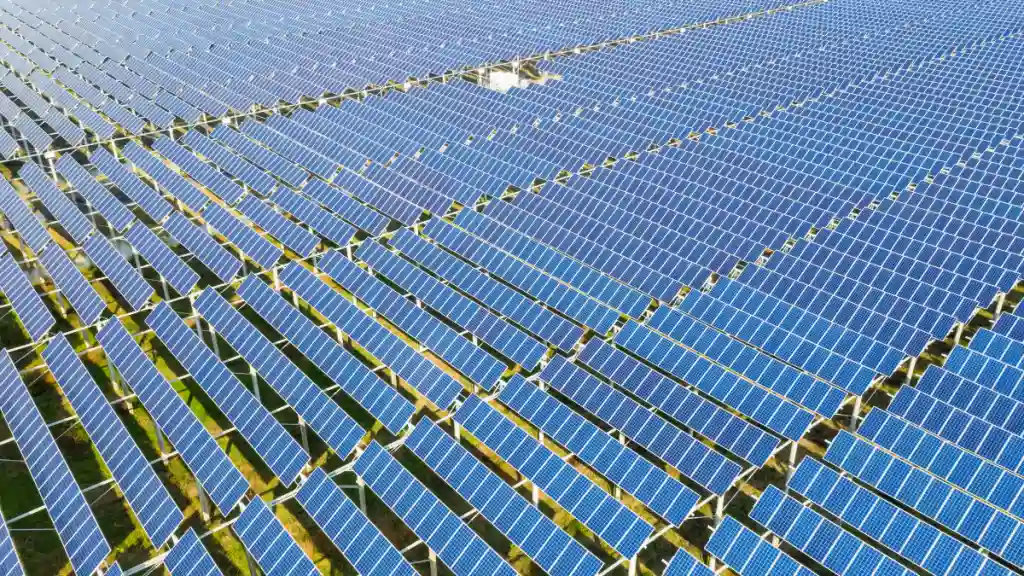
Africa is projected to install a record 17GW of solar capacity in 2026, a 45% increase from 2025. The growth could generate about 23TWh of electricity annually, while solar manufacturing capacity is expected to quadruple to 3.5GW.
Key Overview:
- Africa is forecast to install 17GW of solar power in 2026, up 45% from 2025.
- 36 of Africa’s 54 countries are expected to install record solar capacity this year.
- New solar capacity could generate around 23TWh of electricity annually.
- Solar manufacturing capacity is expected to quadruple to 3.5GW.
- 94% of solar panels installed across Africa are still imported from China.
- About 75% of solar capacity added between 2023 and 2025 came from distributed generation.
Africa’s Solar Installations Set for Third Consecutive Record
Africa is on track to install a record 17GW of solar power in 2026, representing a 45% increase from last year, according to analysis by Ember and the African Tech Futures Lab.
The growth would mark the third consecutive record year for African solar installations, with 36 of Africa’s 54 countries expected to install their highest amount of solar capacity this year.
The expansion is also becoming more geographically widespread, with solar growth extending beyond Africa’s established markets.
Year-on-year solar installations are projected to increase by more than 100% in 19 countries. The Democratic Republic of the Congo (DRC) is expected to record the strongest growth at 544%, followed by Zimbabwe at 282% and Egypt at 176%.
South Africa, which previously accounted for more than half of Africa’s solar imports, is expected to represent less than one-fifth of total installations in 2026. This highlights the increasing geographic spread of solar deployment across the continent.
Solar Growth Could Meet Rising Electricity Demand
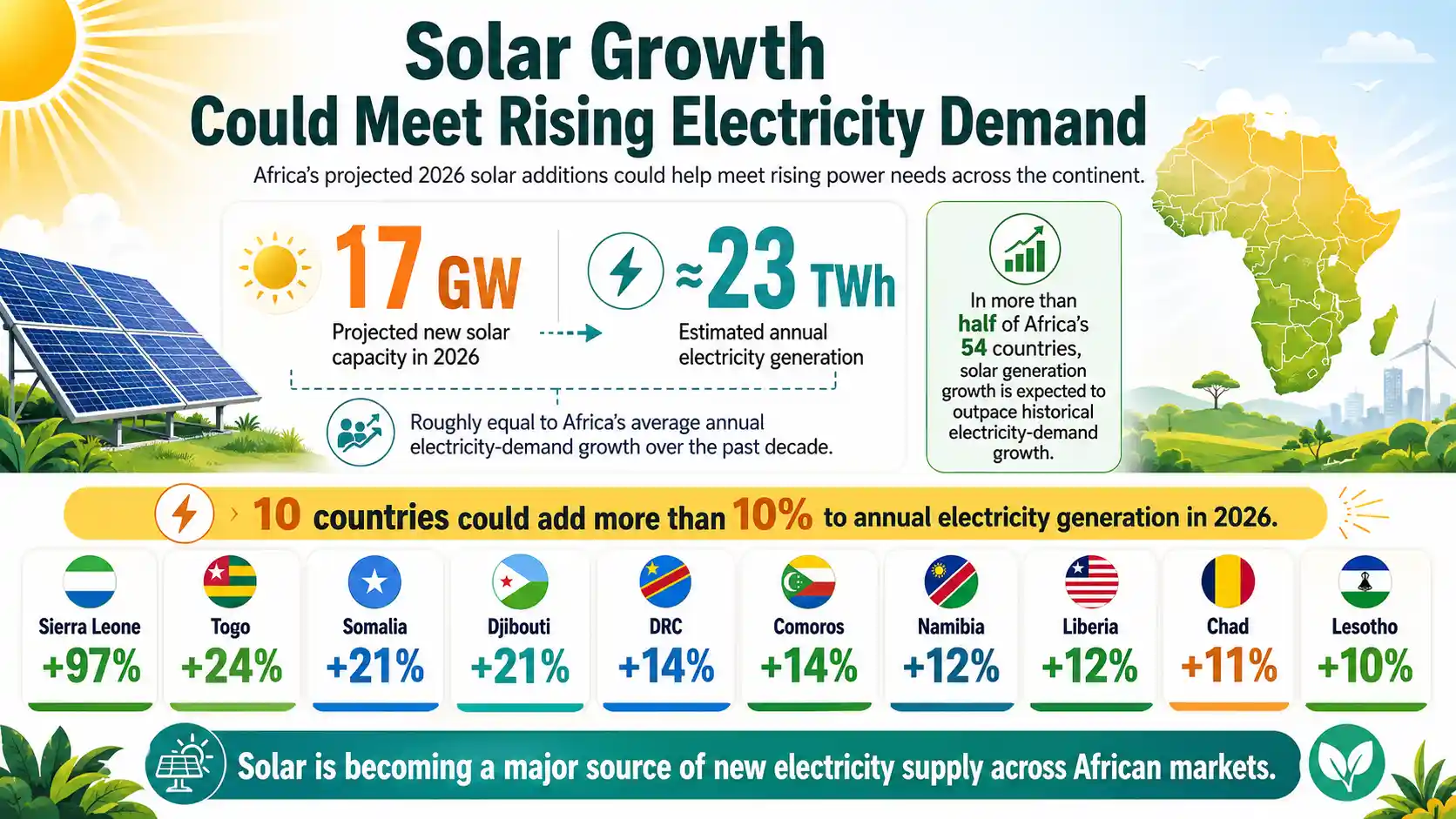
The 17GW of solar power expected to be installed in 2026 could generate approximately 23TWh of electricity annually.
Researchers estimate that this amount would be equivalent to Africa’s average annual electricity demand growth over the past decade.
In more than half of Africa’s 54 countries, solar generation growth is expected to exceed the historical rate of electricity demand growth.
Ten countries are projected to see new solar capacity add more than 10% to their annual electricity generation in 2026.
Sierra Leone is expected to record the largest increase at 97%, followed by Togo at 24%, Somalia and Djibouti at 21% each, and the DRC and Comoros at 14% each.
Other countries expected to see significant increases include Namibia and Liberia at 12% each, Chad at 11% and Lesotho at 10%.
The expected growth highlights the potential for solar power to contribute significantly to meeting rising electricity demand across African markets.
Distributed Solar Remains Underreported
The analysis estimates that approximately 75% of solar capacity added across Africa between 2023 and 2025 came from distributed solar.
Much of this capacity is not captured by official statistics, meaning reported figures may underestimate the actual scale of solar deployment across the continent.
Solar deployment data remains limited across Africa. Only South Africa, Tunisia and Tanzania currently publish solar capacity data quarterly or more frequently.
Official national solar capacity data is available for only 36 of Africa’s 54 countries, while just 14 countries had reported data for 2025.
Ember and African Tech Futures Lab said the available figures are likely to underestimate actual solar installations.
At least 15 African countries now have solar registration and permitting systems at an advanced stage, with several already operational.
The organisations said stronger data collection and reporting systems will be important for governments, grid operators and regulators to effectively plan for the continent’s rapidly expanding solar market.
Context is everything. Stay ahead of shifting trends with today’s market updates, and uncover emerging opportunities using the Serrari Group Market Index and Marketplace. Then, take control of your own financial future by exploring our Money & Life Reset Transformation Blueprint ™ to build stronger habits, create better systems, and design a path toward lasting wealth.
Africa’s Solar Manufacturing Capacity to Quadruple
Africa’s solar panel manufacturing capacity is also expected to expand significantly in 2026.
Manufacturing capacity is forecast to quadruple to around 3.5 GW, supported by new manufacturing facilities coming online in Egypt and Tanzania.
However, the majority of this manufacturing output is expected to be exported to the United States.
At the same time, Africa remains heavily dependent on imported solar equipment. Around 94% of panels installed across the continent are still imported from China, underscoring the continued reliance on Chinese solar manufacturing.
The increase in local manufacturing could therefore represent an important development for Africa’s solar industry, even as imports continue to account for most panels deployed across the continent.
Solar Expansion Spreads Across Africa
The projected growth indicates that solar deployment is no longer concentrated in a small number of major African markets.
The DRC, Zimbabwe and Egypt are among the countries expected to record the strongest year-on-year increases, while several other markets are also projected to install record volumes.
The expansion comes as African countries face increasing electricity demand and seek additional generation capacity.
Falling solar panel costs and increasingly attractive economics are contributing to the growth, according to Dave Jones, Chief Analyst at Ember.
Jones also highlighted the importance of improved data collection, saying that better information would help governments understand and plan for the pace of solar growth.
With 36 countries expected to install record amounts of solar in 2026, the continent is entering another significant year for renewable energy deployment.
Outlook
Africa’s projected 17GW of solar installations in 2026 would represent another record for the continent and could provide around 23TWh of electricity annually.
The expansion is occurring alongside growth in solar manufacturing, although Africa continues to rely heavily on imported panels from China.
Improving registration, permitting and reporting systems will remain important as distributed solar expands and official statistics continue to capture only part of the market.
If the projected installations materialize, solar will play an increasingly important role in meeting Africa’s growing electricity demand and expanding access to renewable power.
4 FAQs
1. How much solar power is Africa expected to install in 2026?
Africa is expected to install a record 17GW of solar power in 2026, representing a 45% increase from 2025.
2. How much electricity could Africa’s new solar capacity generate?
The projected 17GW of new solar capacity could generate approximately 23TWh of electricity annually, equivalent to Africa’s average yearly electricity demand growth over the past decade.
3. Which African countries are expected to record the strongest solar growth?
The Democratic Republic of the Congo is forecast to record the strongest year-on-year growth at 544%, followed by Zimbabwe at 282% and Egypt at 176%.
4. How much of Africa’s solar panels are imported from China?
Around 94% of solar panels installed across Africa are imported from China, despite Africa’s solar manufacturing capacity being expected to quadruple to around 3.5GW in 2026.
Sources: Energy Live News, EMBER, SolarQuarter
Your financial future isn’t something you wait for—it’s something you build.
The real question is: when do you begin?
Move beyond simply staying informed.
Navigate the markets with clarity—track trends through the Serrari Group Market Index, uncover opportunities in the Serrari Marketplace, and build practical knowledge with our Curated Wealth Builder Platform.
Stay connected to what truly matters.
Get daily insights on macro trends and financial movements across Kenya, Africa, and global markets—delivered through the Serrari Newsletter.
Growth opens doors.
Advance your career through professional programs including ACCA, HESI A2, ATI TEAS 7 , HESI EXIT , NCLEX – RN and NCLEX – PN, Financial Literacy!🌟—designed to move you forward with confidence.
See where money is flowing—clearly and in real time.
Track Money Market Funds, Treasury Bills, Treasury Bonds, Green Bonds, and Fixed Deposits, alongside global and African indexes, key economic indicators, and the evolving Crypto and stablecoin landscape—all within Serrari’s Market Index.