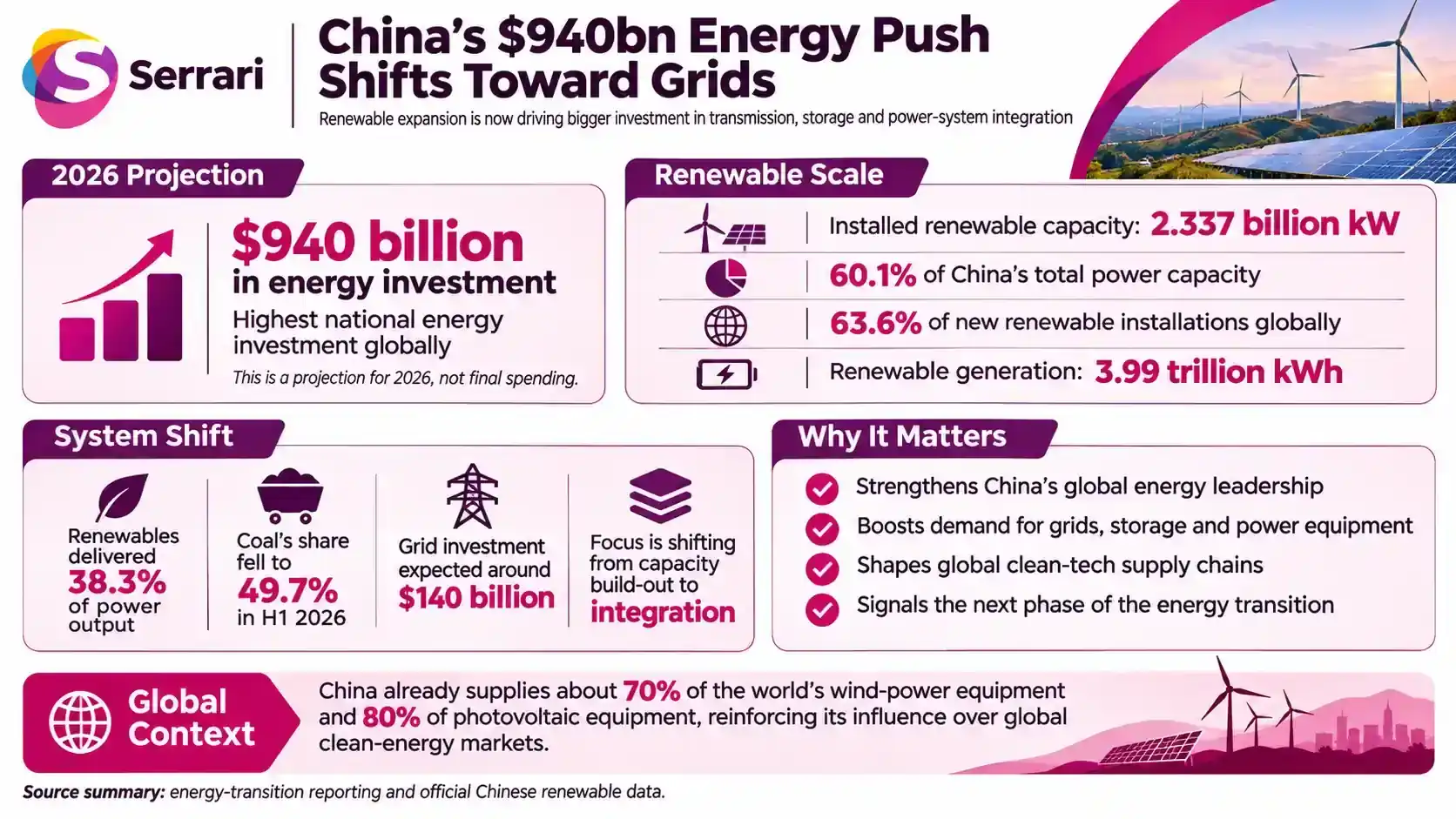
China is projected to invest $940 billion in its energy sector in 2026, the highest amount of any country, as Beijing increasingly directs capital toward electricity networks, energy storage and infrastructure needed to support the world’s largest renewable power system.
The projection, contained in the Global Energy Transition Report 2026 released by the China Enterprise Reform and Development Society, highlights a significant shift in China’s energy strategy. Having spent years expanding solar, wind and other renewable generation capacity, the country is increasingly confronting the challenge of transporting, storing and efficiently distributing the electricity produced.
By the end of 2025, China’s installed renewable energy capacity had reached 2.337 billion kilowatts, accounting for 60.1% of its total power capacity. Renewable generation reached 3.99 trillion kilowatt-hours, equivalent to 38.3% of electricity output, with additional renewable generation sufficient to cover the year’s increase in electricity consumption.
The investment drive is reshaping China’s domestic energy system while strengthening its influence over global clean-energy supply chains. However, the expansion also exposes infrastructure constraints, manufacturing overcapacity and the continued importance of coal in meeting electricity demand.
Key Overview
- Record investment projection: China is expected to invest $940 billion in energy in 2026, making it the world’s largest national energy investor.
- Grid investment accelerates: Electricity network spending is expected to reach approximately $140 billion as China addresses infrastructure constraints associated with rapid renewable deployment.
- Renewable capacity dominates: Installed renewable capacity reached 2.337 billion kilowatts in 2025, representing 60.1% of China’s total generating capacity.
- Global renewable leadership: China accounted for approximately 63.6% of newly installed renewable energy capacity worldwide in 2025.
- Renewables cover additional demand: Renewable electricity generation reached 3.99 trillion kilowatt-hours in 2025, with its annual increase sufficient to cover the growth in national electricity consumption.
- Coal’s share declines: Coal-fired power contributed 49.7% of China’s electricity generation during the first half of 2026, falling below half for the first time.
- Manufacturing dominance: China supplies an estimated 70% of global wind-power equipment and 80% of solar photovoltaic equipment, strengthening its position in international energy supply chains.
- Global implications: The investment programme could influence renewable equipment prices, grid technology demand, energy security strategies and clean-energy investment across emerging economies.
Why China Is Preparing to Invest $940 Billion in Energy
China’s projected $940 billion energy investment in 2026 reflects a strategic effort to strengthen electricity infrastructure after years of rapid renewable capacity expansion.
According to the Global Energy Transition Report 2026 findings, the country is expected to remain the world’s largest national energy investor, supported by substantial spending on renewable power, electricity networks and associated infrastructure.
The scale of the projection becomes clearer when compared with the global investment environment.
The World Energy Investment 2026 assessment estimates that worldwide energy investment will reach approximately $3.4 trillion in 2026, an increase of 5% from 2025.
Of this amount, about $2.2 trillion is expected to flow into clean-energy technologies and infrastructure, nearly twice the investment directed toward fossil fuels.
China’s $940 billion projection would represent more than a quarter of that global total if measured on a comparable basis. However, differences in reporting methodologies and investment classifications mean the figures should not be treated as perfectly interchangeable.
China’s investment ambitions are driven by three interconnected priorities: meeting rising electricity demand, strengthening energy security and maintaining industrial leadership in clean-energy technologies.
The country’s economy is increasingly dependent on electricity-intensive activities, including advanced manufacturing, electric vehicles, digital infrastructure and artificial intelligence data centres.
At the same time, energy security remains a major economic concern for Beijing because disruptions to electricity supply can affect industrial output, manufacturing competitiveness and broader economic activity.
Renewable energy offers China an opportunity to diversify electricity generation while reducing exposure to imported fossil fuels.
However, expanding renewable generation alone cannot guarantee reliable electricity supply.
The country must also develop sufficient transmission capacity, storage infrastructure and power-system flexibility to ensure electricity reaches consumers when and where it is needed.
This explains why the investment strategy is increasingly shifting from building generating capacity toward strengthening the infrastructure supporting the entire power system.
Electricity Grids Become China’s Next Major Energy Investment Priority
One of the most significant developments in China’s energy transition is the growing importance of electricity transmission and distribution networks.
After years of expanding solar farms and wind projects, China’s power system faces an increasingly complex infrastructure challenge.
Much of its renewable energy capacity is located in regions with abundant wind and solar resources, while substantial electricity demand is concentrated in industrial centres and densely populated eastern provinces.
Electricity generated in one region must therefore be transported over considerable distances to reach major consumers.
Without adequate transmission capacity, renewable projects can produce electricity that cannot be fully absorbed by the grid.
This can result in curtailment, where renewable generation is deliberately reduced because of network limitations, system stability requirements or mismatches between electricity supply and demand.
The assessment of China’s energy investment priorities identifies electricity networks, energy storage and smart infrastructure as increasingly important areas of capital expenditure.
China’s electricity grid investment is expected to approach $140 billion in 2026, according to the latest investment reporting.
This represents a substantial allocation toward infrastructure that supports rather than directly generates electricity.
China’s longer-term plans reinforce the direction of investment.
Under its 15th Five-Year Plan for power grid development, State Grid Corporation of China plans to invest up to 4 trillion yuan in fixed assets between 2026 and 2030, approximately 40% more than during the previous five-year period.
The increased spending reflects an important change in the economics of renewable energy.
Initially, the priority was to reduce the cost of solar panels and wind turbines while increasing installed capacity.
Now, as renewable energy occupies a larger share of the electricity system, the challenge is ensuring that electricity can be delivered reliably despite changing weather conditions and fluctuations in demand.
Investment in high-voltage transmission, distribution networks, battery storage and digital grid management could therefore become as important as additional renewable power installations.
The shift also creates commercial opportunities for manufacturers of transformers, cables, power electronics, energy storage systems and other electricity infrastructure equipment.
Renewable Power Capacity Reaches 60% of China’s Electricity System
China’s investment strategy follows an extraordinary expansion of renewable energy capacity.
By the end of 2025, installed renewable power capacity had reached approximately 2.337 billion kilowatts, equivalent to 2,337 gigawatts.
Renewables represented 60.1% of China’s total installed electricity generation capacity, reflecting years of investment in solar, wind, hydropower and other renewable technologies.
Official renewable energy development statistics also show that renewables accounted for more than 60% of global capacity additions during 2025, underlining the scale of China’s contribution to worldwide clean-energy expansion.
However, installed capacity and actual electricity generation are different measures.
Capacity represents the maximum potential output of generating facilities under suitable operating conditions, while generation measures the electricity actually produced.
Solar installations generate power primarily during daylight hours, while wind turbines depend on prevailing wind conditions.
Consequently, their contribution to annual electricity generation can be smaller than their share of installed capacity.
In 2025, China’s renewable electricity generation reached 3.99 trillion kilowatt-hours, equivalent to approximately 38.3% of national electricity output.
The increase in renewable generation was sufficient to cover the entire rise in electricity consumption during the year.
This represents a significant development because additional electricity demand no longer necessarily translates into increased fossil-fuel generation.
However, it does not mean China has eliminated its dependence on coal or that renewable output can meet electricity demand at every hour of the day.
Seasonal fluctuations, peak demand periods and the availability of transmission and storage capacity remain important determinants of electricity supply.
The next stage of China’s energy transition will therefore depend increasingly on how effectively the country integrates its expanding renewable resources into the wider electricity system.
Why Coal’s Share Has Fallen Below 50%
China’s growing renewable electricity supply is beginning to alter the composition of its power generation system.
During the first half of 2026, coal-fired generation accounted for 49.7% of national electricity output, falling below the 50% threshold for the first time in a half-year reporting period.
According to official electricity generation data, renewable energy contributed 41.2% of electricity generation during the same period.
The figures mark a significant change from China’s historical reliance on coal as the dominant source of electricity.
The decline in coal’s share reflects the rapid growth of renewable electricity generation relative to conventional thermal power.
However, a declining percentage share does not necessarily mean absolute coal consumption is falling.
If total electricity demand increases significantly, coal-fired power generation can remain stable or even rise despite contributing a smaller proportion of the overall electricity mix.
This distinction is particularly important for China, where electricity demand continues to grow alongside industrial electrification and the expansion of data-intensive technologies.
Coal also retains an important role in power-system reliability.
Unlike solar and wind generation, coal-fired plants can provide dispatchable electricity when renewable output is insufficient, although their flexibility and operating characteristics vary.
The transition therefore involves more than replacing one generating technology with another.
It requires China to develop an electricity system capable of balancing variable renewable output with storage, flexible generation, transmission infrastructure and demand-management technologies.
The long-term implications could be substantial for global coal markets, particularly if renewable deployment eventually reduces China’s absolute coal consumption.
As the world’s largest coal consumer, changes in Chinese demand can influence international coal trade, prices and investment decisions.
Nevertheless, the transition is likely to remain gradual rather than producing an immediate end to coal dependence.
Context is everything. Stay ahead of shifting trends with today’s market updates, and uncover emerging opportunities using the Serrari Group Market Index and Marketplace. Then, take control of your own financial future by exploring our Money & Life Reset Transformation Blueprint ™ to build stronger habits, create better systems, and design a path toward lasting wealth.
China’s Clean-Energy Manufacturing Dominance Reshapes Global Markets
China’s renewable energy strategy extends beyond meeting domestic electricity demand.
The country has also established a dominant position in manufacturing equipment used in the global energy transition.
According to the 2026 energy transition findings, China supplies approximately 70% of global wind-power equipment and 80% of solar photovoltaic equipment.
This industrial leadership reflects years of investment in production capacity, manufacturing infrastructure, technology development and supply-chain integration.
Large-scale manufacturing has helped reduce renewable energy equipment costs worldwide, making solar and wind projects increasingly competitive with conventional energy sources.
However, China’s production dominance presents both opportunities and risks for the international market.
For developing economies, access to competitively priced Chinese solar panels, batteries and related equipment can lower the cost of renewable electricity projects.
Lower equipment costs can improve project economics and make renewable energy more accessible to countries facing capital constraints.
For competing manufacturers, however, China’s scale creates intense price competition.
The renewable energy industry outlook highlights the financial pressures facing solar manufacturers amid global oversupply and declining equipment prices.
Chinese solar photovoltaic prices have fallen substantially since 2023, contributing to weaker margins and financial losses across parts of the manufacturing industry.
This creates an important contradiction.
While expanding renewable installations supports global decarbonisation, excessive manufacturing capacity can undermine profitability and discourage investment in competing production facilities.
Governments seeking greater energy independence may therefore face difficult trade-offs between purchasing inexpensive Chinese technology and developing domestic manufacturing capacity.
China’s expansion of electricity infrastructure could also generate fresh domestic demand for components and technology beyond conventional solar panels and wind turbines.
As investment shifts toward transmission systems, storage and grid management, the composition of clean-energy manufacturing demand is likely to change.
What China’s Investment Drive Means for Africa
China’s energy investment strategy has implications for African economies seeking to expand electricity access, strengthen power reliability and develop renewable energy resources.
Many African countries possess substantial solar, wind, geothermal and hydropower potential but face significant constraints in electricity transmission, distribution and project financing.
China’s experience demonstrates that developing renewable generation capacity without corresponding investment in electricity networks can limit the benefits of new projects.
This lesson is particularly relevant for countries where electricity demand is growing while existing grids struggle with technical losses, inadequate transmission capacity and unreliable supply.
Chinese manufacturers are also important suppliers of solar panels, batteries and other energy equipment used in African renewable energy projects.
The scale of China’s manufacturing industry can reduce the cost of imported renewable technologies, potentially supporting investment in residential solar systems, commercial installations and utility-scale generation.
However, lower equipment prices do not automatically translate into affordable electricity.
Project financing costs, currency risks, import duties, electricity tariffs and grid-connection expenses can significantly affect the final cost of power.
For countries such as Kenya, where electricity generation already includes substantial renewable contributions, the challenge increasingly involves ensuring that electricity infrastructure can support growing demand at competitive prices.
Investment in transmission networks, storage and grid flexibility could help countries make better use of existing renewable resources while accommodating new generation projects.
There may also be opportunities for African businesses involved in electrical engineering, equipment distribution, project development and maintenance services.
Nevertheless, China’s growing dominance in global supply chains raises questions about supplier concentration and long-term dependence on imported technologies.
African policymakers and investors must therefore balance the benefits of competitively priced equipment against the importance of building technical capacity, resilient supply chains and financially sustainable electricity systems.
Rising Electricity Demand Adds Urgency to Grid Investment
China’s energy expansion is occurring alongside a broader global increase in electricity demand.
Electrification of transport, manufacturing, heating and digital services is increasing the importance of reliable electricity supply across major economies.
Artificial intelligence and data centres are adding another source of demand, particularly in regions seeking to develop advanced computing infrastructure.
The Electricity 2026 outlook identifies electricity networks and system flexibility as major investment priorities as countries accommodate growing demand and integrate larger shares of renewable generation.
The report estimates that global annual grid investment must increase substantially by 2030 to support projected electricity demand.
It also highlights extensive delays affecting renewable generation, storage and major electricity consumers awaiting grid connections.
These constraints explain why investment in generation capacity alone is increasingly insufficient.
Electricity systems must be capable of moving energy between regions, balancing supply and demand, and maintaining stability as the generation mix becomes more diverse.
China’s planned spending reflects this changing investment environment.
Rather than focusing exclusively on adding renewable capacity, the country is attempting to develop the supporting infrastructure required for a more electrified economy.
The shift could influence global capital allocation toward electricity networks, storage systems, transformers and other technologies that enable renewable energy integration.
Can China Sustain Its Energy Investment Momentum?
Despite the scale of its investment ambitions, China’s energy transition faces several challenges.
First, rapid renewable capacity expansion has created localised grid constraints.
The analysis of distributed energy integration identifies congestion and connection restrictions in several Chinese provinces, where renewable deployment has outpaced distribution-network readiness.
These constraints can reduce the economic benefits of new installations and highlight the need for better coordination between generation investment and network development.
Second, manufacturing overcapacity continues to place pressure on renewable equipment producers.
Although lower prices benefit project developers, sustained losses among manufacturers could weaken the industry’s financial position and eventually affect future investment.
Third, growing electricity demand creates uncertainty over the pace at which renewable generation can displace fossil fuels in absolute terms.
Coal’s declining share of electricity output marks important progress, but stronger demand could maintain substantial fossil-fuel generation requirements.
Finally, the benefits of major infrastructure spending will depend on investment efficiency.
Constructing additional transmission capacity and storage facilities can support electricity reliability, but poorly coordinated projects may create underutilised assets or increase costs.
For China, the challenge is therefore not simply mobilising capital.
It is ensuring that investments deliver measurable improvements in electricity reliability, renewable energy utilisation, industrial productivity and long-term energy affordability.
The projected $940 billion expenditure will be significant only to the extent that it translates into productive infrastructure and a more efficient power system.
The Bigger Picture: Energy Investment Enters a New Phase
China’s investment plans illustrate a broader transformation in the global energy industry.
For much of the past decade, the clean-energy transition was primarily associated with increasing renewable generation capacity and reducing the cost of solar and wind technologies.
Those priorities remain important, but the rapid expansion of renewable power has exposed a second challenge: integrating new generating capacity into existing electricity systems.
As renewable penetration increases, grid infrastructure, battery storage, flexible generation and electricity market coordination become increasingly important.
The investment opportunities are therefore expanding beyond conventional renewable power developers toward companies supplying the infrastructure required to operate modern electricity networks.
China’s position is especially influential because it combines the world’s largest renewable energy deployment programme with substantial manufacturing capacity and significant domestic electricity demand.
Its investment decisions can consequently affect global equipment prices, industrial supply chains and the pace of clean-energy deployment in other economies.
The implications also extend to energy security.
Countries with diversified generation systems and resilient electricity networks may be better positioned to withstand disruptions in imported fossil fuel supplies and changes in international energy markets.
However, greater reliance on renewable technologies can introduce different supply-chain dependencies, particularly where manufacturing is concentrated in a limited number of countries.
The global energy transition is therefore increasingly shaped by two interconnected objectives: reducing dependence on fossil fuels while strengthening the resilience of electricity infrastructure and technology supply chains.
China’s planned investment programme reflects both priorities.
Conclusion
China’s projected $940 billion energy investment in 2026 underscores its determination to maintain a leading position in global energy development while addressing the infrastructure challenges created by its rapid renewable expansion.
With renewable energy accounting for more than 60% of installed power capacity and generating a growing share of national electricity, the country’s transition has reached a stage where building additional solar and wind projects is no longer sufficient on its own.
Electricity transmission, storage and grid flexibility are becoming central to determining how effectively China can use its renewable resources.
The decline in coal-fired power’s share below 50% during the first half of 2026 demonstrates the changing composition of the electricity system, although continued demand growth and reliability requirements mean coal remains significant.
For global markets, China’s investment strategy could stimulate demand for grid infrastructure and energy storage technologies while reinforcing its influence over renewable equipment supply chains.
For emerging economies, including those in Africa, the development highlights the importance of coordinating renewable generation investments with electricity networks capable of delivering reliable and affordable power.
Ultimately, China’s next energy challenge is not simply producing more renewable electricity, but ensuring that its increasingly complex power system can use that electricity efficiently, reliably and economically.
The success of its investment programme will depend less on the headline amount committed than on whether the infrastructure delivers stronger energy security, improved renewable integration and sustainable long-term economic benefits.
Sources: Business Standard / Bloomberg / China Enterprise Reform and Development Society / China Central Television / International Energy Agency / National Energy Administration of China / Government of China / Kazinform
Your financial future isn’t something you wait for—it’s something you build.
The real question is: when do you begin?
Move beyond simply staying informed.
Navigate the markets with clarity—track trends through the Serrari Group Market Index, uncover opportunities in the Serrari Marketplace, and build practical knowledge with our Curated Wealth Builder Platform.
Stay connected to what truly matters.
Get daily insights on macro trends and financial movements across Kenya, Africa, and global markets—delivered through the Serrari Newsletter.
Growth opens doors.
Advance your career through professional programs including ACCA, HESI A2, ATI TEAS 7 , HESI EXIT , NCLEX – RN and NCLEX – PN, Financial Literacy!🌟—designed to move you forward with confidence.
See where money is flowing—clearly and in real time.
Track Money Market Funds, Treasury Bills, Treasury Bonds, Green Bonds, and Fixed Deposits, alongside global and African indexes, key economic indicators, and the evolving Crypto and stablecoin landscape—all within Serrari’s Market Index.