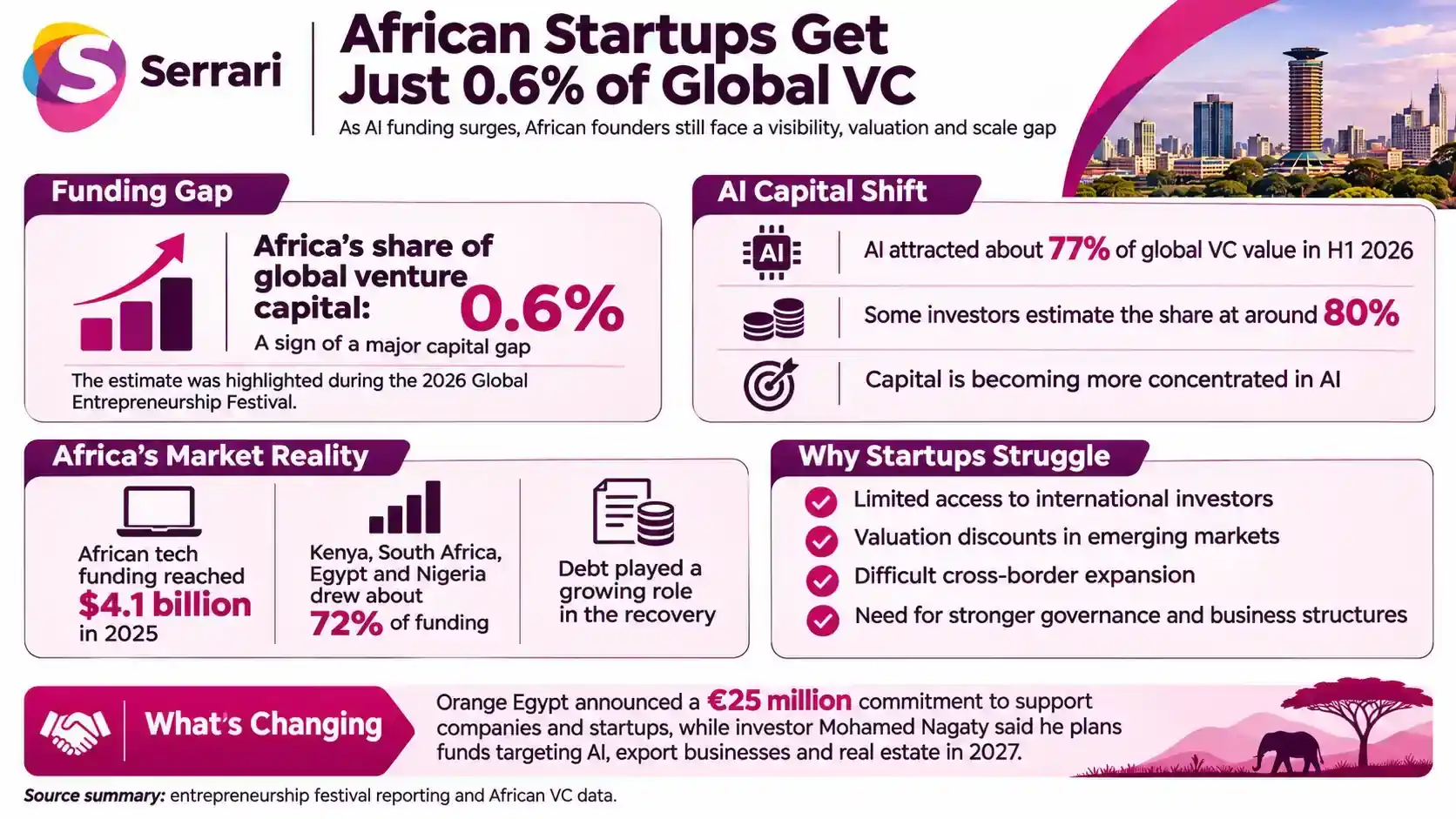
African startups attract an estimated 0.6% of global venture capital funding, highlighting the persistent investment gap facing the continent’s technology entrepreneurs as international investors increasingly concentrate financing on artificial intelligence (AI).
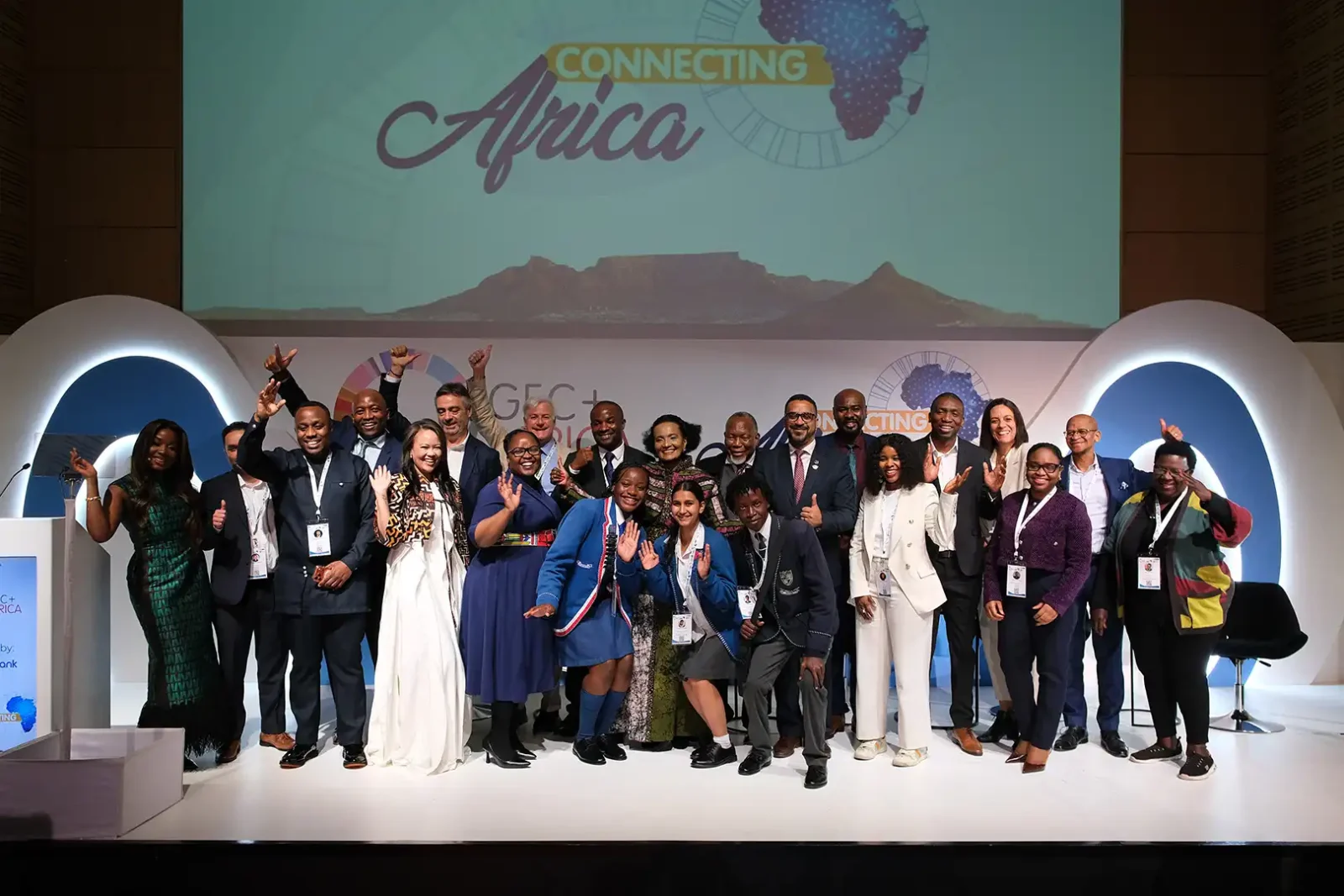
The figure was highlighted by Egyptian investor and entrepreneur Mohamed Abou El-Naga Nagaty during the 2026 Global Entrepreneurship Festival in Cairo, where industry leaders discussed the financing challenges facing African startups and the opportunities emerging from AI adoption, international expansion and institutional investment.
Nagaty argued that limited access to international investors, difficulties securing competitive valuations and weaknesses in business structures continue to restrict African startups’ ability to raise capital.
The challenge is becoming more urgent as AI companies attract a growing proportion of global venture investment. According to the latest global innovation assessment, AI accounted for approximately 77% of global venture capital investment value in the first half of 2026, reflecting a significant concentration of capital in the sector.
Although African startup funding has recovered from earlier declines, the continent continues to capture a disproportionately small share of global technology investment. The growing emphasis on AI could create new opportunities for African founders developing commercially viable solutions, but it also risks widening the financing divide between established technology markets and emerging startup ecosystems.
Key Overview
- Limited global funding share: African startups attract an estimated 0.6% of global venture capital, according to Egyptian investor Mohamed Abou El-Naga Nagaty.
- AI dominates investment flows: AI companies accounted for approximately 77% of global venture capital investment value during the first half of 2026, according to international innovation research.
- Funding recovery remains uneven: African technology companies raised $4.1 billion in combined equity and debt financing in 2025, but equity investment increased by only 8%.
- Three new investment funds planned: Nagaty announced plans to launch funds in 2027 targeting AI, export-oriented businesses and real estate.
- Corporate investment commitment: Orange Egypt announced a €25 million commitment to support local companies and startups, alongside plans to expand its digital training centres.
- Structural financing barriers: Limited investor visibility, weak institutional structures, valuation difficulties and challenges expanding across borders continue to restrict funding.
- Concentrated investment markets: Kenya, South Africa, Egypt and Nigeria accounted for approximately 72% of Africa’s technology funding in 2025.
- Employment implications: Broader technological and economic transformation could create 170 million jobs globally by 2030 while displacing 92 million existing positions.
Why African Startups Receive So Little Global Venture Capital
African technology companies continue to struggle to secure international venture capital despite the continent’s expanding digital economy and increasing demand for technology-driven services.
During a panel discussion at the 2026 Global Entrepreneurship Festival in Cairo on November 8, Egyptian investor Mohamed Abou El-Naga Nagaty estimated that African startups receive only 0.6% of worldwide venture capital funding.
The figure illustrates the scale of the financing gap, although estimates of Africa’s global market share vary depending on the reporting period and whether funding calculations include equity, debt or other financing instruments.
For example, the African startup funding assessment covering the first half of 2025 estimated that startups on the continent captured approximately 0.4% of global equity funding.
The broader conclusion remains the same: Africa continues to attract a small proportion of global investment relative to the scale of its population, business opportunities and economic development needs.
Nagaty argued that the problem extends beyond the amount of capital available.
African startups often struggle to gain visibility among international investors, demonstrate financial sustainability and secure valuations that adequately reflect their growth prospects.
These challenges are especially significant because venture capital is generally directed toward businesses expected to achieve rapid growth and generate substantial returns through acquisitions, public listings or other exits.
Investors therefore assess not only the size of a company’s potential market but also its ability to expand operations, generate returns and eventually provide a viable exit.
In African markets, fragmented regulatory environments, currency volatility, smaller domestic capital markets and limited exit opportunities can complicate these assessments.
For investors managing international portfolios, such risks may reduce the attractiveness of African startups relative to businesses operating in larger and more established technology ecosystems.
This can create a reinforcing cycle.
Limited investor participation reduces access to growth financing, while insufficient funding makes it harder for startups to demonstrate the scale and commercial maturity that international investors require.
Global AI Investment Boom Widens the Funding Divide
Africa’s venture capital challenges are emerging at a time when international investors are directing an increasingly large share of funding toward artificial intelligence.
Nagaty estimated that approximately 80% of global venture capital is now directed toward AI, reflecting the sector’s growing influence over investment decisions.
Independent research provides evidence of a similarly pronounced shift, although estimates differ by methodology and reporting period.
According to the Global Innovation Index 2026 analysis, AI accounted for approximately 77% of worldwide venture capital investment value in the first half of 2026, compared with 53% in 2025.
AI companies represented a smaller proportion of the number of deals, at approximately 36% during the first half of 2026.
This distinction is important because the concentration reflects extraordinarily large financing rounds rather than AI companies accounting for almost every investment transaction.
A separate international venture capital assessment found that AI companies attracted $258.7 billion in 2025, equivalent to 61% of the $427.1 billion in global venture investment captured by its dataset.
The differences between estimates reflect variations in investment classifications, transaction coverage and measurement periods.
However, the underlying trend is consistent: AI is capturing an increasingly substantial share of international venture financing.
Much of this investment is being directed toward companies developing advanced AI models, computing infrastructure, enterprise software and other technologies supporting the rapidly expanding AI ecosystem.
The concentration creates additional competition for African startups seeking capital, particularly those operating outside AI-related industries.
Investors allocating larger portions of their portfolios to AI may have less capital available for early-stage companies in conventional fintech, e-commerce, logistics and other sectors.
At the same time, African AI startups face competition from established international companies that often possess greater computing resources, deeper technical expertise and stronger relationships with global investors.
The potential risk is that African businesses become consumers of AI technologies developed elsewhere rather than significant participants in creating and commercialising them.
Nevertheless, the AI investment boom also presents opportunities.
African startups developing applications for local economic challenges could attract investors seeking commercially viable AI products rather than exclusively financing large foundational models.
The challenge is converting those opportunities into scalable businesses capable of attracting sustained investment.
African Startup Funding Recovers but Remains Concentrated
The latest investment data indicate that Africa’s startup ecosystem is recovering from the financing slowdown experienced during 2023 and 2024.
According to the 2025 Africa technology investment report, technology companies raised approximately $4.1 billion in combined equity and debt financing during 2025.
This represented growth of around 25% from the previous year and the strongest annual funding performance since 2022.
However, the composition of that recovery reveals an important distinction.
Equity investment increased by approximately 8% to $2.4 billion across 462 transactions, while debt financing surged 63% to approximately $1.6 billion.
Debt financing therefore accounted for a substantial proportion of the increase in total funding.
Unlike equity investment, where investors acquire ownership stakes, debt typically creates repayment obligations and may require predictable cash flows or identifiable assets.
Its growing importance reflects the increasing maturity of some African technology businesses, particularly companies operating in asset-intensive sectors.
However, debt financing is generally less suitable for early-stage startups that have limited revenue and are still developing their products.
Consequently, stronger overall funding figures do not necessarily indicate improved access to investment for smaller businesses.
The geographical distribution of investment also remains uneven.
Kenya, South Africa, Egypt and Nigeria accounted for approximately 72% of total African technology funding in 2025.
These markets benefit from relatively established entrepreneurial ecosystems, stronger investor networks and more developed financial and business infrastructure.
Startups operating in smaller African economies often face additional barriers to attracting international investors, even when their products address commercially viable problems.
The concentration becomes more pronounced when larger transactions are considered.
According to the third-quarter 2026 funding assessment, African startups raised approximately $712 million across 114 deals between July and September.
Although the amount exceeded funding recorded in the previous quarter, investment was concentrated in a relatively small number of businesses and markets.
The report found that Nigeria accounted for 46% of the quarter’s total funding, with one major financing round representing approximately 35% of the continent’s investment value.
These figures demonstrate how individual large transactions can significantly influence aggregate funding totals without necessarily reflecting improved financing conditions for the wider startup ecosystem.
Why Investor Visibility and Startup Valuations Matter
Nagaty identified limited access to international investment networks as a major obstacle preventing African startups from securing financing.
For venture capital investors, finding and evaluating investment opportunities requires credible information about a company’s performance, governance, market potential and financial position.
Businesses with established investor relationships and transparent reporting structures are often better positioned to attract international attention.
African startups without these connections may struggle to demonstrate their value, even where they have strong products or attractive growth prospects.
Valuation presents a related challenge.
Investors generally determine startup valuations by assessing expected growth, market size, profitability prospects, competition and the likelihood of achieving a successful exit.
However, businesses operating in emerging markets can face higher perceived risks associated with currencies, regulations and economic stability.
These risks may lead investors to apply more conservative valuations.
For founders, accepting a low valuation can result in surrendering a larger ownership stake than initially anticipated.
This can create difficulties during subsequent funding rounds, particularly if the business needs additional capital before achieving profitability.
Nagaty emphasised the importance of preparing businesses for investment by establishing sustainable operating models and stronger management structures.
This includes demonstrating a credible path to revenue growth, improving financial reporting and developing governance systems capable of supporting expansion.
The broader implication is that raising more capital is not solely a matter of increasing investor interest in Africa.
It also requires creating businesses that can meet the financial, operational and governance standards expected by institutional investors.
Three New Funds Target AI, Exports and Real Estate
Against this backdrop, Nagaty announced plans to launch three investment funds in 2027 targeting artificial intelligence, export-oriented businesses and real estate.
The proposed funds reflect an investment strategy aimed at sectors with opportunities for commercial expansion both within Egypt and internationally.
AI-focused investment could support startups developing software, automation tools and technology-enabled services.
Export-oriented businesses may benefit from access to larger international markets, allowing them to reduce dependence on domestic demand.
Real estate investment represents a different asset class, potentially offering exposure to property development and other income-generating activities rather than conventional technology venture capital.
However, the funds remain planned initiatives, and their eventual size, investment terms and deployment schedules have not been established in the reported announcements.
Nagaty also highlighted his involvement in an existing fintech-focused investment fund providing financing ranging from $10,000 to $50,000.
Such investments can be particularly important at the early stages of business development.
Small financing rounds allow founders to test products, acquire initial customers and demonstrate whether their business models can generate sustainable revenue.
This early-stage investment can help bridge the gap between business formation and larger institutional financing rounds.
However, smaller investments must eventually be complemented by sufficient growth capital if successful startups are to expand beyond their initial markets.
Context is everything. Stay ahead of shifting trends with today’s market updates, and uncover emerging opportunities using the Serrari Group Market Index and Marketplace. Then, take control of your own financial future by exploring our Money & Life Reset Transformation Blueprint ™ to build stronger habits, create better systems, and design a path toward lasting wealth.
Orange Egypt Commits €25 Million to Support Startups
Corporate investment is also becoming an important component of startup financing and development.
During the Cairo discussions, Orange Egypt’s executive vice president for business, Mohamed Shibl, announced a €25 million commitment intended to support local businesses and startups.
The company also plans to expand its Orange Digital Centres network, which currently includes operations in Cairo and Aswan, with a new centre planned for Alexandria.
The centres provide digital skills training and entrepreneurship support, including opportunities to develop technology-based projects.
The commitment is significant because corporate participation can offer benefits beyond direct financing.
Established telecommunications businesses possess customer relationships, distribution networks, technical infrastructure and operational expertise that smaller technology companies may struggle to develop independently.
Access to these capabilities can reduce some of the commercial barriers facing early-stage entrepreneurs.
Shibl also emphasised the importance of developing AI applications that solve practical problems rather than adopting technology without a clear commercial purpose.
He identified healthcare and transportation as sectors where AI applications could improve service delivery and operational efficiency.
This approach is especially relevant for emerging markets, where startups may find stronger business opportunities in applying existing technologies to specific local challenges than in attempting to compete directly with global AI infrastructure developers.
Cross-Border Expansion Remains a Major Challenge
Beyond financing, African startups face difficulties expanding across national borders.
Although Africa represents a large potential market, it consists of countries with different regulatory frameworks, currencies, consumer preferences and financial systems.
A startup operating successfully in one market cannot automatically replicate its business model elsewhere.
Expansion may require new licences, additional partnerships, locally adapted products and separate compliance arrangements.
These requirements increase costs and can delay revenue growth.
During the conference, Wael El-Desouky, secretary general of the Saleh Kamel Sustainable Entrepreneurship and Enterprise Development Organization, called for stronger investment and business networks connecting entrepreneurs with international markets.
He highlighted opportunities through networks associated with the Organisation of Islamic Cooperation’s 57 member states, including Nigeria, Indonesia and Saudi Arabia.
Such connections could help startups access new customers, commercial partners and potential investors.
Cross-border expansion is particularly important because larger addressable markets can improve the investment prospects of technology businesses.
For international investors, a startup capable of operating across multiple countries may offer greater growth potential than one dependent on a small domestic market.
However, the commercial benefits of international expansion must be balanced against execution risks and the cost of entering unfamiliar markets.
Startups that expand before establishing sustainable unit economics can increase their financial vulnerability rather than strengthen their long-term prospects.
What the AI Investment Shift Means for Kenya and Africa
The changing global investment environment has important implications for Kenya, one of Africa’s leading technology financing destinations.
Kenyan startups attracted approximately $1.04 billion in combined equity and debt financing in 2025, placing the country first in Africa by total funding raised.
However, the country-level funding breakdown indicates that Kenya’s position was heavily influenced by debt financing and several exceptionally large transactions.
This illustrates the importance of distinguishing between overall capital flows and the availability of venture equity for early-stage businesses.
Kenya’s established fintech ecosystem, growing digital services market and expanding technology workforce provide a foundation for developing AI-enabled businesses.
Potential applications include financial services, agricultural productivity, healthcare administration, education and logistics.
However, successful AI adoption requires more than technical experimentation.
Startups must identify clear customer needs, develop reliable data systems and establish business models that can generate revenue.
The growth of AI investment also creates pressure to strengthen digital infrastructure and technical skills.
Companies developing AI applications may require access to computing services, specialised talent and reliable data.
For smaller businesses, the cost of these resources can become a barrier to entry.
African investors and policymakers therefore face the challenge of supporting commercially viable AI adoption without diverting all available resources from other productive sectors.
Fintech, clean technology, healthcare and logistics continue to address significant economic needs across the continent.
A balanced financing ecosystem would support innovation across these industries while enabling businesses to integrate AI where it delivers measurable improvements.
AI Could Transform Employment and Skills Demand
The growing importance of AI also has implications for employment and workforce development.
According to the Future of Jobs Report 2025, broader technological, economic, demographic and environmental changes could create approximately 170 million jobs globally by 2030 while displacing 92 million existing positions.
This would result in a projected net increase of 78 million jobs.
These figures reflect multiple structural changes in the global economy and should not be interpreted as jobs created or eliminated by AI alone.
The projections nevertheless highlight the scale of workforce transformation expected as businesses adopt new technologies.
During the conference, Islam Wagih of the Arab Academy for Science, Technology and Maritime Transport emphasised the importance of developing technical skills required to build and manage AI systems.
He highlighted training programmes, specialised boot camps, hackathons and scholarships providing access to programming and AI education.
For African economies, workforce development will be critical to capturing the potential benefits of technological change.
AI adoption could improve business productivity and create opportunities in software development, data analysis and technology-enabled services.
However, automation may also reduce demand for certain administrative and routine tasks.
Countries that invest in technical education, digital literacy and workforce adaptation may be better positioned to capture emerging employment opportunities.
Without such investment, the benefits of AI could become concentrated among businesses and workers already possessing advanced technological capabilities.
The Bigger Picture: Africa Risks Missing Another Investment Cycle
Africa’s limited share of global venture capital reflects a wider challenge in the international distribution of technology investment.
Capital continues to concentrate in markets with established investors, large technology companies, deeper financial systems and well-developed innovation ecosystems.
The rapid growth of AI investment may intensify this concentration because developing advanced models and computing infrastructure requires substantial financial and technical resources.
For African startups, competing directly in capital-intensive AI infrastructure may be difficult.
However, the continent has opportunities to develop commercially viable applications addressing local and regional challenges.
The key distinction is between participating in AI as a technology user and building businesses that capture economic value from its adoption.
African startups capable of improving agricultural productivity, expanding access to financial services, strengthening healthcare delivery or reducing logistics costs could develop business models with identifiable customer demand.
Yet these opportunities require financing systems capable of supporting businesses from early-stage development through commercial expansion.
The continent’s growing reliance on debt financing demonstrates that some startups are becoming capable of attracting alternative forms of capital.
However, equity investment remains essential for young companies that cannot yet support conventional repayment obligations.
Improving the investment environment will therefore require stronger local investor participation, better corporate governance, more accessible early-stage financing and greater opportunities for successful exits.
International investment networks and regional market integration could also help businesses reach the scale required to attract larger financing rounds.
The challenge is not simply increasing Africa’s percentage of global venture capital.
It is ensuring that available capital supports productive, sustainable businesses capable of creating employment, improving services and contributing to economic growth.
Conclusion
Africa’s estimated 0.6% share of global venture capital underscores the persistent financing barriers facing technology entrepreneurs as international investors increasingly prioritise artificial intelligence.
Although African startup funding has recovered, the growth has been uneven, with debt financing accounting for much of the improvement and investment remaining concentrated in a handful of established markets.
The latest announcements involving new investment funds, corporate financing commitments and expanded digital training initiatives signal continued interest in developing the continent’s entrepreneurial ecosystem.
However, these initiatives alone are unlikely to close the funding gap.
African startups must strengthen their financial reporting, governance and business models while improving their ability to reach international investors and expand across borders.
At the same time, investors and policymakers must address the structural barriers that limit access to early-stage equity financing and restrict the development of viable exit opportunities.
The global AI investment boom introduces both a risk and an opportunity.
If investment remains concentrated in established technology markets, African startups could face greater competition for capital and become increasingly dependent on technologies developed elsewhere.
However, businesses capable of applying AI to commercially viable African problems could attract new investment while strengthening productivity across multiple industries.
The central challenge for Africa is therefore not merely attracting a larger share of global venture capital, but building an investment ecosystem capable of converting technological innovation into sustainable businesses, employment opportunities and long-term economic value.
Whether Africa benefits from the current AI investment cycle will depend on how effectively founders, investors, corporations and policymakers address the financing and institutional weaknesses that have historically constrained the continent’s technology sector.
Sources: Ahram Online / World Intellectual Property Organization / OECD / Partech / Propel Africa / Africa The Big Deal / World Economic Forum / African Private Capital Association
Your financial future isn’t something you wait for—it’s something you build.
The real question is: when do you begin?
Move beyond simply staying informed.
Navigate the markets with clarity—track trends through the Serrari Group Market Index, uncover opportunities in the Serrari Marketplace, and build practical knowledge with our Curated Wealth Builder Platform.
Stay connected to what truly matters.
Get daily insights on macro trends and financial movements across Kenya, Africa, and global markets—delivered through the Serrari Newsletter.
Growth opens doors.
Advance your career through professional programs including ACCA, HESI A2, ATI TEAS 7 , HESI EXIT , NCLEX – RN and NCLEX – PN, Financial Literacy!🌟—designed to move you forward with confidence.
See where money is flowing—clearly and in real time.
Track Money Market Funds, Treasury Bills, Treasury Bonds, Green Bonds, and Fixed Deposits, alongside global and African indexes, key economic indicators, and the evolving Crypto and stablecoin landscape—all within Serrari’s Market Index.