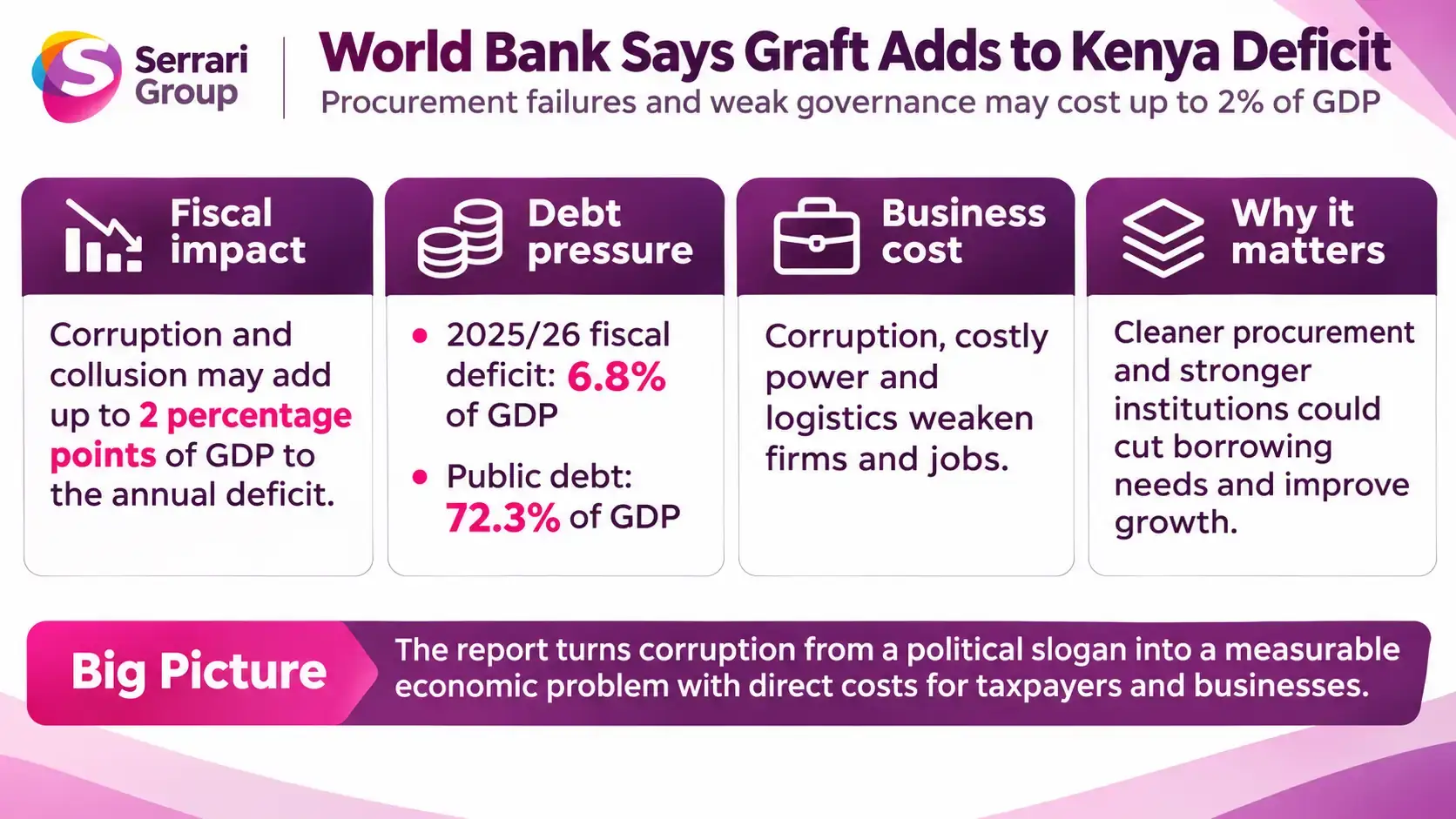
Corruption, collusion and weaknesses in public procurement and revenue collection may be adding as much as two percentage points of gross domestic product to Kenya’s annual fiscal deficit, according to the World Bank’s 34th Kenya Economic Update released on November 4, 2026. The assessment places a measurable economic cost on governance failures at a time when public debt is elevated, interest payments absorb about one-third of government revenue and businesses continue facing expensive services and unpredictable regulation.
The economic assessment suggests that improving governance is not merely a question of prosecuting corruption. It is central to reducing the need for borrowing, improving electricity and logistics costs, attracting investment and creating better-paying employment. However, estimates of possible improvements by 2035 are modelled scenarios, not guarantees that reforms will deliver particular amounts of money or specific job numbers.
Key Overview
- Fiscal damage: Governance weaknesses are estimated to contribute up to two percentage points of GDP to the annual budget deficit, through inefficient spending and revenue collection.
- Borrowing pressure: The 2025/26 fiscal deficit reached 6.8% of GDP against a target of 4.7%, while public debt stood at 72.3% of GDP in August 2026.
- Interest burden: Debt interest consumes around one-third of government revenue, limiting space for public services and development.
- Businesses affected: Some 39% of surveyed firms identified corruption as a major constraint; among medium-sized firms, 48% reported needing to give gifts to get things done.
- Growth potential: Moderate anti-corruption reforms could raise GDP by approximately 8.7% by 2035 against a no-reform baseline; more ambitious scenarios could deliver larger gains.
- Employment opportunity: Strong reforms could support up to 7.7 million additional and better jobs under the report’s modelling, rather than through an immediate hiring programme.
- Reform priorities: Transparent procurement, disclosure of beneficial ownership, improved tax administration and fewer opportunities for discretionary bribery feature prominently.
Why Procurement and Corruption Are Widening Kenya’s Deficit
The latest economic findings put governance at the centre of Kenya’s fiscal problem. When public agencies pay more than necessary for goods and services, approve poorly justified contracts or fail to collect revenue owed, the government must either cut other spending or find money to finance the difference.
Procurement is especially important because it converts budget allocations into actual infrastructure, medicines, equipment and public services. Weak competition can inflate contract prices. Hidden interests and collusion can reduce the number of credible bidders. Poor contract management can result in delayed projects, costly variations or payment for work that delivers less than expected.
The estimate of two percentage points of GDP refers to the contribution of corruption and collusion to fiscal deficits through spending and revenue channels. It should not be reported as proof that exactly 2% of GDP has been stolen or is recoverable immediately. Some losses involve higher prices, missed revenues and economic inefficiencies that may be difficult to identify in individual transactions.
The distinction matters because reform must address how decisions are made, contracts are awarded and results are monitored. Recovering stolen funds is important, but future losses will persist unless systems make collusion and excessive discretion harder.
Why the Estimate Matters for Kenya’s Public Debt
The governance findings arrive when Kenya has limited room to absorb additional borrowing costs. The country’s fiscal deficit for the last financial year reached 6.8% of GDP, compared with a 4.7% target, while the public debt ratio was reported at 72.3% in August 2026. Interest payments already claim roughly a third of revenue.
A larger deficit requires additional financing or a drawdown of available government resources. Borrowing to cover waste does not automatically create the productive assets that might generate future tax revenue. Over time, this can produce a damaging cycle: governance failures increase deficits, new debt raises interest obligations, and debt service crowds out the spending needed to expand economic opportunity.
This is why a more efficient public sector could complement fiscal consolidation. If the government receives better value from existing allocations and collects taxes already owed, it may reduce pressure to introduce new taxes or cut essential services. But savings depend on implementation; a modelled potential gain does not translate into an immediately available budget allocation.
The pressure is particularly significant after public resistance to tax increases and continued demands for better services. Improving spending credibility can help rebuild confidence that taxpayers’ contributions are used for their stated purposes.
Why Electricity and Transport Costs Are Part of the Story
The report extends the economic consequences of weak governance beyond national accounts. It identifies electricity, logistics and land administration as major areas in which opaque agreements, repeated inspections and integrity problems can raise the cost of doing business.
Power supply illustrates the mechanism. Electricity tariffs can reflect generation contracts, capacity-payment arrangements, transmission and distribution costs, taxes and other charges. If procurement limits competition or commits the country to expensive long-term terms, businesses and households may face higher costs. However, not every high electricity charge is evidence of corruption, and the report does not establish that the full cost of an individual household’s electricity tokens results from a particular improper contract.
The longstanding debate over private power-purchase agreements makes beneficial-ownership transparency relevant. Parliamentary consideration of energy contracting reforms has included proposals requiring disclosure of the real owners of power-generating companies and greater scrutiny before electricity is purchased. These proposals are part of a legislative discussion, not evidence that every independent power producer has engaged in wrongdoing.
Similar problems can arise in transport, port services and land administration. Delays and unofficial payments create uncertainty for importers, exporters and developers. Those costs can be passed through to consumers, reducing the competitiveness of Kenyan products and discouraging investment in job-creating sectors.
How Corruption Restricts Business Growth and Employment
Businesses face an additional cost when approvals, inspections or access to government services depend on unofficial payments. According to the governance assessment, 39% of firms regarded corruption as a major constraint. Among medium-sized enterprises, 48% reported a need to give gifts to complete administrative processes.
These figures matter because medium-sized firms are often large enough to expand hiring but still lack the influence or resources to absorb administrative obstacles. Uncertain approvals can delay factories, raise working-capital needs and deter investment. Companies that compete fairly may lose contracts to rivals benefiting from privileged access.
Informal workers can also be exposed to repeated inspections, threats and demands for bribes, directly reducing already modest earnings. The report found that 83.8% of jobs remained informal, illustrating the scale of the challenge of moving workers towards more secure and productive employment.
Reducing corruption therefore has a potential labour-market benefit beyond government finances. Fairer regulation and more predictable licensing can make it easier for productive firms to expand, formalise operations and hire workers. But the transition will also require finance, skills, reliable infrastructure and sustained private-sector demand.
Context is everything. Stay ahead of shifting trends with today’s market updates, and uncover emerging opportunities using the Serrari Group Market Index and Marketplace. Then, take control of your own financial future by exploring our Money & Life Reset Transformation Blueprint ™ to build stronger habits, create better systems, and design a path toward lasting wealth.
What the 8.7% Growth and 7.7 Million Jobs Estimates Mean
The report assesses how different improvements in governance might influence economic outcomes by 2035. One moderate reform scenario suggests that GDP could be 8.7% higher than under a no-reform baseline, while a stronger reform path has been reported as yielding gains of about 22.3% against the baseline.
These are differences in the projected level of economic output in 2035, not additions to Kenya’s annual GDP growth rate. A country that produces more in 2035 than it otherwise would have done does not necessarily experience an immediate one-year surge of the same magnitude.
The modelling also indicates that ambitious reforms could support as many as 7.7 million additional and better jobs, alongside higher household consumption and a lower public-debt ratio than in the baseline scenario. The figure should be understood as a potential economy-wide employment outcome, not a promise that the government will directly employ 7.7 million people.
The channels are nevertheless significant: lower business costs can support investment, greater investment can improve productivity and hiring, and stronger public finances can protect services that contribute to household welfare. Whether those outcomes materialise depends on the scope, pace and credibility of implementation.
What the Government Says It Is Doing
The government has pointed to procurement digitisation, conflict-of-interest rules and improvements in contractor payment practices as part of its reform response. Earlier in 2026, a governance-focused financing programme supported measures intended to strengthen accountability, public financial management and social protection.
Such measures offer mechanisms for reducing discretion, but legislation and computer systems do not by themselves guarantee integrity. Electronic procurement can preserve an audit trail, yet officials still need to verify specifications, prevent bid-rigging, publish awards and sanction misconduct. Beneficial-ownership records are useful only when authorities can test the identity of actual controllers and act on conflicts of interest.
Treasury officials have also pledged stronger spending discipline while preparing the next budget. Their ability to demonstrate improvement will depend on independently assessable results: more competitive contracts, fewer unexplained project variations, more reliable payments and clearer disclosure of public expenditure.
Why the Findings Matter Ahead of the 2027 Election
Governance and public spending are likely to feature in Kenya’s political debates ahead of the August 2027 general election. Politicians have offered varying estimates of corruption losses and proposed reforms to public contracting, particularly in energy.
However, political allegations should be kept separate from the findings of an economic study. An estimate that weak governance widens the deficit does not independently substantiate a particular politician’s claim that a specified amount is stolen from the budget. Nor can the report be used as proof of wrongdoing by named individuals without supporting investigative evidence.
Its deeper contribution is to make the public debate testable. Parties can be assessed on whether their proposals would increase contract transparency, improve revenue administration, reduce unnecessary inspections and improve value for money. Campaign promises can then be compared with measurable outcomes rather than relying solely on competing accusations.
Outlook: Better Governance Is an Economic Reform
Kenya’s economy expanded by 5.2% in the first half of 2026, but the World Bank expects full-year growth of 4.6% as momentum moderates. The resilience of output and foreign-exchange buffers provides a foundation, yet the fiscal deficit, public debt and predominance of informal employment reveal how much work remains.
The governance findings suggest that improving institutions could help unlock growth without depending entirely on higher taxation or additional borrowing. That opportunity is especially relevant when interest expenses already consume scarce public revenue and private firms need predictable operating conditions.
For households, the test will be whether public money produces better services and whether more competitive electricity, transport and business conditions translate into lower costs and stronger earnings. For investors, it will be whether procurement, licensing and tax administration become sufficiently predictable to justify long-term commitments.
The central question is no longer only how much money Kenya can raise, but how much economic value it can secure from each shilling already available. Cutting governance-related waste is therefore not simply an anti-corruption slogan: it is a potential route towards lower borrowing needs, more productive investment and better jobs, provided the reforms are implemented and independently measured.
Sources: World Bank / Reuters / The Star / Parliament of Kenya / Kenya News Agency
Your financial future isn’t something you wait for—it’s something you build.
The real question is: when do you begin?
Move beyond simply staying informed.
Navigate the markets with clarity—track trends through the Serrari Group Market Index, uncover opportunities in the Serrari Marketplace, and build practical knowledge with our Curated Wealth Builder Platform.
Stay connected to what truly matters.
Get daily insights on macro trends and financial movements across Kenya, Africa, and global markets—delivered through the Serrari Newsletter.
Growth opens doors.
Advance your career through professional programs including ACCA, HESI A2, ATI TEAS 7 , HESI EXIT , NCLEX – RN and NCLEX – PN, Financial Literacy!🌟—designed to move you forward with confidence.
See where money is flowing—clearly and in real time.
Track Money Market Funds, Treasury Bills, Treasury Bonds, Green Bonds, and Fixed Deposits, alongside global and African indexes, key economic indicators, and the evolving Crypto and stablecoin landscape—all within Serrari’s Market Index.