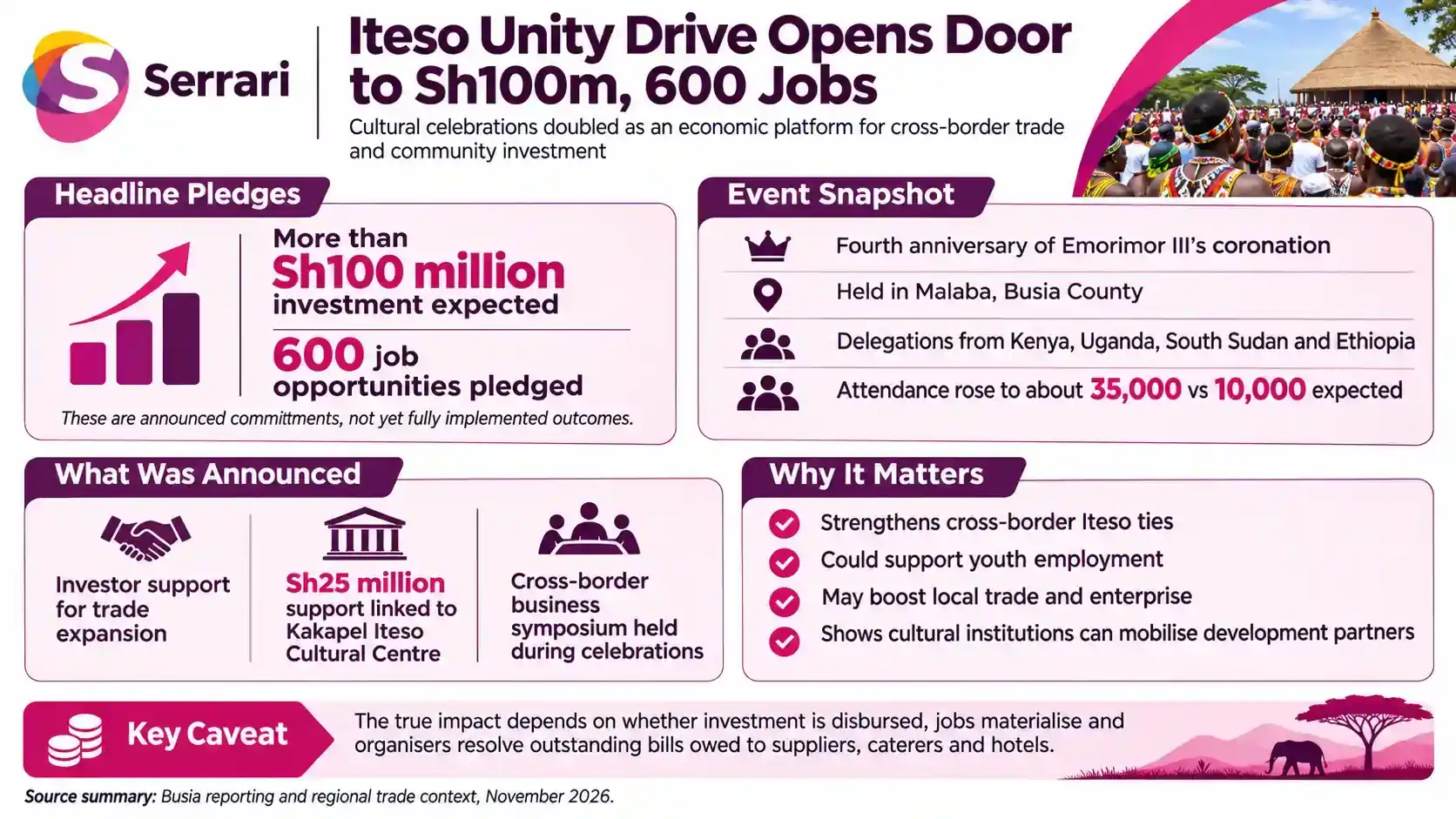
The Iteso community’s cultural unity initiative has attracted a proposed investment exceeding Sh100 million and pledges of 600 employment opportunities, highlighting the growing potential of cultural organisations to mobilise economic development and strengthen cross-border trade between Kenya and Uganda.
The commitments emerged from the fourth coronation anniversary of Iteso cultural leader Emorimor III, His Highness Papa Sande Emolot, held from October 29 to 31, 2026, at Amagoro Comprehensive School in Malaba, Busia County.
The celebrations brought together Iteso communities from Kenya, Uganda, South Sudan and Ethiopia, with organisers positioning the event as a platform for economic cooperation, investment mobilisation and regional integration.
Planning committee vice chairman Dr Robert Oopat said an investor had expressed commitment to inject more than Sh100 million into activities intended to expand trade, while additional employment opportunities were pledged for young people at facilities associated with Mombasa and Tororo Cement.
The gathering also helped mobilise support for the Kakapel Iteso Cultural Centre, a long-delayed community infrastructure project whose completion organisers say has been supported by a Sh25 million contribution.
However, the economic significance of these announcements will depend on whether the investment commitments translate into actual capital deployment, operational businesses and sustainable employment opportunities.
Key Overview
- Sh100 million investment commitment: Organisers announced that an investor is expected to inject more than Sh100 million into initiatives supporting trade and economic activity in the Teso region.
- 600 employment opportunities pledged: An investor committed to facilitating 600 jobs for Teso youths at facilities in Mombasa and Tororo Cement, although recruitment and employment terms have not been independently confirmed.
- Cross-border cultural cooperation: The three-day celebrations brought together Iteso communities from Kenya, Uganda, South Sudan and Ethiopia to strengthen cultural unity and commercial relationships.
- Sh25 million cultural-centre support: Organisers reported that investor financing had helped advance the Kakapel Iteso Cultural Centre, following years of construction delays.
- 35,000 participants: Attendance reportedly exceeded the original expectation of 10,000 visitors, demonstrating substantial community participation.
- Regional trade opportunities: The initiative comes as Kenya and Uganda work to address trade barriers and improve the movement of goods through Malaba and Busia.
- Outstanding event obligations: Despite the economic commitments, organisers disclosed unpaid bills owed to service providers involved in the celebrations.
- Investment delivery remains critical: The next challenge is converting announcements into measurable investment, employment and lasting economic benefits for local communities.
How the Iteso Cultural Celebrations Became an Investment Platform
The fourth anniversary of the coronation of Iteso cultural leader Papa Sande Emolot has created fresh expectations for economic development in western Kenya following announcements of potential investment and employment opportunities.
The celebrations, held between October 29 and 31, 2026, attracted community members, cultural representatives, entrepreneurs and visitors from several East African countries.
Although primarily organised to commemorate the cultural leader’s coronation, the gathering also incorporated discussions on economic cooperation, regional trade and investment opportunities.
According to the announcements following the celebrations, planning committee vice chairman Dr Robert Oopat said an economic symposium had been organised to showcase investment opportunities in the Teso region.
He disclosed that an investor had been secured and was expected to commit more than Sh100 million toward activities intended to stimulate trade.
The announcement reflects an effort to position cultural institutions as platforms for attracting private investment rather than limiting their activities to traditional ceremonies.
For communities situated along international borders, such cooperation can help connect entrepreneurs, investors and business networks that operate across different national markets.
The Iteso community has a substantial presence in Kenya and Uganda, making cross-border cultural relationships potentially relevant to commercial cooperation.
However, the identity of the proposed investor, the structure of the Sh100 million commitment, the expected investment sectors and the timetable for releasing funds were not established in the reported announcement.
The distinction matters because an investment pledge does not automatically represent capital already received by businesses or communities.
The economic impact will depend on the financing arrangements, projects selected and ability of the proposed investments to generate sustainable commercial activity.
Why Cultural Unity Matters for Cross-Border Trade
The economic significance of the celebrations extends beyond the announced investment amount.
Communities with longstanding cultural and family relationships across national boundaries can provide informal networks that support trade, business partnerships and the movement of commercial information.
For the Iteso community, these relationships are particularly relevant because of the region’s proximity to major Kenya-Uganda border crossings.
Malaba is an important transit point along the Northern Corridor, connecting Kenya’s transport infrastructure and the Port of Mombasa with Uganda and other inland East African markets.
The border supports both large-scale commercial transportation and smaller businesses involved in trading, transport, hospitality and other services.
According to regional border infrastructure plans, improvements to border facilities are intended to reduce congestion, streamline customs procedures and strengthen the movement of goods between Kenya and Uganda.
These initiatives demonstrate why additional investment in the Teso region could generate commercial benefits.
Businesses operating near major trade routes may benefit from access to multiple markets, particularly where improved infrastructure reduces transportation costs and border delays.
However, cultural connections alone cannot eliminate the regulatory and logistical challenges affecting cross-border commerce.
Traders must still navigate customs procedures, product standards, financing constraints and transport costs.
For the Iteso initiative to produce lasting economic benefits, the relationships established during the celebrations would need to support practical business arrangements.
These could include partnerships between traders, better market access for local producers, shared commercial infrastructure and stronger networks connecting investors with viable businesses.
The economic symposium therefore represents an initial opportunity to connect cultural cooperation with market development, rather than proof that major commercial expansion has already occurred.
Sh100 Million Investment Could Support Local Businesses
The proposed investment exceeding Sh100 million could create opportunities for businesses in the Teso region if it is directed toward commercially viable projects.
Oopat indicated that organisers were exploring opportunities to expand trade and develop export markets for products originating from the region.
Such initiatives could be particularly relevant to agricultural producers, traders and small businesses seeking access to larger markets.
Western Kenya’s proximity to Uganda creates opportunities for businesses involved in agricultural production, distribution, transport and services supporting regional trade.
Investment in aggregation facilities, storage infrastructure, processing activities or market distribution networks could potentially improve the commercial value of locally produced goods.
However, the announced investment has not been publicly broken down by sector, project or beneficiary.
It would therefore be premature to conclude that specific industries have already secured allocations from the proposed financing.
The most important consideration is how the capital will be deployed.
Investment that supports productive businesses may generate benefits beyond the initial amount committed by creating demand for suppliers, transportation services and local labour.
For example, a business expanding its distribution network could generate additional income opportunities for transport operators and traders.
Similarly, investment in processing facilities could allow producers to sell goods with higher commercial value rather than relying exclusively on unprocessed products.
The scale of these benefits would depend on project profitability, market demand and the capacity of local businesses to participate.
The proposed Sh100 million commitment should therefore be evaluated not only by its headline value but also by the quality of the projects it eventually finances.
What the 600 Job Pledges Mean for Teso Youths
One of the most significant announcements from the celebrations was a pledge to facilitate employment opportunities for 600 young people from the Teso region.
According to organisers, the opportunities are expected to be associated with facilities in Mombasa and Tororo Cement.
The announcement could be particularly important for young people seeking formal employment and industrial work opportunities.
Employment in manufacturing and related industries can provide income, technical experience and opportunities to develop transferable skills.
For communities where employment opportunities may be limited, access to established industrial facilities can offer an alternative to dependence on informal trade or small-scale self-employment.
However, the pledge should be distinguished from completed recruitment.
The available reporting does not establish whether the 600 positions are newly created jobs, existing vacancies or opportunities to be filled through future recruitment arrangements.
It also does not specify job categories, wages, eligibility requirements or the expected recruitment schedule.
These details are important for assessing the likely economic impact.
If the opportunities materialise, the benefits could extend beyond the individuals recruited.
Workers may support households through regular income, while expenditure on housing, food, transport and other services could generate additional economic activity.
Employment outside the Teso region could also increase household income through money sent back to families.
Nevertheless, the ultimate impact will depend on the number of people actually employed, the duration and quality of the jobs, and whether workers receive adequate compensation and protection.
Transparent recruitment procedures would also be essential to ensuring that opportunities are distributed fairly among eligible applicants.
Kakapel Cultural Centre Receives Fresh Financial Support
The celebrations also brought renewed attention to the Kakapel Iteso Cultural Centre, a project intended to support cultural heritage and community activities.
Oopat reported that an investor had supported the project’s completion through a Sh25 million contribution, helping address longstanding construction delays.
The development follows earlier efforts by the Busia County Government and private-sector partners to revive construction.
According to an October 2026 construction update, work on the centre resumed after the project had stalled for more than a decade.
The earlier project had been abandoned by a contractor after initial construction works, leading to a prolonged period of inactivity.
County officials subsequently facilitated the resumption of construction through cooperation involving Mombasa Cement and Tororo Cement.
The latest statement from organisers indicates that additional support has helped advance the project, although independent confirmation of the final construction status and expenditure was not available in the reviewed material.
The centre’s potential economic contribution extends beyond preserving cultural traditions.
A functioning cultural facility could provide space for community gatherings, exhibitions, educational programmes and cultural events.
It could also support tourism-related activities, particularly if connected with other attractions and commercial services in Busia County.
However, sustaining the facility would require effective management, maintenance funding and a programme of activities capable of attracting continued participation.
The long construction delay illustrates another important lesson: announcing infrastructure projects is easier than completing and operating them successfully.
The economic value of the centre will ultimately depend on how effectively the facility is used and maintained.
Context is everything. Stay ahead of shifting trends with today’s market updates, and uncover emerging opportunities using the Serrari Group Market Index and Marketplace. Then, take control of your own financial future by exploring our Money & Life Reset Transformation Blueprint ™ to build stronger habits, create better systems, and design a path toward lasting wealth.
Kenya-Uganda Trade Reforms Create a Wider Opportunity
The Iteso investment initiative comes amid broader efforts by Kenya and Uganda to strengthen bilateral trade and reduce barriers affecting businesses operating across their shared border.
In August 2025, the two governments reached an agreement on eliminating trade barriers, including measures intended to address discriminatory charges, congestion and infrastructure challenges.
The agreement reflected concerns that administrative obstacles and transport delays were increasing the cost of doing business.
Further bilateral trade discussions in November 2025 focused on improving cooperation between border agencies and strengthening operations at the Malaba One Stop Border Post.
These initiatives are relevant because investment opportunities in the Teso region depend partly on the efficiency of cross-border movement.
Even where businesses have access to capital and customers, delayed customs clearance and transport disruptions can weaken profitability.
Recent trade figures demonstrate the economic importance of the corridor.
The Malaba border revenue performance showed collections exceeding Sh11 billion during the 2025/2026 financial year.
Revenue at the border increased from approximately Sh1.49 billion in FY2014/2015 to Sh11.04 billion in FY2025/2026.
These collections are government revenue associated with border operations, not the total value of trade or income earned by residents.
Nevertheless, the increase illustrates the expanding scale of formal commercial activity through the crossing.
For communities living around Malaba and the wider Teso region, stronger trade flows can create demand for transportation, warehousing, accommodation, food services and other supporting businesses.
The challenge is ensuring that local enterprises have the financial resources, infrastructure and commercial connections required to benefit from these opportunities.
The investment discussions initiated during the cultural celebrations could contribute to this objective if they result in practical business partnerships.
Regional Infrastructure Could Strengthen Investment Prospects
Transport infrastructure remains a central factor influencing the economic competitiveness of border communities.
The East African Community has supported plans to upgrade the Lwakhakha border crossing as an alternative route intended to reduce congestion at Malaba and Busia.
The proposed border upgrade includes measures to improve customs coordination and supporting road infrastructure between Kenya and Uganda.
Improved transport connections could reduce delivery times and expand access to markets for businesses operating in western Kenya.
These improvements could be especially beneficial to traders dealing in time-sensitive products, including agricultural commodities.
However, infrastructure expansion must be accompanied by effective border administration and commercial services.
Road improvements alone may not resolve delays caused by inadequate customs systems, documentation requirements or inconsistent enforcement of regulations.
The relationship between infrastructure and private investment is therefore complementary.
Better roads and border facilities can make commercial projects more attractive, while private investment can create additional demand for transport and logistics services.
For the Iteso community, the opportunity lies in connecting the proposed investment initiatives with these broader regional developments.
Large Turnout Demonstrates Community Support but Raises Costs
Organisers reported that approximately 35,000 people attended the three-day celebrations, substantially exceeding the initial expectation of 10,000 visitors.
The reported turnout illustrates the cultural significance of the anniversary and the capacity of community institutions to mobilise large gatherings across national borders.
Such events can generate temporary business opportunities for hotels, transport providers, caterers, traders and other service operators.
However, the unexpected attendance also created financial and logistical challenges.
Oopat acknowledged that organisers had to seek additional assistance to accommodate and feed visitors.
The committee also faced questions over the use of 19 bulls donated for the celebrations.
According to the organisers’ account of expenditure and donations, ten bulls were contributed by individuals and groups, while nine were provided by the cultural leader.
Organisers stated that the animals were used to feed participants and visiting delegations during different activities.
The committee also disclosed outstanding obligations to caterers, hotels, event organisers and young people who provided security services.
These unpaid bills highlight an important distinction between attracting investment commitments and maintaining sound financial management.
While the celebration generated expectations of future economic activity, the immediate event costs still require settlement.
For community development initiatives seeking private-sector partnerships, transparent financial reporting and timely payment of suppliers can help maintain confidence among businesses and contributors.
Why Cultural Institutions Are Increasingly Relevant to Development
The Iteso initiative reflects an approach in which cultural organisations seek to contribute to development by mobilising networks, strengthening community relationships and connecting entrepreneurs with potential investors.
Traditional institutions can provide a sense of shared identity and social trust, which may help bring together people from different geographical and commercial backgrounds.
In cross-border communities, these relationships can be particularly valuable because cultural connections often extend beyond national administrative boundaries.
However, cultural unity does not automatically produce investment or sustainable economic growth.
Successful development initiatives require viable businesses, sound financial management, effective institutions and access to markets.
Cultural organisations may be well positioned to convene stakeholders, but commercial projects still need professional execution and accountability.
The Iteso celebrations demonstrate how cultural events can create opportunities for economic dialogue, while the investment and employment pledges illustrate the potential benefits of those connections.
Their longer-term significance will depend on whether organisers establish mechanisms to follow up on commitments and measure results.
The Bigger Picture: Turning Regional Identity Into Economic Value
The Iteso unity initiative comes at a time when regional integration is becoming increasingly important for East African economies.
Trade agreements and infrastructure investments are intended to reduce barriers between countries, but local communities must still develop the capacity to participate effectively in expanding markets.
For border communities, economic integration can create opportunities that extend beyond large companies and established traders.
Small enterprises may benefit from wider markets, additional customers and stronger supply relationships.
However, these benefits depend on access to financing, market information and supportive infrastructure.
The Iteso community’s cross-border presence creates an opportunity to build relationships that facilitate business cooperation between Kenya and Uganda.
The proposed Sh100 million investment, employment pledges and cultural-centre support could become meaningful elements of a broader economic development strategy.
Yet the announcements should be assessed against measurable outcomes rather than expectations alone.
The identity of participating investors, confirmation of disbursements, actual employment numbers and performance of supported businesses will be important indicators of progress.
Similarly, the cultural centre’s value will depend on its operational use and capacity to support continued community and economic activity.
The broader lesson is that cultural institutions can help initiate development partnerships, but sustainable economic benefits require structured investment, implementation and transparent oversight.
Conclusion
The fourth coronation anniversary of Iteso cultural leader Papa Sande Emolot has expanded beyond its ceremonial purpose, creating a platform for economic cooperation and renewed expectations of investment in the Teso region.
The proposed investment exceeding Sh100 million, pledges of 600 employment opportunities and support for the Kakapel Cultural Centre demonstrate the potential of community networks to attract business interest and mobilise development partnerships.
The timing is significant as Kenya and Uganda pursue measures to improve border efficiency, reduce trade barriers and strengthen economic integration.
For communities around Malaba and the wider Teso region, these developments could create opportunities for businesses and young workers to participate more actively in regional commerce.
However, the announced commitments remain subject to implementation, and organisers must also address outstanding financial obligations associated with the celebrations.
The true economic significance of the Iteso unity initiative will not be determined by the number of visitors or the value of investment pledges, but by how much capital is actually deployed, how many jobs materialise and whether local businesses achieve sustained growth.
If the commitments are implemented transparently and supported by effective regional trade cooperation, the initiative could demonstrate how cultural unity can contribute to meaningful economic development beyond traditional celebrations.
Sources: The Star / Kenya News Agency / East African Community / Kenya State Department for Trade / Uganda Revenue Authority / Government Advertising Agency / Uganda Ministry of Trade, Industry and Cooperatives
Your financial future isn’t something you wait for—it’s something you build.
The real question is: when do you begin?
Move beyond simply staying informed.
Navigate the markets with clarity—track trends through the Serrari Group Market Index, uncover opportunities in the Serrari Marketplace, and build practical knowledge with our Curated Wealth Builder Platform.
Stay connected to what truly matters.
Get daily insights on macro trends and financial movements across Kenya, Africa, and global markets—delivered through the Serrari Newsletter.
Growth opens doors.
Advance your career through professional programs including ACCA, HESI A2, ATI TEAS 7 , HESI EXIT , NCLEX – RN and NCLEX – PN, Financial Literacy!🌟—designed to move you forward with confidence.
See where money is flowing—clearly and in real time.
Track Money Market Funds, Treasury Bills, Treasury Bonds, Green Bonds, and Fixed Deposits, alongside global and African indexes, key economic indicators, and the evolving Crypto and stablecoin landscape—all within Serrari’s Market Index.