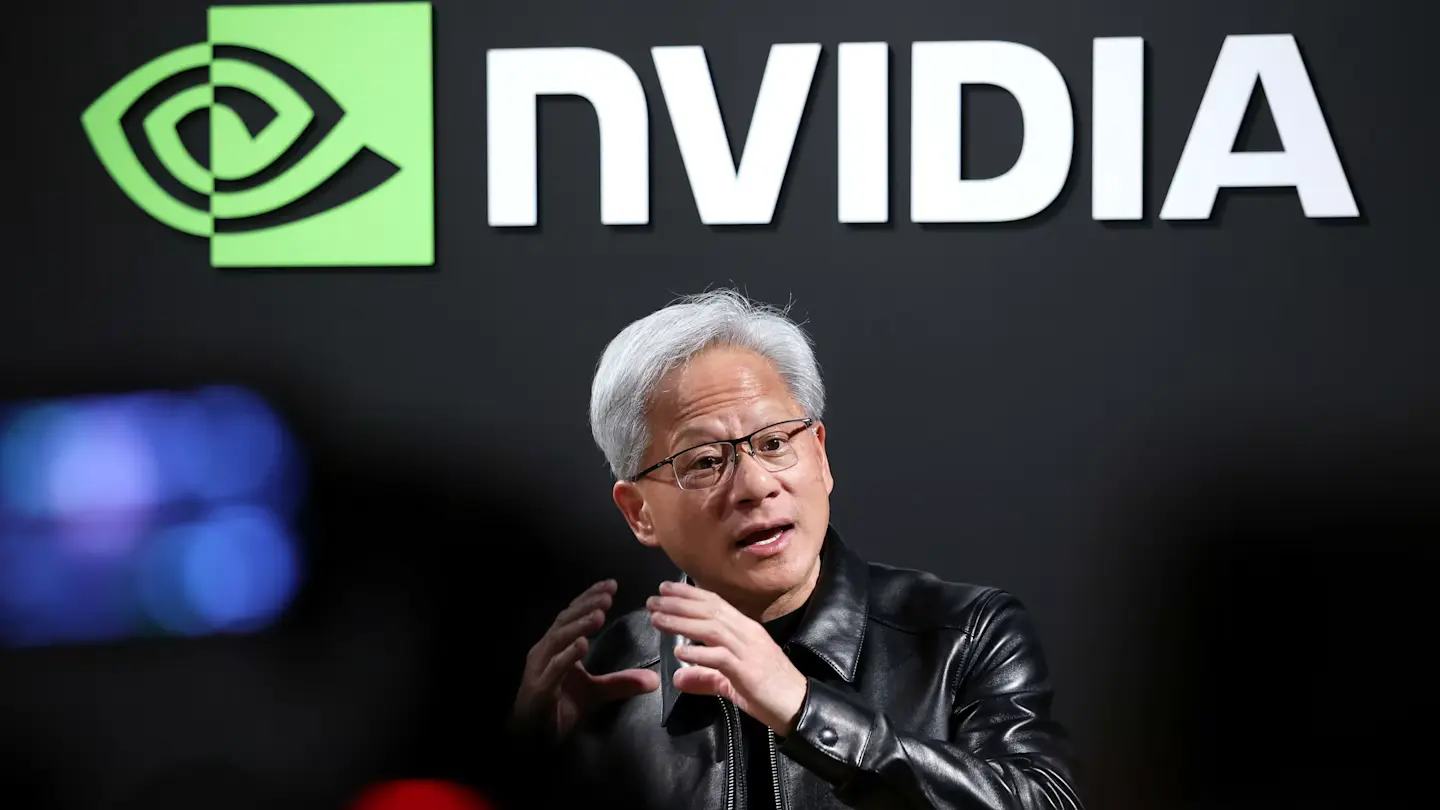
Nvidia shares traded lower outside regular U.S. market hours on November 9 after its board announced an independent investigation into reports that chief executive Jensen Huang may have been targeted by a foreign intelligence effort. Huang separately acknowledged being unfaithful to his wife, but neither his admission nor the board’s announcement establishes that he disclosed company secrets or compromised national security.
The episode matters because Nvidia sits at the intersection of the global AI investment boom, U.S.-China technology competition and the market’s confidence in a highly influential founder-CEO. The central question is whether the inquiry reveals an actual security failure or remains a serious but contained governance issue.
Key Overview
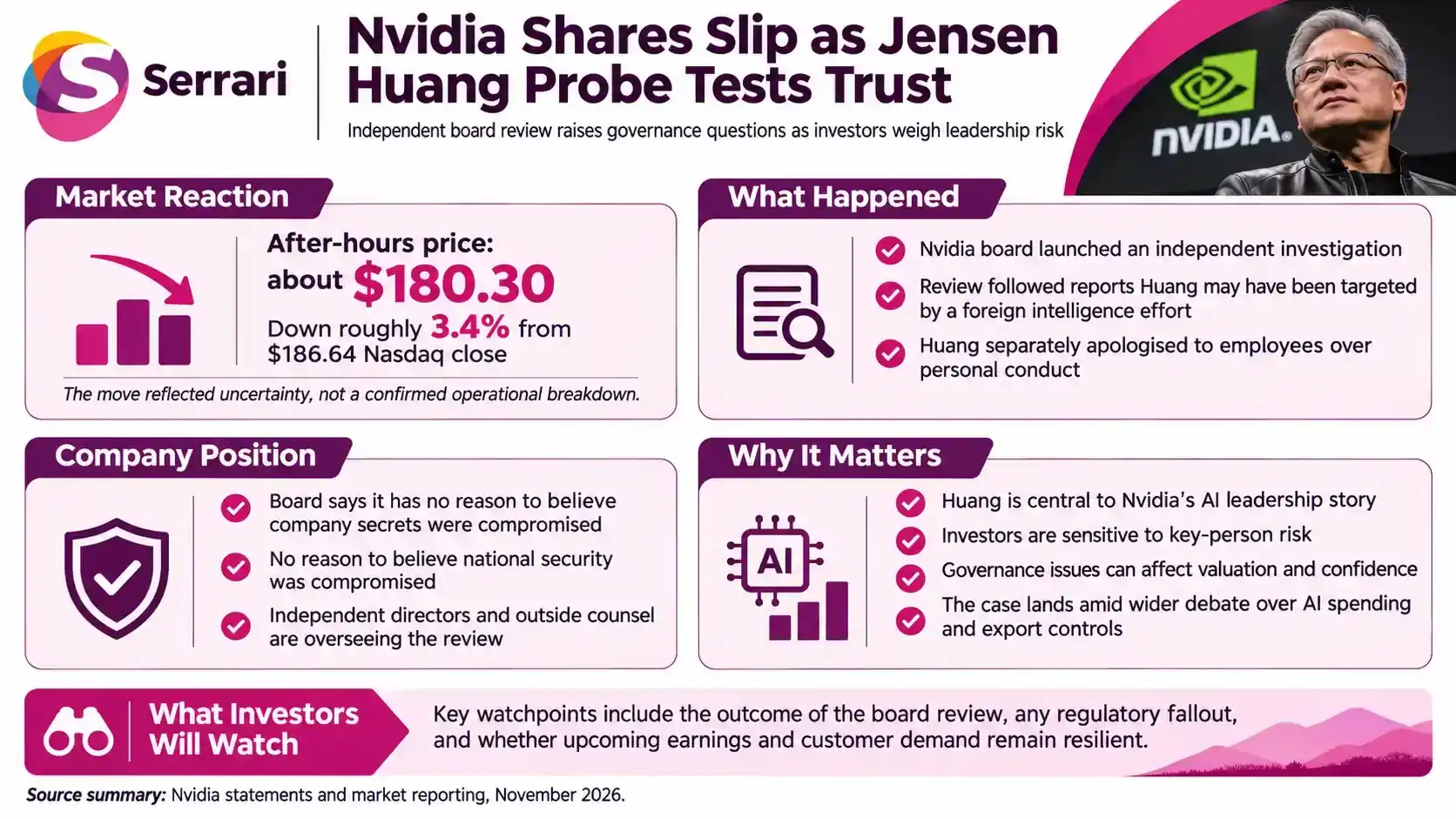
- Market reaction: After-hours trading indicated Nvidia at around $180.30, approximately 3.4% below its previous Nasdaq close of $186.64; these indications were not a regular-session closing price.
- Independent investigation: Nvidia’s board appointed independent directors and external legal counsel to examine reports of a possible foreign intelligence effort targeting Huang.
- No established breach: The company says it has no reason to believe national security or its confidential information was compromised.
- Leadership exposure: Huang’s central role in Nvidia’s strategy and customer relationships makes uncertainty around him relevant to investors.
- Broader stakes: Export controls, AI infrastructure spending and Nvidia’s Asian chip supply chain could magnify the consequences if new facts emerge.
Why Nvidia’s Board Launched the Investigation
Nvidia’s board announced on November 8 that it was opening an independent investigation following reporting that founder and chief executive Jensen Huang may have been targeted by a foreign intelligence operation. The board said independent directors, supported by outside counsel, would oversee the work.
That structure matters: the subject of the reporting is also the executive most closely associated with the company’s strategic direction, so ordinary internal reporting lines would not offer the same appearance of independence.
The inquiry followed allegations concerning Huang’s reported relationship with Alice Huang, a former executive at Singapore-based Megaspeed. According to reporting on the allegations, U.S. authorities had examined her alleged connections to Chinese intelligence, while Megaspeed separately faced scrutiny over suspicions involving access to advanced chips restricted from China.
Those allegations remain distinct from any finding about Jensen Huang’s conduct or disclosure of information. The existence of an investigation is not evidence that espionage succeeded.
Huang publicly acknowledged marital infidelity in a message to employees published on November 8. He apologised to his family and colleagues, accepted responsibility for his personal actions and pledged to cooperate with the board’s review.
His statement did not establish what information, if any, was exchanged with the woman named in reports. Nvidia’s board said it had no reason to believe its secrets or U.S. national security had been compromised and expressed confidence in Huang and the management team.
That distinction is central to the story. Personal misconduct may raise questions about judgement and leadership, but a national-security breach would present a different order of corporate, legal and regulatory risk.
The board’s task is to establish whether the reported relationship created an exploitable vulnerability, whether sensitive information was accessible and whether the company’s safeguards operated as intended.
Why Investors Marked Down Nvidia Shares
In early trading outside normal U.S. exchange hours, Nvidia was indicated at roughly $180.30 compared with Friday’s $186.64 Nasdaq close, a decline of about 3.4%, according to the November 9 market report.
The quoted levels came from alternative after-hours trading venues and perpetual-futures markets; they should not be confused with a subsequent official closing price.
The decline reflects a risk that is difficult to quantify immediately. Investors can model sales growth, gross margins and capital expenditure, but an unfolding investigation into a founder-CEO introduces uncertainty about leadership continuity, political scrutiny and management attention.
A small probability of a highly disruptive outcome can still alter how investors value a company, particularly when its shares already reflect expectations of substantial future growth.
It does not follow that a 3.4% move represents a market prediction that Huang will leave. That would be an unsupported inference.
Rather, the price reaction suggests investors were demanding some compensation for uncertainty before the investigation could establish the facts. Analysts quoted in the coverage also cautioned that leadership changes were far from inevitable.
This news arrived amid wider doubts about whether the enormous sums being committed to AI data centres will produce sufficient returns.
Nvidia’s operational performance has been exceptionally strong: its second-quarter fiscal 2027 results showed revenue of $96.2 billion, including $89.0 billion from data centres.
Such growth demonstrates the scale of demand, but it also raises the stakes. When investors expect sustained expansion, new governance uncertainty can add to existing concerns about customer spending and the durability of the AI investment cycle.
Context is everything. Stay ahead of shifting trends with today’s market updates, and uncover emerging opportunities using the Serrari Group Market Index and Marketplace. Then, take control of your own financial future by exploring our Money & Life Reset Transformation Blueprint ™ to build stronger habits, create better systems, and design a path toward lasting wealth.
Why National Security Is Part of a Corporate Governance Story
Nvidia is not an ordinary consumer-technology supplier. Its accelerators and networking products support AI models, cloud infrastructure and high-performance computing.
The possible transfer of sensitive information could therefore affect more than a company’s competitive position: advanced chips are embedded in Washington’s strategic competition with Beijing.
The United States has long restricted selected advanced semiconductor exports to China. In January 2026, the Commerce Department revised licensing rules to permit case-by-case review of certain products, including Nvidia’s H200, subject to security requirements.
The policy illustrates the balancing act facing regulators: supporting U.S. chipmakers’ commercial interests while limiting access to technologies considered strategically sensitive.
That regulatory setting explains why allegations involving a prominent chip executive and a customer-linked business contact have drawn exceptional attention.
The issue is not whether meeting overseas customers is improper; international commercial relationships are an essential part of the semiconductor business.
It is whether security controls around those relationships are robust enough to prevent the inadvertent release of protected technical, commercial or government-sensitive information.
Congress is also seeking answers. Senior Republican lawmakers requested a briefing from Huang for November 18 regarding the allegations and Nvidia’s safeguards.
Political scrutiny could outlast the immediate share-price move, especially if investigators identify gaps in disclosure practices or internal controls.
Conversely, a clear and credible review finding no compromise would help distinguish the allegations from a proven security incident.
Why Jensen Huang’s Role Raises the Stakes
Huang is not merely a hired executive. As Nvidia’s co-founder and longstanding chief executive, he has helped define the company’s technology roadmap, developer ecosystem, commercial relationships and position in AI computing.
His personal visibility is part of Nvidia’s investor narrative: customers and markets closely associate major platform launches and partnerships with his leadership.
That creates what investors call key-person risk.
A company can have capable engineers, substantial cash generation and deep customer relationships yet remain vulnerable to uncertainty about the individual who connects its strategy to partners and shareholders.
Even without a resignation, a prolonged inquiry could consume management time or complicate high-profile meetings, while potential succession questions could become more prominent.
But key-person risk should not be exaggerated into operational paralysis.
Nvidia’s development cycles, sales processes and supply-chain agreements are institutional activities involving thousands of employees and partners.
There is no verified evidence that the investigation has halted product shipments or derailed a launch.
The meaningful question is whether the board can safeguard business continuity while investigating a leader it publicly supports.
Why Asian Suppliers Have Not Reacted the Same Way
Nvidia relies on a broad Asian production network, including Taiwan’s TSMC and South Korean memory specialists Samsung Electronics and SK Hynix.
Yet the same November 9 reporting described gains of approximately 6.5%, 2.9% and 4.7%, respectively, for those suppliers, as regional AI-related shares rebounded from earlier selling.
The divergence is instructive. Investors were not necessarily interpreting the probe as evidence that AI chip orders had evaporated.
Nvidia faces a company-specific leadership and governance question, while its suppliers still benefit from demand across the broader semiconductor ecosystem.
South Korean officials also said they did not expect disruption to contracted Nvidia graphics-processor deliveries.
The investigation nonetheless created immediate scheduling consequences. Nvidia executive Madison Huang reportedly cancelled planned engagements with South Korean businesses, while the company’s AI Day Seoul event was expected to proceed.
A cancelled executive visit demonstrates how a governance crisis can interrupt relationship-building, but it does not by itself establish production problems or lost orders.
The potential spillover would grow if the investigation led to delayed strategic decisions, tighter export requirements or uncertainty over customer access to chips.
Those are scenarios to monitor, not outcomes that have already occurred.
What Comes Next for Nvidia and the AI Market
There are three distinct developments investors should follow.
First is the scope and outcome of the independent board review: whether it identifies any sensitive disclosures, control weaknesses or reason for disciplinary action.
Second is the response from U.S. authorities and lawmakers, whose concerns extend to export-control compliance and broader economic security.
Third is the company’s operating performance, which can show whether customer orders and AI infrastructure investment remain resilient despite the controversy.
Nvidia has scheduled its next quarterly results call for November 17, one day before the requested congressional briefing.
The proximity of those events could put financial performance and leadership accountability under simultaneous scrutiny.
Strong earnings would not settle a security investigation; equally, an investigation alone does not establish deterioration in chip demand.
The larger lesson reaches beyond Nvidia. As AI infrastructure becomes economically and strategically important, company governance is increasingly inseparable from national-security policy.
Boards of major technology suppliers must manage conventional shareholder interests alongside exposure to export restrictions, geopolitical pressure and the risk that executives become targets of influence or intelligence operations.
For shareholders, the immediate issue is uncertainty rather than a proven breach.
Nvidia’s board says it has no evidence so far that secrets were compromised and continues to back Huang.
The investigation will matter most if it changes that assessment, results in restrictions or disrupts the company’s ability to execute.
Until then, the prudent distinction is between verified corporate actions, reported allegations and possible future consequences.
That distinction is essential to understanding both the market reaction and the stakes for the global AI industry.
Sources: NVIDIA Investor Relations / NVIDIA Newsroom / Reuters / U.S. Bureau of Industry and Security / Global Banking & Finance Review
Your financial future isn’t something you wait for—it’s something you build.
The real question is: when do you begin?
Move beyond simply staying informed.
Navigate the markets with clarity—track trends through the Serrari Group Market Index, uncover opportunities in the Serrari Marketplace, and build practical knowledge with our Curated Wealth Builder Platform.
Stay connected to what truly matters.
Get daily insights on macro trends and financial movements across Kenya, Africa, and global markets—delivered through the Serrari Newsletter.
Growth opens doors.
Advance your career through professional programs including ACCA, HESI A2, ATI TEAS 7 , HESI EXIT , NCLEX – RN and NCLEX – PN, Financial Literacy!🌟—designed to move you forward with confidence.
See where money is flowing—clearly and in real time.
Track Money Market Funds, Treasury Bills, Treasury Bonds, Green Bonds, and Fixed Deposits, alongside global and African indexes, key economic indicators, and the evolving Crypto and stablecoin landscape—all within Serrari’s Market Index.