Uganda is preparing to issue its first sovereign green bond, potentially raising up to $500 million (about UGX 1.87 trillion) to finance climate-related projects. The move comes as the country faces an estimated UGX 85.8 trillion climate finance gap needed to meet its 2030 climate commitments.
Key Overview
- Target bond size: Up to $500 million, approximately UGX 1.87 trillion
- Climate finance requirement: $28.1 billion, approximately UGX 104.8 trillion
- Funding mobilised: $5.1 billion, approximately UGX 19 trillion
- Estimated funding gap: $23 billion, approximately UGX 85.8 trillion
- Currency: Planned local and foreign currency tranches
- EU support: Nearly €20 million, approximately UGX 87 billion
- Priority areas: Clean energy, water systems, climate-resilient infrastructure and drought-resistant agriculture
Uganda Prepares First Sovereign Green Bond
Uganda is preparing to issue its first sovereign green bond, with the government targeting up to $500 million (about Shs1.87 trillion), to finance projects that address the effects of climate change.
The planned issuance comes as Uganda faces a substantial funding shortfall in implementing its climate commitments by 2030. The country requires an estimated $28.1 billion (about Shs104.8 trillion) to implement its Nationally Determined Contributions (NDCs), but only $5.1 billion (about Shs19 trillion) has so far been mobilised, according to the Ministry of Water and Environment.
This leaves a funding gap of about $23 billion (Shs85.8 trillion), which the government says cannot be closed through public resources alone.
Dennis Muggaga, Head of the Climate Finance Unit at the Ministry of Finance, Planning and Economic Development, said the government has developed a Green Bond Framework and expects to finalise it by the end of August, paving the way for investor roadshows.
Muggaga said the planned bond will be divided into local and foreign currency tranches to attract both domestic banks and international investors.
“As a Ugandan, I’m not interested in holding a US dollar. I want it in my own currency,” Muggaga said, explaining the plan to offer a shilling-denominated option alongside a dollar tranche.
Green Bond to Finance Climate Projects
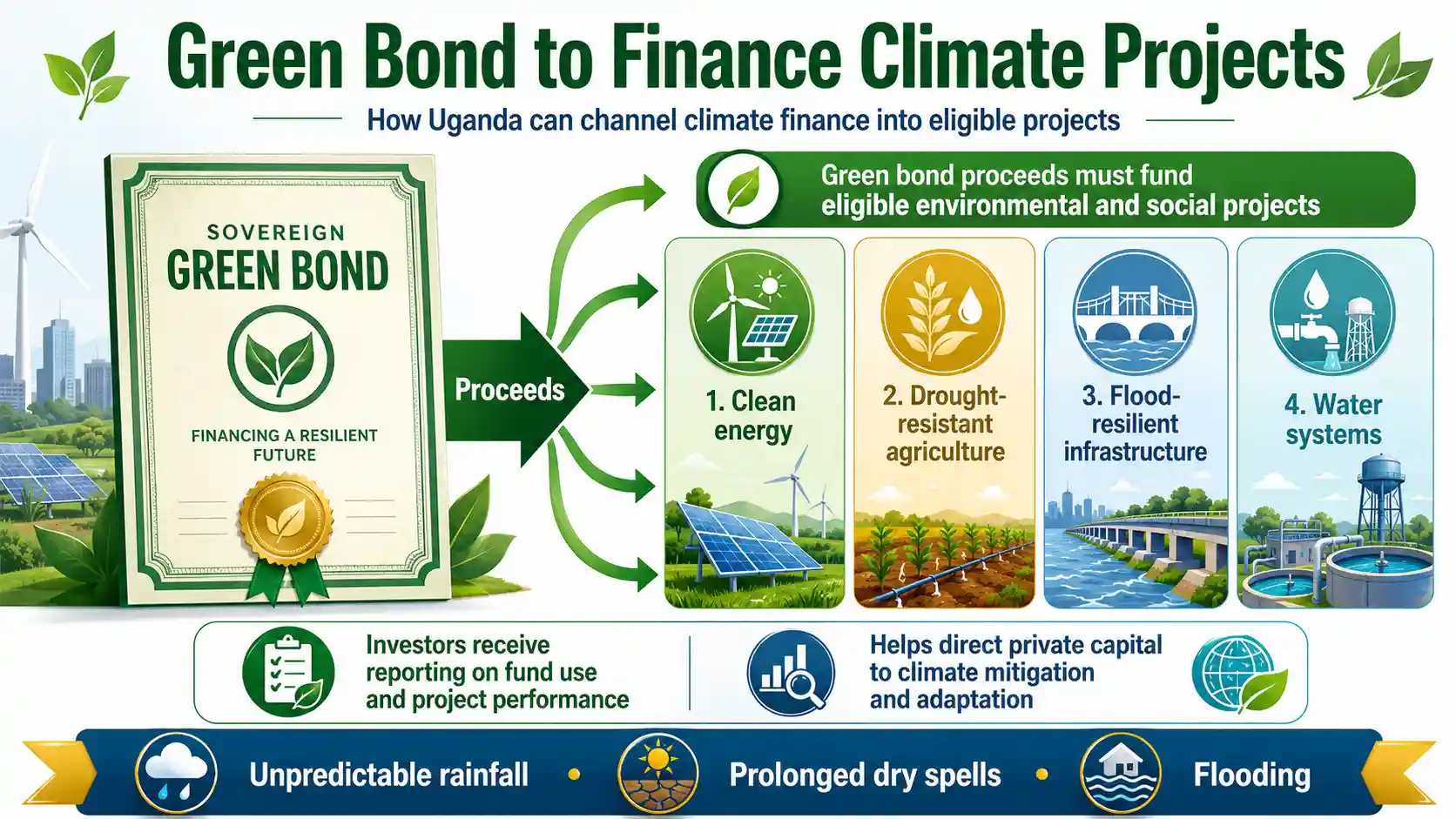
Unlike conventional Treasury bonds, whose proceeds go into the Consolidated Fund, proceeds from a green bond must be allocated to projects that meet specified environmental and social criteria.
The government will also be required to report to investors on how the funds are used and the performance of projects financed through the bond.
The planned issuance is therefore expected to provide Uganda with a mechanism for directing private capital toward projects linked to climate mitigation and adaptation.
Potential areas include clean energy, climate-resilient agriculture and flood-resistant infrastructure.
The initiative comes as Uganda faces increasingly unpredictable rainfall, prolonged dry spells, flooding and other effects associated with climate change.
EU Provides Support for Green Bond Issuance
The Ministry of Finance is working with the European Union under its Global Green Bond Initiative, which has committed nearly 20 million Euros (approximately 87 billion shillings), to support Uganda’s entry into the green bond market.
The funding is expected to help cover issuance costs and subsidise the bond’s coupon rate. Such a pricing advantage is commonly referred to as a “greenium” in green finance.
The EU also plans to purchase part of Uganda’s maiden green bond, potentially providing an anchor investor for the issuance and encouraging participation from other investors.
Christina Banuta, an EU delegation programme manager, said Uganda’s recent sustainable finance measures provide the foundation needed to enter both domestic and international green bond markets.
“These building blocks are a prerequisite to Uganda accessing the international and domestic green bond market,” she said at a validation workshop on the framework.
The support is intended to provide both financial and technical assistance as Uganda develops the framework and prepares for its first sovereign green bond.
Domestic Banks Targeted as Investors
Uganda is also bringing local commercial banks into the process. The banks already act as primary dealers for government securities and could use the green bond to diversify their portfolios while responding to growing environmental, social and governance (ESG) requirements.
The bond is expected to be tradable on the secondary market, giving investors an opportunity to buy and sell the securities after issuance.
Offering both local and foreign currency tranches could also broaden the investor base, allowing Uganda to target domestic institutions as well as international investors.
The government hopes this approach will help mobilise larger amounts of private capital for climate-related investment.
Context is everything. Stay ahead of shifting trends with today’s market updates, and uncover emerging opportunities using the Serrari Group Market Index and Marketplace. Then, take control of your own financial future by exploring our Money & Life Reset Transformation Blueprint ™ to build stronger habits, create better systems, and design a path toward lasting wealth.
Uganda Builds Sustainable Finance Framework
The planned green bond follows other measures introduced by Uganda over the past two years, including a National Green Taxonomy and a Climate Finance Strategy.
These measures are intended to establish clearer standards for sustainable investments, improve investor confidence and prepare the country for participation in domestic and international green finance markets.
The Green Bond Framework will provide the criteria for determining which projects qualify for financing through the issuance.
However, experts have warned that Uganda will need a credible pipeline of investment-ready projects capable of absorbing the funds raised.
The availability of financing alone may not be sufficient if projects are not sufficiently developed to attract investment and begin implementation.
Africa’s Green Bond Market Remains Limited
Uganda’s planned issuance also comes against the backdrop of Africa’s relatively small share of the global sustainable bond market.
While sustainable finance has grown into a multi-trillion-dollar global sector, Africa captures less than 1% of global sustainable bond issuances. Much of the capital flowing into the continent has also been provided by development finance institutions rather than commercial private investors.
If successfully issued, Uganda’s sovereign green bond would add to a growing number of African countries using green bonds to finance climate-related investments.
The financing could support areas such as renewable energy, climate-resilient infrastructure, water systems and agriculture while creating another channel for institutional investors to gain exposure to Uganda’s sustainable development priorities.
Outlook
Uganda’s first sovereign green bond represents an attempt to bridge a major climate finance shortfall by attracting domestic and international private capital.
With up to $500 million potentially available through the issuance, alongside EU financial and technical support, the government is seeking to establish a stronger foundation for climate investment.
The success of the bond will ultimately depend on completing the Green Bond Framework, attracting investors and developing a pipeline of credible projects capable of turning the financing into measurable climate and economic outcomes.
FAQs
1. How much is Uganda targeting through its first sovereign green bond?
Uganda plans to raise up to $500 million, equivalent to approximately UGX 1.87 trillion, through its maiden sovereign green bond.
2. Why is Uganda issuing a sovereign green bond?
The bond is intended to mobilise private investment for climate-related projects and help address Uganda’s estimated UGX 85.8 trillion climate finance gap through 2030.
3. What projects could Uganda’s green bond finance?
Potential projects include clean energy, drought-resistant agriculture, flood-resilient infrastructure and water systems, subject to the criteria in Uganda’s Green Bond Framework.
4. How much support is the EU providing for Uganda’s green bond?
The EU has committed nearly €20 million, approximately UGX 87 billion, under its Global Green Bond Initiative to help cover issuance costs, subsidise the coupon rate and provide technical support.
Sources: Kikubo Lane, MSA Trader, BusinessFocus, allAfrica, Uganda Radionetwork
Your financial future isn’t something you wait for—it’s something you build.
The real question is: when do you begin?
Move beyond simply staying informed.
Navigate the markets with clarity—track trends through the Serrari Group Market Index, uncover opportunities in the Serrari Marketplace, and build practical knowledge with our Curated Wealth Builder Platform.
Stay connected to what truly matters.
Get daily insights on macro trends and financial movements across Kenya, Africa, and global markets—delivered through the Serrari Newsletter.
Growth opens doors.
Advance your career through professional programs including ACCA, HESI A2, ATI TEAS 7 , HESI EXIT , NCLEX – RN and NCLEX – PN, Financial Literacy!🌟—designed to move you forward with confidence.
See where money is flowing—clearly and in real time.
Track Money Market Funds, Treasury Bills, Treasury Bonds, Green Bonds, and Fixed Deposits, alongside global and African indexes, key economic indicators, and the evolving Crypto and stablecoin landscape—all within Serrari’s Market Index.