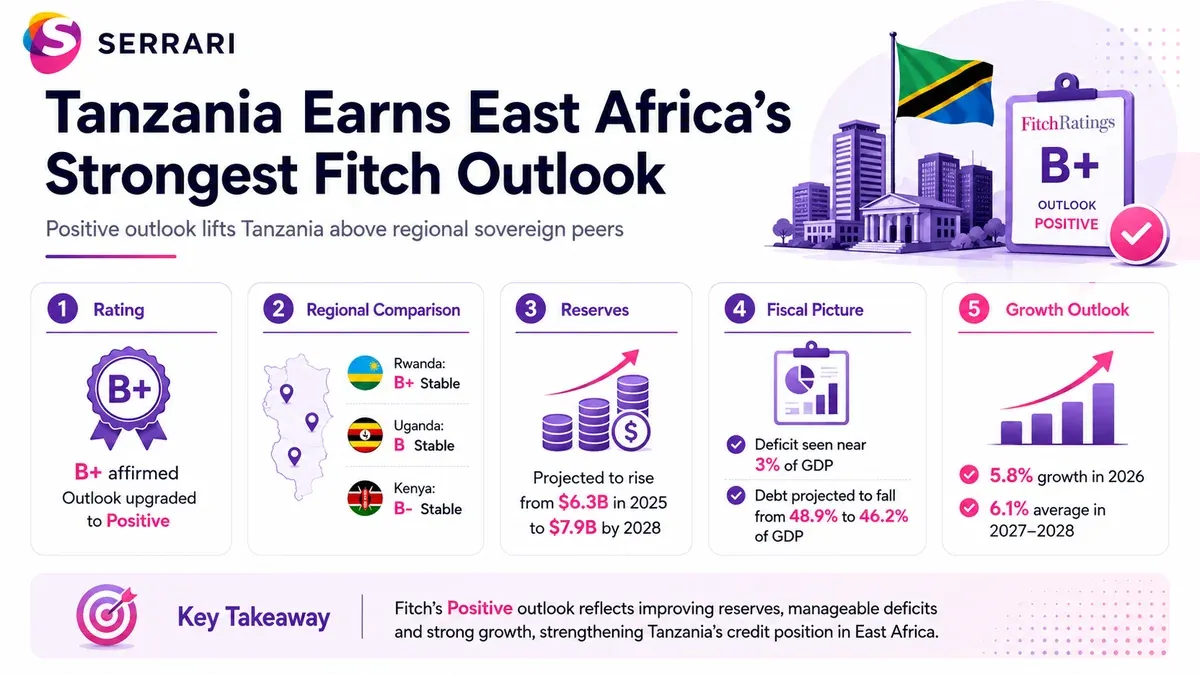
Tanzania has strengthened its position among East Africa’s sovereign borrowers after its B+ credit rating was affirmed and its outlook upgraded to Positive from Stable on August 21, 2026. The assessment places Tanzania ahead of Rwanda’s B+ Stable profile and above Uganda and Kenya, currently rated B Stable and B- Stable respectively.
The improved outlook reflects expectations that foreign-exchange reserves will increase, fiscal deficits will remain moderate and strong economic growth will gradually reduce government debt relative to GDP. The development comes as Tanzania is simultaneously liberalising access to its domestic debt market and pursuing reforms intended to attract more international capital.
Key Overview
- Tanzania retains a B+ sovereign rating, with the outlook upgraded from Stable to Positive.
- Rwanda is also rated B+, but carries a Stable outlook.
- Uganda holds a B rating with a Stable outlook, while Kenya is rated B- with a Stable outlook.
- Foreign-exchange reserves are forecast to increase from $6.3 billion in 2025 to $7.9 billion by 2028.
- Government debt is projected to decline from 48.9% of GDP in 2025 to 46.2% by 2028.
- Tanzania’s economy is forecast to grow 5.8% in 2026 and average 6.1% in 2027–2028.
- The country has also opened its Treasury bill and bond market to foreign investors of all nationalities.
Tanzania Moves Ahead on the Regional Credit Ladder
The Positive outlook is significant because Tanzania and Rwanda currently share the same B+ headline rating, but Tanzania’s outlook now points toward a potential upgrade if improvements in its external and fiscal position continue.
Rwanda’s B+ rating carries a Stable outlook after its outlook was revised from Negative in March 2026. Uganda’s latest assessment retained its B rating and Stable outlook, while Kenya remains at B- with a Stable outlook.
A Positive outlook does not guarantee a rating upgrade, but it indicates that the balance of risks could lead to a higher rating if favourable trends are sustained. Stronger reserves, continued fiscal discipline and greater confidence in Tanzania’s macroeconomic framework are among the developments that could support such a move.
Reserves and Gold Strengthen Tanzania’s Buffer
One of the biggest drivers of the improved assessment is Tanzania’s external position. International reserves are projected to rise from $6.3 billion at the end of 2025 to $7.9 billion in 2028, equivalent to approximately 3.3 months of current external payments.
The Bank of Tanzania also holds approximately $2.4 billion of non-monetary gold, providing an additional potential liquidity buffer. The gold could potentially be converted into monetary reserves or foreign exchange if required.
Recent external-sector data already show greater resilience. Official reserves stood at about $6.24 billion in February 2026, while stronger tourism and gold receipts helped support the external accounts.
These buffers matter because a larger reserve position improves Tanzania’s ability to meet foreign obligations, manage exchange-rate volatility and absorb external shocks.
Context is everything. Stay ahead of shifting trends with today’s market updates, and uncover emerging opportunities using the Serrari Group Market Index and Marketplace. Then, take control of your own financial future by exploring our Money & Life Reset Transformation Blueprint ™ to build stronger habits, create better systems, and design a path toward lasting wealth.
Debt Ratio Expected to Decline
Fiscal discipline is another important factor. Tanzania’s deficit was estimated at 2.8% of GDP for the fiscal year ending June 2026 and is expected to remain close to 3% through 2028.
Tax revenue increased from about 14.6% to 15.6% of GDP between fiscal 2023 and 2025, providing additional support for public finances.
As a result, government debt is projected to fall from 48.9% of GDP in 2025 to 46.2% in 2028. That would leave Tanzania below the approximately 55% median projected for sovereigns in the wider B rating category.
The direction is also broadly consistent with the country’s wider fiscal consolidation and debt-sustainability programme, although maintaining stronger revenue collection and controlling expenditure remain critical.
Economic Growth Remains a Major Strength
Tanzania’s growth outlook continues to distinguish it from many similarly rated economies. Real GDP is forecast to expand by 5.8% in 2026, compared with an estimated 3.7% median among B-rated sovereigns.
Growth is then expected to average 6.1% in 2027 and 2028, supported by public investment, tourism, logistics and mining. Separate economic projections also indicate growth of around 6% over the medium term as agriculture, mining and tourism continue expanding.
Inflation is forecast to average about 4.2% in 2026, up from 3.3% in 2025 but still below the 5.6% median expected among comparable B-rated countries.
Tanzania Opens Its Debt Market to Global Investors
The rating improvement arrives shortly after Tanzania made another major capital-market reform. New foreign-exchange regulations now allow non-residents of any nationality to invest in Treasury bills and government bonds.
Previously, direct participation was generally restricted to investors from the East African Community, Southern African Development Community and the Tanzanian diaspora.
Opening the market could broaden the government’s investor base, improve liquidity and potentially attract more foreign capital. Combined with a Positive sovereign outlook, the reform strengthens Tanzania’s efforts to position its financial markets more prominently among international investors.
Significant constraints remain. Governance indicators, relatively low government revenue and modest income per capita continue to weigh on the sovereign rating, while Tanzania’s newer macroeconomic reforms have yet to be tested through a prolonged external shock.
Even so, the shift to a Positive outlook marks a notable improvement. If reserves continue building, debt declines and high growth is sustained, Tanzania could move closer to another sovereign rating upgrade while strengthening its position as one of East Africa’s more attractive emerging investment markets.
Sources: Fitch Ratings / International Monetary Fund / Bank of Tanzania / Rwanda Ministry of Finance and Economic Planning / Kenya National Treasury / The Citizen
Your financial future isn’t something you wait for—it’s something you build.
The real question is: when do you begin?
Move beyond simply staying informed.
Navigate the markets with clarity—track trends through the Serrari Group Market Index, uncover opportunities in the Serrari Marketplace, and build practical knowledge with our Curated Wealth Builder Platform.
Stay connected to what truly matters.
Get daily insights on macro trends and financial movements across Kenya, Africa, and global markets—delivered through the Serrari Newsletter.
Growth opens doors.
Advance your career through professional programs including ACCA, HESI A2, ATI TEAS 7 , HESI EXIT , NCLEX – RN and NCLEX – PN, Financial Literacy!🌟—designed to move you forward with confidence.
See where money is flowing—clearly and in real time.
Track Money Market Funds, Treasury Bills, Treasury Bonds, Green Bonds, and Fixed Deposits, alongside global and African indexes, key economic indicators, and the evolving Crypto and stablecoin landscape—all within Serrari’s Market Index.