The Nigeria real estate sector faces complex challenges ranging from housing affordability and limited mortgage financing to development constraints and the need for stronger engagement between industry professionals and government. Newly inaugurated FIABCI Nigeria Chapter President Ayodeji Odeleye said the profession needs a credible voice capable of contributing meaningfully to discussions around housing, investment, cities and the built environment. His 2026–2028 agenda will focus on strengthening the organisation, improving accountability and increasing its engagement with policymakers and industry stakeholders.
Key Overview
Ayodeji Odeleye has taken over as President of the Nigeria Chapter of the International Real Estate Federation, known as FIABCI Nigeria. Speaking at the organisation’s 2026 Annual General Meeting in Lagos, he identified complex challenges facing the property industry and called for stronger professional representation. His priorities include improving governance, strengthening industry communities, increasing accountability and expanding FIABCI Nigeria’s visibility and government engagement.
Nigeria Real Estate Sector Faces Multiple Challenges
Nigeria’s property industry continues to operate in a difficult environment shaped by challenges affecting housing, investment and urban development.
Speaking during FIABCI Nigeria’s 2026 Annual General Meeting in Lagos, Odeleye said the Nigeria real estate sector requires a credible professional voice capable of contributing intelligently to discussions affecting property and the built environment.
The meeting also included the induction of 16 new members into the organisation.
Rather than treating the country’s property challenges as isolated problems, Odeleye’s comments point toward the need for coordinated engagement between industry professionals, investors, policymakers and other stakeholders.
Housing Affordability Remains a Central Concern
One of the fundamental issues confronting Nigeria’s housing market is the ability of households to afford suitable homes.
Housing affordability depends on several interconnected factors, including household income, financing costs, land prices and the expense of constructing new properties.
When these costs rise faster than incomes, homeownership becomes increasingly difficult for households.
The affordability challenge also affects real estate developers because expensive homes can reduce the number of potential buyers capable of purchasing newly constructed properties.
Addressing the problem therefore requires more than increasing housing supply. New properties also need to be delivered at price points that correspond with the purchasing power of prospective residents.
Mortgage Financing Is Critical for Housing Access
Access to mortgage financing is another important part of Nigeria’s housing challenge.
In markets with developed mortgage systems, households can spread the cost of purchasing property over many years rather than paying a large proportion of the purchase price upfront.
Limited access to affordable long-term financing can significantly reduce the number of Nigerians able to become homeowners.
High borrowing costs can compound the problem because even households that qualify for financing may find monthly repayments unaffordable.
A stronger housing finance system could therefore help connect existing housing demand with developers attempting to deliver new residential projects.
However, expanding mortgage availability must be accompanied by responsible lending standards to prevent households from taking on unsustainable debt.
Construction Costs Affect Property Development
The economics of property development also remain important.
Developers must account for land acquisition, construction materials, labour, financing, regulatory approvals and infrastructure before completing projects.
Higher input costs eventually affect either developers’ margins or the prices charged to buyers and tenants.
This creates a difficult balance.
Developers need projects to remain commercially viable, but substantially higher property prices can make new housing inaccessible to much of the population.
Reducing unnecessary development costs and improving the efficiency of property approvals could consequently contribute to both increased housing supply and improved affordability.
Context is everything. Stay ahead of shifting trends with today’s market updates, and uncover emerging opportunities using the Serrari Group Market Index and Marketplace. Then, take control of your own financial future by exploring our Money & Life Reset Transformation Blueprint ™ to build stronger habits, create better systems, and design a path toward lasting wealth.
Infrastructure Shapes Real Estate Investment
The performance of the property sector is also closely connected to infrastructure.
Transport networks, electricity, water, drainage and other public services influence where developers can construct viable projects and where households and businesses are willing to locate.
Infrastructure investment can open previously underserved locations to development and potentially reduce pressure on highly concentrated urban property markets.
For real estate investment, reliable infrastructure can also affect property valuations and long-term rental demand.
This means discussions about Nigeria’s built environment cannot be separated entirely from wider urban planning and infrastructure policy.
FIABCI Nigeria Calls for Stronger Industry Voice
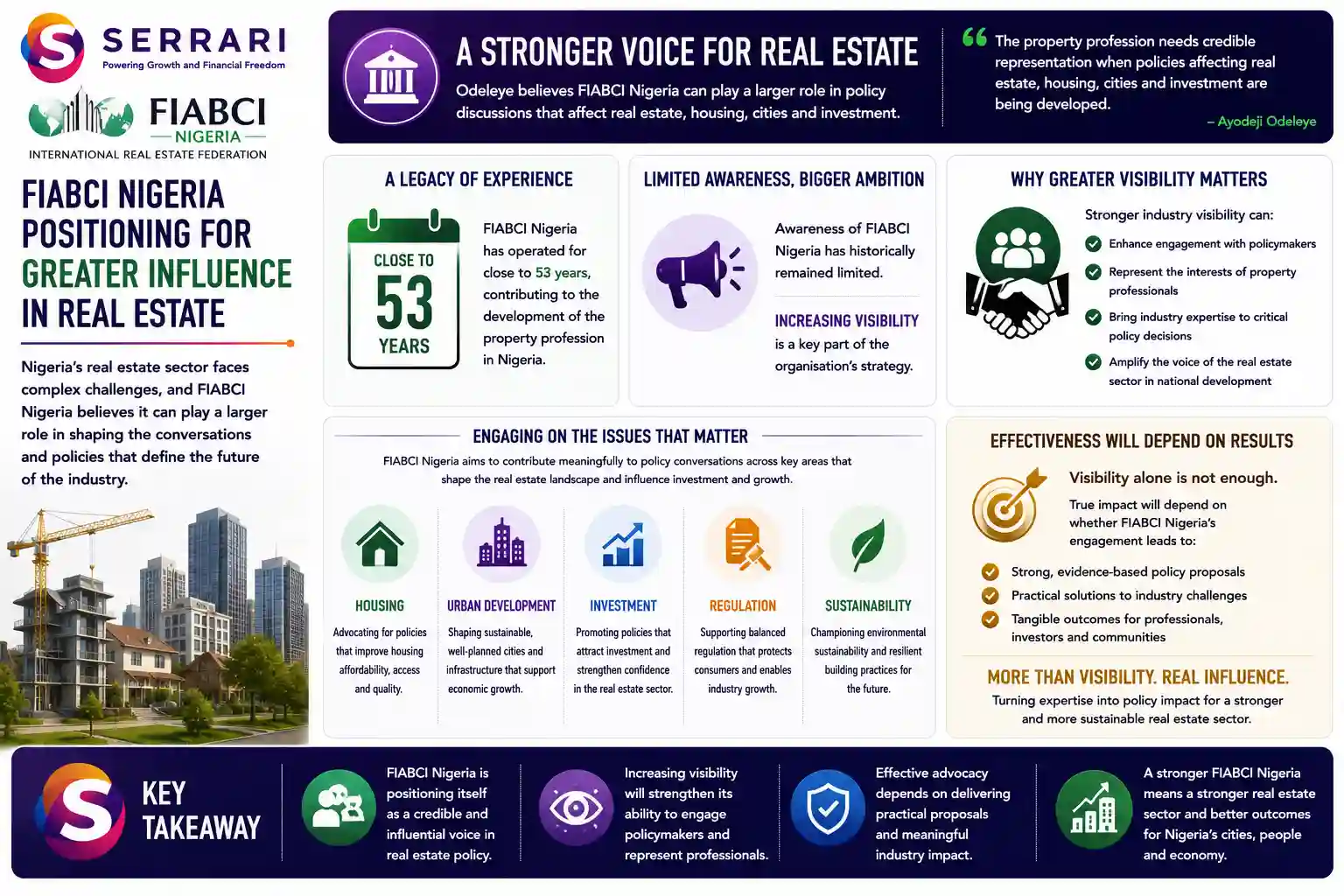
Odeleye believes FIABCI Nigeria can play a larger role in these discussions.
He argued that the property profession needs credible representation when policies affecting real estate, housing, cities and investment are being developed.
FIABCI Nigeria has operated for close to 53 years, but Odeleye acknowledged that awareness of the organisation has historically remained limited.
Increasing visibility is therefore part of the organisation’s strategy.
Greater industry visibility could strengthen FIABCI’s ability to engage policymakers and represent the interests and expertise of property professionals.
However, effective advocacy will depend on whether that engagement produces practical proposals rather than simply increasing the organisation’s public profile.
New Leadership Sets 2026–2028 Priorities
Odeleye outlined several priorities for his administration through 2028.
These include strengthening governance, reactivating councils and professional communities, establishing clearer responsibilities and improving accountability.
The organisation also intends to address outstanding financial obligations and strengthen its institutional foundation.
The agenda follows FIABCI Nigeria’s efforts to increase its international visibility, including securing the right to host the organisation’s World Congress.
Odeleye said that achievement demonstrated Nigeria’s ability to provide a platform for the global real estate community.
He now wants the organisation to convert that visibility into stronger membership growth and greater engagement with government.
Real Estate Investment Requires Policy Certainty
For investors, the wider challenge is creating an environment in which real estate investment can generate sustainable returns while contributing to the country’s housing requirements.
Property is inherently long term. Developers and investors can commit capital years before a project reaches completion.
Uncertainty around regulations, approvals, financing or infrastructure can therefore increase development risk and discourage investment.
Greater collaboration between government and professional organisations could help identify policies that encourage development without weakening planning standards or consumer protections.
Nigeria’s Property Sector Needs Coordinated Solutions
The challenges identified by FIABCI Nigeria cannot be solved by the property industry alone.
Housing affordability depends on incomes, financing and construction economics. Development depends on infrastructure and regulatory efficiency, while investment requires predictable policies and viable returns.
The Nigeria real estate sector therefore needs coordinated responses across government, financial institutions, developers and professional organisations.
FIABCI Nigeria’s new leadership is positioning the organisation to participate more actively in that process. Its impact will ultimately depend on whether stronger visibility and government engagement translate into practical improvements across Nigeria’s housing and property markets.
FAQs
What challenges are facing the Nigeria real estate sector?
Nigeria’s real estate sector faces interconnected challenges involving housing affordability, access to mortgage financing, development costs, infrastructure and the wider investment environment. Addressing these issues requires coordination between government, developers, financial institutions and property professionals.
Why is mortgage financing important to Nigeria’s housing market?
Mortgage financing allows households to spread property costs over a longer period rather than paying most of the purchase price upfront. Greater access to affordable long-term financing could therefore make homeownership accessible to more households and support demand for residential development.
What is FIABCI Nigeria’s role in the real estate industry?
FIABCI Nigeria is the Nigerian chapter of the International Real Estate Federation. The organisation represents property professionals and seeks to contribute to discussions concerning real estate investment, housing, cities and the built environment while connecting Nigeria’s industry with the wider international property community.
What are Ayodeji Odeleye’s priorities for FIABCI Nigeria?
Odeleye’s 2026–2028 priorities include strengthening governance, reactivating professional councils and communities, clarifying responsibilities, improving accountability and expanding the organisation’s visibility. He also intends to strengthen engagement with the government and increase FIABCI Nigeria’s role in discussions affecting the property sector.
Your financial future isn’t something you wait for—it’s something you build.
The real question is: when do you begin?
Move beyond simply staying informed.
Navigate the markets with clarity—track trends through the Serrari Group Market Index, uncover opportunities in the Serrari Marketplace, and build practical knowledge with our Curated Wealth Builder Platform.
Stay connected to what truly matters.
Get daily insights on macro trends and financial movements across Kenya, Africa, and global markets—delivered through the Serrari Newsletter.
Growth opens doors.
Advance your career through professional programs including ACCA, HESI A2, ATI TEAS 7 , HESI EXIT , NCLEX – RN and NCLEX – PN, Financial Literacy!🌟—designed to move you forward with confidence.
See where money is flowing—clearly and in real time.
Track Money Market Funds, Treasury Bills, Treasury Bonds, Green Bonds, and Fixed Deposits, alongside global and African indexes, key economic indicators, and the evolving Crypto and stablecoin landscape—all within Serrari’s Market Index.