For Kenya fixed income investors, the August Treasury switch presents a choice between liquidity and duration. Eligible holders of three Treasury bills maturing in September 2026 and FXD1/2012/015 can voluntarily exchange holdings into FXD4/2019/010, a Treasury bond carrying a 12.28% coupon and maturing in November 2029. Keeping the short-term securities means receiving cash sooner but facing reinvestment risk when they mature. Switching reduces that immediate reinvestment requirement but exposes investors to longer-duration price sensitivity if government bond yields change. The auction is multi-price, meaning the 12.28% coupon should not be confused with the investor’s eventual acquisition yield. Clean price, accrued interest, tax and the accepted auction yield all affect the economic return from the switch.
LIVEKenya bond yields: Average yield 11.85% across 58 bonds · 21 OctSee yields →Key Overview
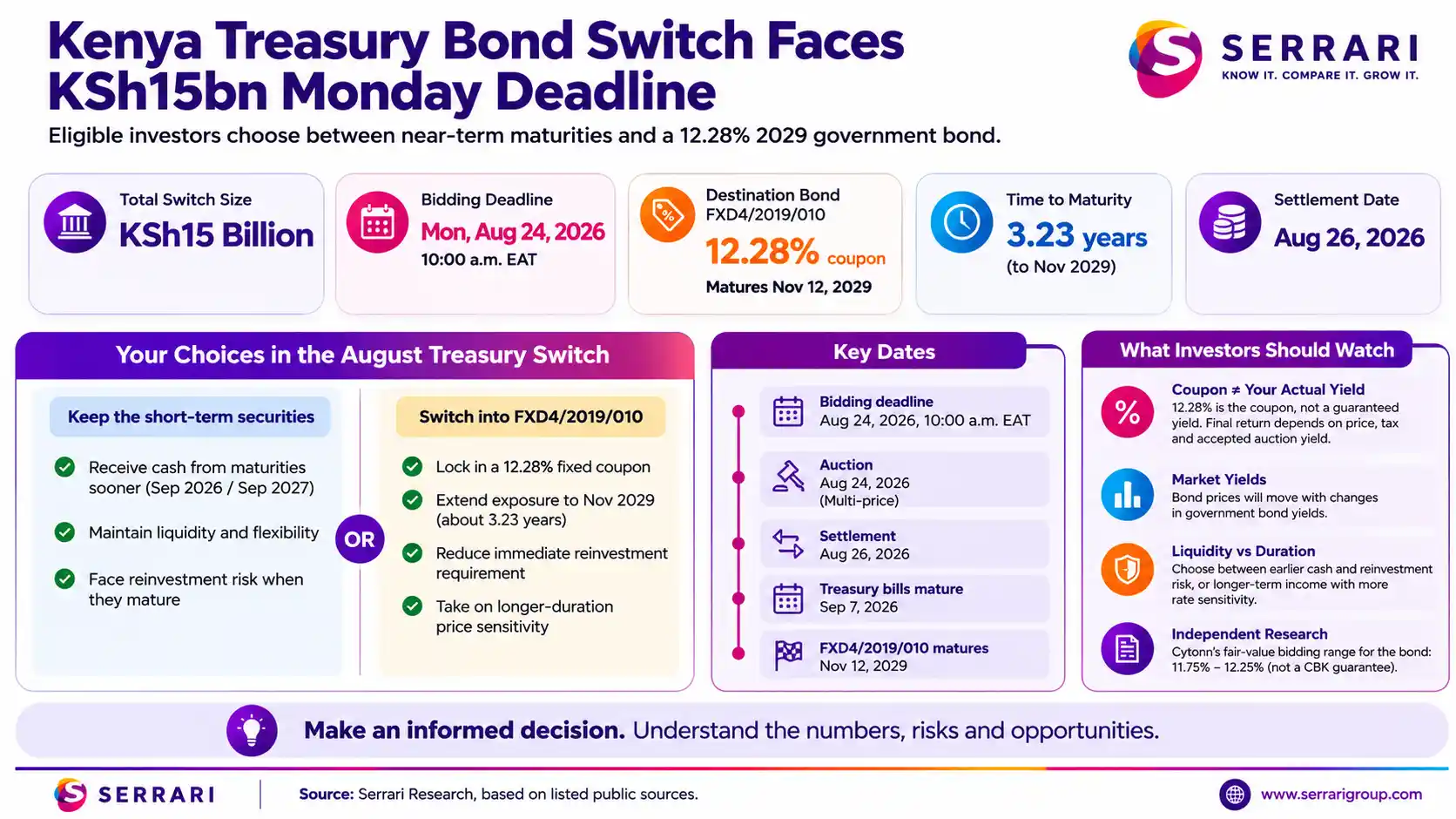
- The Central Bank of Kenya is offering KSh15 billion through the voluntary switch auction.
- Bidding closes at 10:00 a.m. on Monday, August 24, 2026, with the multi-price auction conducted the same day.
- Settlement is scheduled for August 26, while all three eligible Treasury bills mature on September 7, 2026.
- The destination security, FXD4/2019/010, carries a 12.28% coupon and matures on November 12, 2029, leaving about 3.23 years to maturity.
- Non-competitive bids range from KSh50,000 to KSh50 million, while competitive bids start at KSh2 million per CSD account per tenor.
- Cytonn’s July research placed its indicative fair-value bidding range at 11.75%–12.25%, but this is an independent research-house assessment rather than a CBK-guaranteed auction yield.
Kenya Treasury Bond Switch Faces KSh15bn Monday Deadline
Monday’s Deadline Turns Into a Portfolio Decision
Kenya’s latest Treasury switch reaches its decision point on Monday, turning a government debt-management operation into a practical portfolio choice for eligible investors.
The auction offers KSh15 billion total and allows holders of selected Treasury bills and FXD1/2012/015 to exchange part or all of their unencumbered holdings into FXD4/2019/010. The deadline August 24 is 10:00 a.m., and the auction uses a multi-price bidding method.
For investors, the central question is simple: take cash from securities that mature soon and reinvest later, or extend exposure now into a government bond that runs further along the yield curve?
The Switch Changes the Timing of Cash
The three bills mature September 7, 2026. Investors who keep them receive principal back shortly afterwards and can decide what to do with the cash at prevailing market rates.
The older source bond, FXD1/2012/015, runs longer. The 2027 bond matures September 6. Each eligible holder is therefore deciding whether to replace an existing maturity profile with the same destination security.
The destination matures November 12 2029. Its remaining tenor equals 3.23 years, taking Treasury-bill investors materially further out on the Kenyan government yield curve.
The trade-off is liquidity versus reinvestment risk. Staying short brings cash back sooner. Extending duration reduces the need to reinvest immediately but increases sensitivity to market yields.
The 12.28% Figure Is a Coupon
The destination carries 12.28% fixed coupon, but that figure needs careful interpretation.
A coupon is the contractual interest rate applied to face value. It is not automatically the return earned by an investor acquiring the bond at auction.
In other words, 12.28% is a coupon, not a guaranteed Kenya government bond yield. Actual yield depends on the price paid, remaining cash flows, time to maturity and tax.
That distinction matters in a multi-price CBK bond switch. Competitive investors submit their preferred yield, meaning accepted bidders can receive different prices.
Cytonn estimates 11.75%-12.25% bidding range as its fair-value view for FXD4/2019/010, based on the government yield curve, comparable secondary-market pricing and prevailing liquidity. It is independent research, not a CBK guarantee of the rate that will clear the auction.
Clean Price and Dirty Price Matter
The switch also provides a useful example of bond-pricing mechanics.
A 12.28% yield gives KSh99.9547 clean-price per KSh100 of face value. Accrued interest equals KSh3.3736 per-KSh100, taking the dirty price equals KSh103.3283 approximately.
The clean price excludes accrued coupon interest; the dirty price includes it. An investor can therefore see a quoted clean price close to par but settle above par after accrued interest is added.
The withholding tax rate is 10% on the destination bond. Tax, accrued interest and accepted yield all influence the cash-flow result, so coupon alone is an incomplete measure of return.
Context is everything. Stay ahead of shifting trends with today’s market updates, and uncover emerging opportunities using the Serrari Group Market Index and Marketplace. Then, take control of your own financial future by exploring our Money & Life Reset Transformation Blueprint ™ to build stronger habits, create better systems, and design a path toward lasting wealth.
Staying Short Preserves Flexibility
For holders of the September Treasury bills, doing nothing means receiving cash in early September.
That preserves flexibility. If rates rise, investors can potentially reinvest at higher yields. The risk is that market yields fall before or shortly after maturity, forcing reinvestment at a lower rate.
That is reinvestment risk, and it can matter to pension funds, insurers and other institutions managing future cash flows.
For investors building portfolios of Kenya Treasury bonds, keeping shorter instruments can also preserve room to respond to future primary-market auctions rather than committing immediately to a longer security.
Switching Extends Duration Today
Switching does the opposite. It gives up a near-term maturity in exchange for longer exposure to FXD4/2019/010.
It reduces immediate reinvestment pressure but adds duration risk. If Kenyan government bond yields rise materially after the switch, the market value of the destination security would generally fall. If yields decline, its price could rise.
The choice therefore depends on liabilities, liquidity needs, future-rate expectations and tolerance for price movements before maturity.
LIVEKenya bond yields: Average yield 11.85% across 58 bonds · 21 OctSee yields →Investors should also distinguish between mark-to-market risk and holding-to-maturity cash flows. A holder intending to retain the bond until redemption experiences interim market-price changes differently from an investor who may need to sell beforehand.
The Government Gets a Liability-Management Benefit
The issuer gains something too.
By moving part of a near-term maturity obligation into a longer bond, the switch can extend the government’s domestic debt maturity profile and reduce immediate refinancing pressure.
That is the Kenya debt management logic behind switch auctions: instead of waiting for every short-term security to mature and then refinancing the entire amount with new borrowing, the government can voluntarily move willing holders into securities with later redemption dates.
Participation remains voluntary. Eligible investors can exchange part, all or none of their unencumbered holdings.
That makes the transaction a portfolio choice for investors and a liability-management tool for government rather than a compulsory restructuring.
What Investors Should Watch Monday
The most immediate signal will be the auction result.
Bids close Monday morning, while settlement follows on August 26. Successful allocations are expected to become available through the DhowCSD investor portal.
Accepted yields will show what compensation investors demanded to move from near-term instruments into the destination bond. That is more informative than simply comparing its stated coupon with current Treasury-bill rates.
Investors should also watch how much of the offer is taken up.
Strong participation would suggest appetite to extend duration and reduce near-term reinvestment exposure. Weaker participation could indicate that eligible holders prefer liquidity, expect better future issuance opportunities or consider the accepted yields insufficient for the additional duration.
Conclusion
Kenya’s Treasury switch is ultimately a maturity decision, not simply a search for the highest stated interest rate.
Staying short means cash arrives sooner but must then be reinvested. Switching provides longer fixed-coupon exposure but increases interest-rate sensitivity and reduces near-term liquidity.
The stated coupon is therefore only one part of the decision. Price, acquisition yield, accrued interest, tax, reinvestment risk and an investor’s own cash-flow requirements determine whether extending duration makes economic sense.
FAQs
What is the Kenya Treasury Bond Switch?
The current Kenya Treasury Bond Switch is a voluntary Central Bank of Kenya auction allowing eligible investors holding three specified Treasury bills and FXD1/2012/015 to exchange some or all of those holdings into FXD4/2019/010. The operation is part of the government’s domestic liability-management programme and is designed to shift some near-term debt maturities further into the future while giving investors the option to extend the duration of their government-securities portfolios.
Does the 12.28% coupon mean investors will earn 12.28%?
Not necessarily. The coupon determines the interest payment based on the bond’s face value, while an investor’s actual yield depends on the acquisition price, remaining coupon payments, time to maturity, accrued interest and tax. Because the switch uses multi-price bidding, competitive investors submit yields and the resulting clean prices vary accordingly. A bond can therefore carry a 12.28% coupon while an investor’s yield to maturity is above or below that figure.
What happens if an eligible investor does not switch?
Participation is voluntary. An investor who does not switch continues holding the existing Treasury bill or bond under its original terms until maturity or until it is otherwise sold. For holders of the three eligible Treasury bills, that means principal is scheduled to return in early September. The investor can then decide where to reinvest the cash, creating both flexibility and exposure to whatever interest rates are available at that time.
What is the difference between clean and dirty bond price?
The clean price excludes interest that has accrued since the bond’s previous coupon date, while the dirty price includes that accrued interest. In the switch pricing example at a 12.28% yield, the clean price is approximately KSh99.9547 per KSh100 of face value and accrued interest is KSh3.3736, producing an illustrative dirty price of approximately KSh103.3283. The distinction matters because settlement cash flows are based on more than the quoted clean price alone.
Why would an investor extend duration instead of taking cash?
Extending duration can reduce reinvestment risk by keeping funds invested for longer rather than receiving cash and having to reinvest it soon afterwards. That can be useful if market yields subsequently decline. The trade-off is that longer-duration securities generally experience greater market-price movements when yields change. The appropriate choice therefore depends on the investor’s liquidity requirements, future liabilities, rate expectations and ability to tolerate interim price volatility.
Sources: People Daily, Business Today, Cytonn, Tuko, Central Bank of Kenya, Standard Investment Bank
Your financial future isn’t something you wait for—it’s something you build.
The real question is: when do you begin?
Move beyond simply staying informed.
Navigate the markets with clarity—track trends through the Serrari Group Market Index, uncover opportunities in the Serrari Marketplace, and build practical knowledge with our Curated Wealth Builder Platform.
Stay connected to what truly matters.
Get daily insights on macro trends and financial movements across Kenya, Africa, and global markets—delivered through the Serrari Newsletter.
Growth opens doors.
Advance your career through professional programs including ACCA, HESI A2, ATI TEAS 7 , HESI EXIT , NCLEX – RN and NCLEX – PN, Financial Literacy!🌟—designed to move you forward with confidence.
See where money is flowing—clearly and in real time.
Track Money Market Funds, Treasury Bills, Treasury Bonds, Green Bonds, and Fixed Deposits, alongside global and African indexes, key economic indicators, and the evolving Crypto and stablecoin landscape—all within Serrari’s Market Index.