The S&P 500 outlook for the week of August 24 is unusually dependent on both corporate earnings and interest-rate expectations. Nvidia, the index’s largest constituent in S&P Dow Jones Indices’ July 31 snapshot, reports fiscal second-quarter results on August 26. Earlier that day, investors receive revised second-quarter GDP and July PCE inflation data from the Bureau of Economic Analysis. The Jackson Hole Economic Policy Symposium then runs from August 27–29. These events affect the index through different channels: Nvidia can reshape AI earnings expectations, while inflation, GDP and Federal Reserve communication can alter bond yields and equity discount rates. Because the S&P 500’s top 10 companies accounted for 37.6% of its weight as of July 31, large mega-cap moves can have an outsized effect on the benchmark.
Key Overview
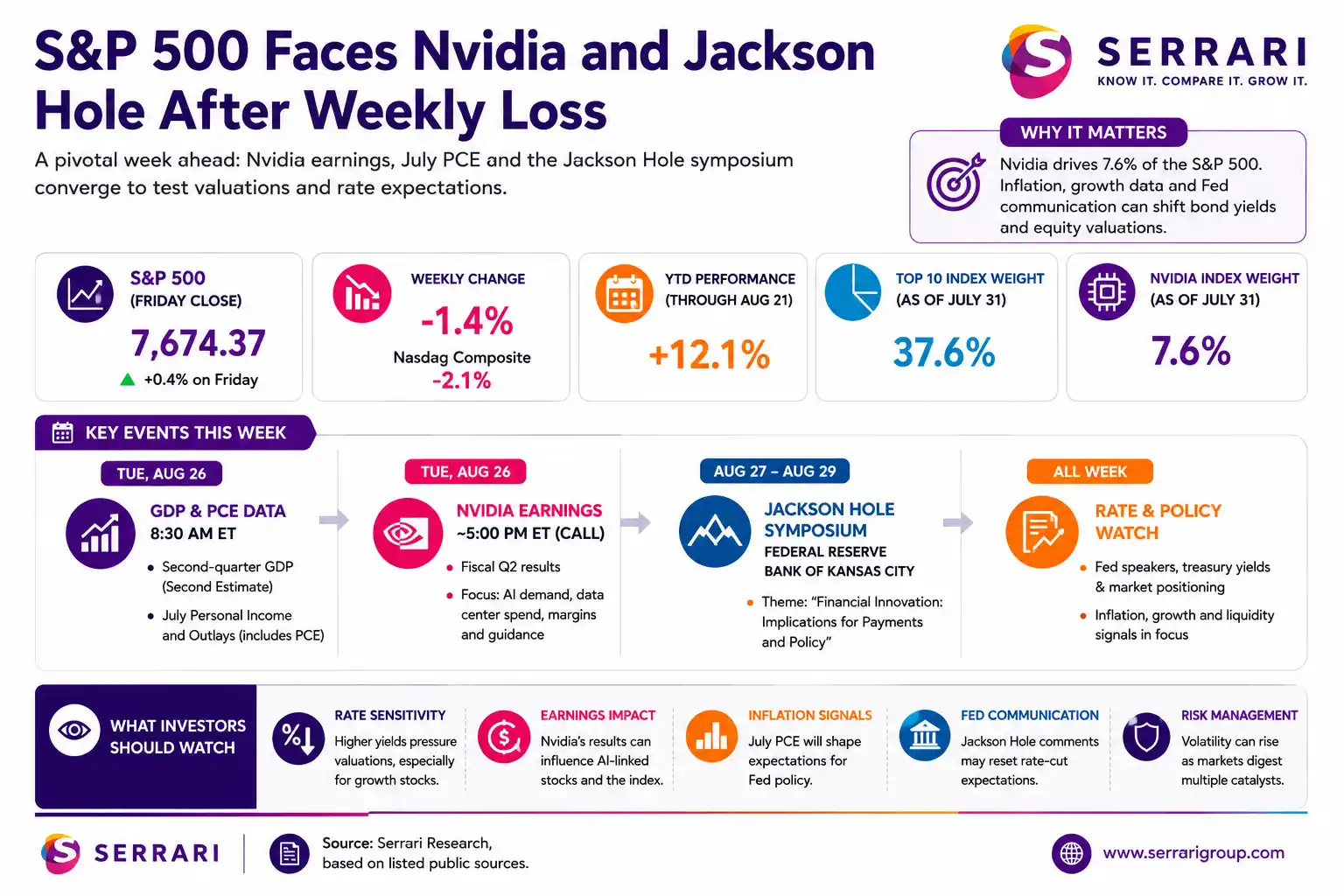
- The S&P closed Friday at 7,674.37, while the index gained 0.4% on Friday.
- The benchmark nevertheless fell 1.4% over the week, while the Nasdaq Composite declined 2.1%.
- The S&P 500 remained approximately 12.1% higher year-to-date through August 21.
- As of July 31, the top ten represented 37.6% weight, while the Nvidia held 7.6% index weight.
- The BEA releases second-quarter GDP revisions and July Personal Income and Outlays at 8:30 a.m. ET on August 26.
- Nvidia reports later on August 26, before Jackson Hole runs August 27–29 under the theme “Financial Innovation: Implications for Payments and Policy.”
S&P 500 Faces Nvidia and Jackson Hole After Weekly Loss
A Concentrated Index Enters a Crowded Week
The S&P 500 begins the final full trading week of August carrying both recent weakness and unusually concentrated event risk.
The S&P closed Friday at 7,674.37, recovering 33.21 points on the session. That rebound was not enough to prevent the benchmark from ending the week lower, while the Nasdaq lost 2.1% for week.
Despite the setback, the index remained up 12.1% YTD. This week tests two pillars of that advance almost simultaneously: mega-cap earnings expectations and the interest-rate assumptions investors use to value those earnings.
Nvidia Matters More in a Concentrated Index
S&P Dow Jones Indices describes the benchmark as a float-adjusted market-capitalisation-weighted index that covers roughly 80% market capitalization available in the US equity market.
That structure means the largest companies have a disproportionate influence on daily index performance.
As of July 31, the top ten represented 37.6% weight, while Nvidia held 7.6% index weight. The official dataset also contained 503 constituents at July-end, reflecting multiple share classes for some companies.
That concentration changes how investors should interpret Nvidia earnings.
A major post-results move in Nvidia is not simply a single-stock event. Through Nvidia’s direct weighting, semiconductor sentiment and the read-through to other AI-linked companies, the result can influence a meaningful portion of the broader index.
Nvidia says its fiscal second-quarter results will be announced Wednesday. The Nvidia results arrive around 1:20 p.m. Pacific Time, while the call begins 5 p.m. Eastern.
For the S&P 500, the critical questions extend beyond whether Nvidia beats earnings estimates. Investors will be listening for AI demand, data-centre spending, margins and guidance strong enough to sustain the growth expectations embedded in large technology valuations.
PCE and GDP Test Discount Rates
Before Nvidia reports, investors receive two major macroeconomic releases.
The Bureau of Economic Analysis has scheduled the second estimate of second-quarter GDP and July Personal Income and Outlays for August 26 at 8:30 a.m. Eastern Time.
The Personal Income and Outlays report contains the PCE price indexes closely watched for changes in inflation.
The starting point remains important. In June, headline PCE rose 3.7% yearly, while core PCE rose 3.3% yearly. On a monthly basis, the headline fell 0.1% month-on-month June while core rose 0.1% month-on-month June.
The GDP revision matters through a different channel. The advance estimate showed 1.5% growth at an annual rate during the second quarter, compared with 2.1% in the first quarter.
For equities, stronger growth can support corporate earnings expectations, but persistent inflation can also keep bond yields elevated.
That creates a valuation tension: stronger economic activity is not automatically positive for expensive growth stocks if it simultaneously pushes the required return on future cash flows higher.
Context is everything. Stay ahead of shifting trends with today’s market updates, and uncover emerging opportunities using the Serrari Group Market Index and Marketplace. Then, take control of your own financial future by exploring our Money & Life Reset Transformation Blueprint ™ to build stronger habits, create better systems, and design a path toward lasting wealth.
Jackson Hole Adds the Policy Layer
The next policy test follows almost immediately.
The Jackson Hole runs August 27-29, according to the Federal Reserve Bank of Kansas City.
The symposium’s theme focuses on financial innovation: “Financial Innovation: Implications for Payments and Policy.”
The event brings central bankers, policymakers, economists and financial-market participants together while investors are already reassessing inflation, economic growth, long-term bond yields and the Federal Reserve outlook.
For the S&P 500, the important transmission mechanism is the discount rate.
A shift toward expectations of tighter or higher-for-longer monetary conditions can lift required returns and pressure US equity valuations, particularly among growth companies whose expected cash flows extend further into the future.
A more supportive rate interpretation would work in the opposite direction.
That is why Nvidia and Jackson Hole matter together: one can alter the market’s view of future earnings, while the other can alter the rate investors use to value those earnings.
The Two Forces Could Reinforce Each Other
The most consequential scenario is when corporate and macroeconomic signals point in the same direction.
Strong Nvidia results combined with softer US PCE inflation or a less restrictive policy interpretation could support both earnings expectations and valuation multiples.
Weak Nvidia guidance combined with stronger inflation pressure or a more restrictive rates outlook could pressure both simultaneously.
Mixed outcomes would be more revealing.
Strong Nvidia results alongside rising bond-yield expectations would test whether earnings momentum can overpower valuation compression. Conversely, weaker Nvidia results accompanied by falling yields would show whether cheaper discount rates are sufficient to cushion deteriorating growth expectations.
That makes this week a useful test of what currently matters more to the US stock market: AI earnings durability or the price investors are willing to pay for those earnings.
What Investors Should Watch
Investors should separate the sequence rather than treating the week as a single event.
Wednesday morning brings GDP and PCE inflation. Nvidia follows after the US market close. Jackson Hole 2026 then runs from Thursday through Saturday.
Within the index itself, investors should watch Nvidia’s direct reaction, semiconductor and technology breadth, Treasury yields and whether leadership broadens beyond the largest constituents.
Breadth is especially important because S&P 500 concentration can make an index-level move appear stronger or weaker than conditions across the average company underneath it.
A rally led almost entirely by a handful of mega-cap companies would communicate something different from gains extending across sectors and smaller index weights.
Conclusion
The S&P 500 enters the week after a weekly decline, but the bigger issue is the concentration of the events ahead.
Nvidia can reset expectations for one of the benchmark’s most important earnings engines. PCE and GDP can change the macroeconomic backdrop. Jackson Hole can alter how markets interpret monetary policy and the discount rate applied to future corporate earnings.
The combination creates a rare simultaneous test of earnings and valuation.
If both forces turn supportive, the index reaction could be amplified. If both deteriorate, concentration could work in the opposite direction. If the signals conflict, investors may get an unusually clear indication of whether earnings strength or interest-rate expectations currently have greater influence over the S&P 500.
FAQs
Why are Nvidia earnings so important for the S&P 500?
Nvidia matters because the S&P 500 is weighted by float-adjusted market capitalisation rather than equally weighting each constituent. Nvidia was the benchmark’s largest constituent in S&P Dow Jones Indices’ July 31 dataset, with a 7.6% weight. A large Nvidia price move can therefore directly influence the headline index, while its earnings and guidance can also affect other semiconductor, AI and technology companies through changes in broader expectations about artificial-intelligence investment and demand.
When does Nvidia report earnings?
Nvidia is scheduled to release its fiscal second-quarter 2027 results on Wednesday, August 26, 2026. The company says results should be publicly announced at approximately 1:20 p.m. Pacific Time, followed by its conference call at 2 p.m. Pacific, or 5 p.m. Eastern. Because the announcement comes after the regular US trading session, much of the immediate S&P 500 impact could first appear in Nvidia after-hours trading, index futures and the following trading session.
What US economic data is released on August 26?
The US Bureau of Economic Analysis will release both the second estimate of second-quarter GDP and July Personal Income and Outlays at 8:30 a.m. Eastern Time on August 26. The latter includes headline and core PCE price indexes. Investors will be looking at the inflation data for evidence about price pressures and at the GDP revision for changes in the growth picture, with both potentially affecting Treasury yields and expectations for monetary policy.
Why does Jackson Hole matter for stock investors?
The Jackson Hole Economic Policy Symposium attracts central bankers, economists and policymakers and can influence how markets interpret future monetary-policy risks. For equity investors, the connection is largely through interest rates and discount rates. When investors expect higher interest rates for longer, the present value assigned to future corporate cash flows can fall, particularly for higher-valued growth companies. More supportive rate expectations can have the opposite effect.
Does high S&P 500 concentration make the index riskier?
Concentration means the largest companies have more influence over index performance, but that does not automatically make the S&P 500 unsuitable or predict that it will fall. It does mean investors should understand what drives headline returns. With the largest companies accounting for a substantial share of index weight, a sharp move in Nvidia or other mega-cap companies can move the overall benchmark even when many smaller constituents behave differently.
Sources: Associated Press, S&P Dow Jones Indices, Nvidia Investor Relations, US Bureau of Economic Analysis, Federal Reserve Bank of Kansas City, MarketWatch
Your financial future isn’t something you wait for—it’s something you build.
The real question is: when do you begin?
Move beyond simply staying informed.
Navigate the markets with clarity—track trends through the Serrari Group Market Index, uncover opportunities in the Serrari Marketplace, and build practical knowledge with our Curated Wealth Builder Platform.
Stay connected to what truly matters.
Get daily insights on macro trends and financial movements across Kenya, Africa, and global markets—delivered through the Serrari Newsletter.
Growth opens doors.
Advance your career through professional programs including ACCA, HESI A2, ATI TEAS 7 , HESI EXIT , NCLEX – RN and NCLEX – PN, Financial Literacy!🌟—designed to move you forward with confidence.
See where money is flowing—clearly and in real time.
Track Money Market Funds, Treasury Bills, Treasury Bonds, Green Bonds, and Fixed Deposits, alongside global and African indexes, key economic indicators, and the evolving Crypto and stablecoin landscape—all within Serrari’s Market Index.