
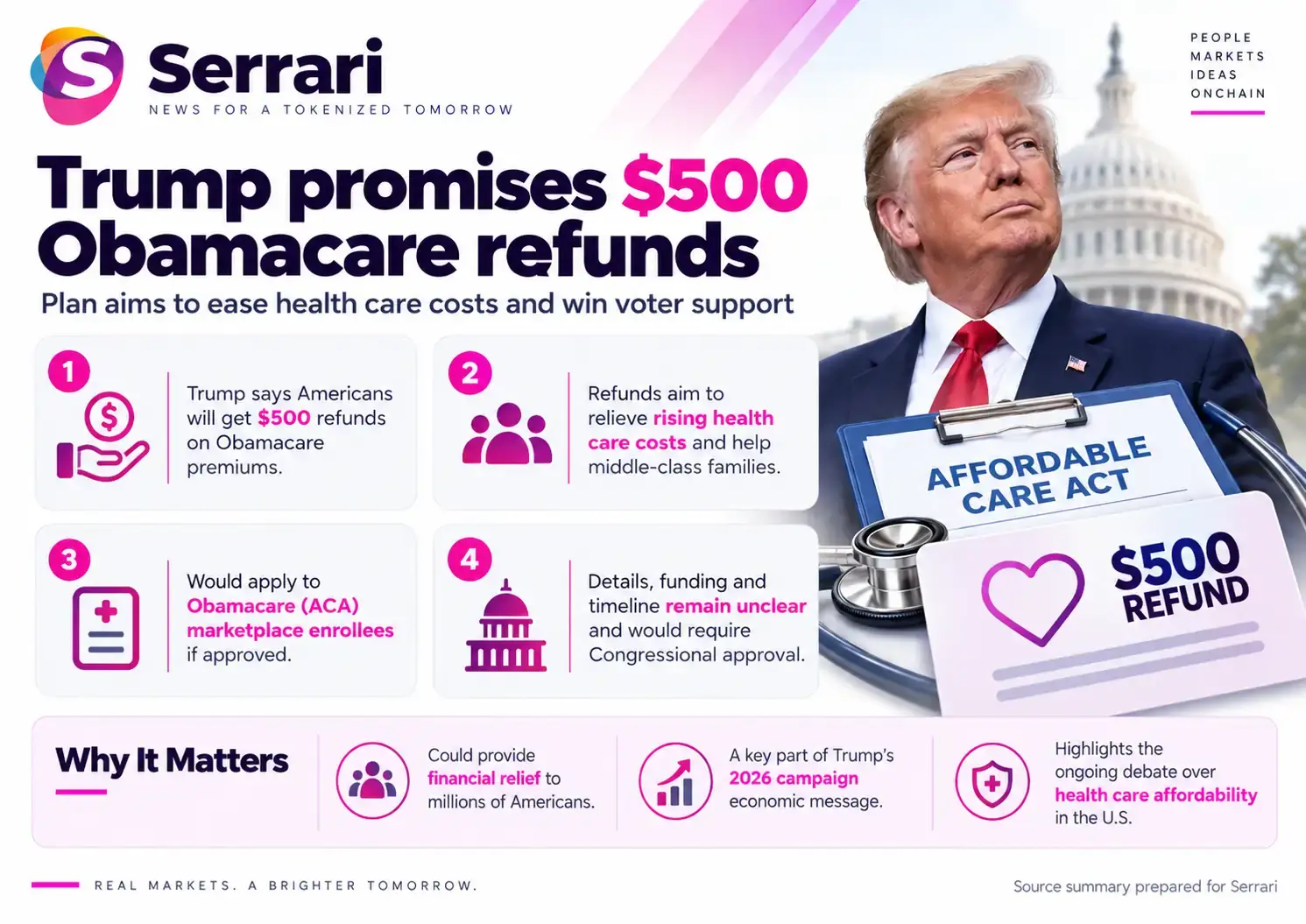
President Donald Trump has announced $500 refunds for nearly one million Americans who bought Affordable Care Act health insurance through the federal marketplace without receiving premium assistance. The payments will cover eligible consumers in 30 states and are scheduled to begin going out in October 2026. (The White House) The measure targets a relatively small portion of people enrolled through the insurance exchanges.
The administration describes the payments as refunds for excess marketplace “user fees” that were ultimately reflected in insurance premiums. However, the claim that consumers were definitively overcharged is disputed: health-policy experts say a surplus can also result when the government collects fees based on earlier spending assumptions and later reduces spending on exchange operations. (Reuters) That distinction is important when assessing what the new payments actually represent.
Key Overview
Under the refund plan announced on September 10, eligible Americans will receive $500 per person rather than a premium credit or future discount. The administration says it has identified nearly one million recipients across the 30 states that use the federally facilitated marketplace for 2026 coverage.
The refunds are aimed at people who did not receive premium assistance and therefore bore the full cost of their insurance premiums. Independent reporting indicates this primarily includes people earning above 400% of the federal poverty level, along with some households between 100% and 400% of the poverty level that did not receive subsidies. (Reuters) Those consumers are more directly exposed when the full price of marketplace insurance rises.
Who Is Expected to Receive the $500 Refund?
The payments are limited to consumers in states using the federal exchange rather than state-run marketplaces. Official 2026 enrollment data confirms that 30 states used the federal platform during the latest open-enrollment period, meaning residents purchasing coverage through separate state-operated exchanges are outside this particular refund program.
Those states include Florida, Texas, North Carolina, Ohio, Michigan, Wisconsin, Arizona, Tennessee and others. The administration says checks will begin to be mailed in October, with eligible recipients already identified rather than being asked to apply through a newly announced public application process. (Reuters)
The $500 payments are separate from Trump’s more recent proposal to send $5,000 to American adults if Republicans retain control of Congress after the November 2026 midterm elections. (Reuters) The healthcare refunds are tied specifically to money collected through the Affordable Care Act marketplace system.
Why Marketplace User Fees Matter
Health insurers offering plans through the federal exchange pay the government a user fee calculated as a percentage of monthly premiums. Those fees finance functions such as the enrollment platform, call-centre operations and consumer-assistance programs, while insurers generally incorporate the cost into the premiums they charge. (Reuters) Consumers therefore do not normally see the user fee as a separate charge on their insurance bill.
For 2026, the federal marketplace user-fee rate was set at 2.5% of monthly premiums. The rate was established partly on expectations that enrollment could fall after enhanced premium tax credits expired, which would leave fewer enrollees over whom the exchange’s operating costs could be spread. (Centers for Medicare & Medicaid Services)
The current administration has since lowered the future charge. Under the 2027 payment rule finalized in May, the federal exchange user fee will fall to 1.9% of monthly premiums, while the rate for state-based exchanges using the federal platform will fall to 1.5%.
That reduction is intended to put downward pressure on future premiums, although the size of any actual premium change will also depend on medical costs, insurer pricing decisions, enrollee risk profiles and other factors.
Context is everything. Stay ahead of shifting trends with today’s market updates, and uncover emerging opportunities using the Serrari Group Market Index and Marketplace. Then, take control of your own financial future by exploring our Money & Life Reset Transformation Blueprint ™ to build stronger habits, create better systems, and design a path toward lasting wealth.
Is the Money Really an Obamacare “Overcharge”?
The administration says previous user fees generated substantially more money than was needed to operate the federal exchange, creating a surplus that should be returned to people who paid full premiums. (The White House) The term “overcharge,” however, reflects the administration’s interpretation of why that surplus exists.
In independent reporting on the refund, health-policy experts noted that a surplus does not automatically mean consumers were improperly charged. Part of the excess can arise when exchange spending falls after a fee has already been set, including through reductions in enrollment-assistance programs.
The distinction matters because the user fee is not normally shown to consumers as a separate line-item charge. Instead, insurers pay the fee and incorporate it into overall premium pricing, making the administration’s $500 payment different from correcting an individually calculated billing error.
Why Subsidized Enrollees Are Largely Excluded
The refund is focused on people who received no premium assistance because subsidized marketplace customers do not generally bear the full impact of premium increases. Their contribution toward coverage is limited by the subsidy formula, with the federal government absorbing much of the additional cost when benchmark premiums rise. (Reuters)
Unsubsidized consumers are more directly exposed because they pay the full premium. This group was particularly vulnerable after enhanced Affordable Care Act subsidies expired, making the one-time refund potentially more meaningful for households that experienced large increases in their monthly insurance costs.
What Happens Next?
Eligible consumers are expected to begin receiving checks in October 2026. The announcement does not establish a permanent annual rebate, and the longer-term effect on healthcare affordability will depend more heavily on future premium levels, subsidy policy and the lower exchange-user-fee structure taking effect in 2027.
The program therefore provides immediate cash relief to a relatively narrow group of marketplace customers, while leaving the broader debate over Affordable Care Act affordability, subsidies and federal healthcare policy unresolved.
Sources: White House / Reuters / Centers for Medicare & Medicaid Services / Associated Press
Your financial future isn’t something you wait for—it’s something you build.
The real question is: when do you begin?
Move beyond simply staying informed.
Navigate the markets with clarity—track trends through the Serrari Group Market Index, uncover opportunities in the Serrari Marketplace, and build practical knowledge with our Curated Wealth Builder Platform.
Stay connected to what truly matters.
Get daily insights on macro trends and financial movements across Kenya, Africa, and global markets—delivered through the Serrari Newsletter.
Growth opens doors.
Advance your career through professional programs including ACCA, HESI A2, ATI TEAS 7 , HESI EXIT , NCLEX – RN and NCLEX – PN, Financial Literacy!🌟—designed to move you forward with confidence.
See where money is flowing—clearly and in real time.
Track Money Market Funds, Treasury Bills, Treasury Bonds, Green Bonds, and Fixed Deposits, alongside global and African indexes, key economic indicators, and the evolving Crypto and stablecoin landscape—all within Serrari’s Market Index.