UBS has reversed its previous expectation that the Federal Reserve would leave interest rates unchanged for the remainder of 2026, now forecasting two 25-basis-point hikes in September and December. The shift follows unexpectedly strong U.S. employment data alongside persistent inflation concerns and a more hawkish tone from Federal Reserve Chair Kevin Warsh.
The Fed currently maintains its policy rate at 3.50%–3.75%. If UBS’s forecast materialises without any intervening policy changes, the target range would rise to 4.00%–4.25% by year-end, extending the period of restrictive borrowing conditions for households and businesses.
Key Overview
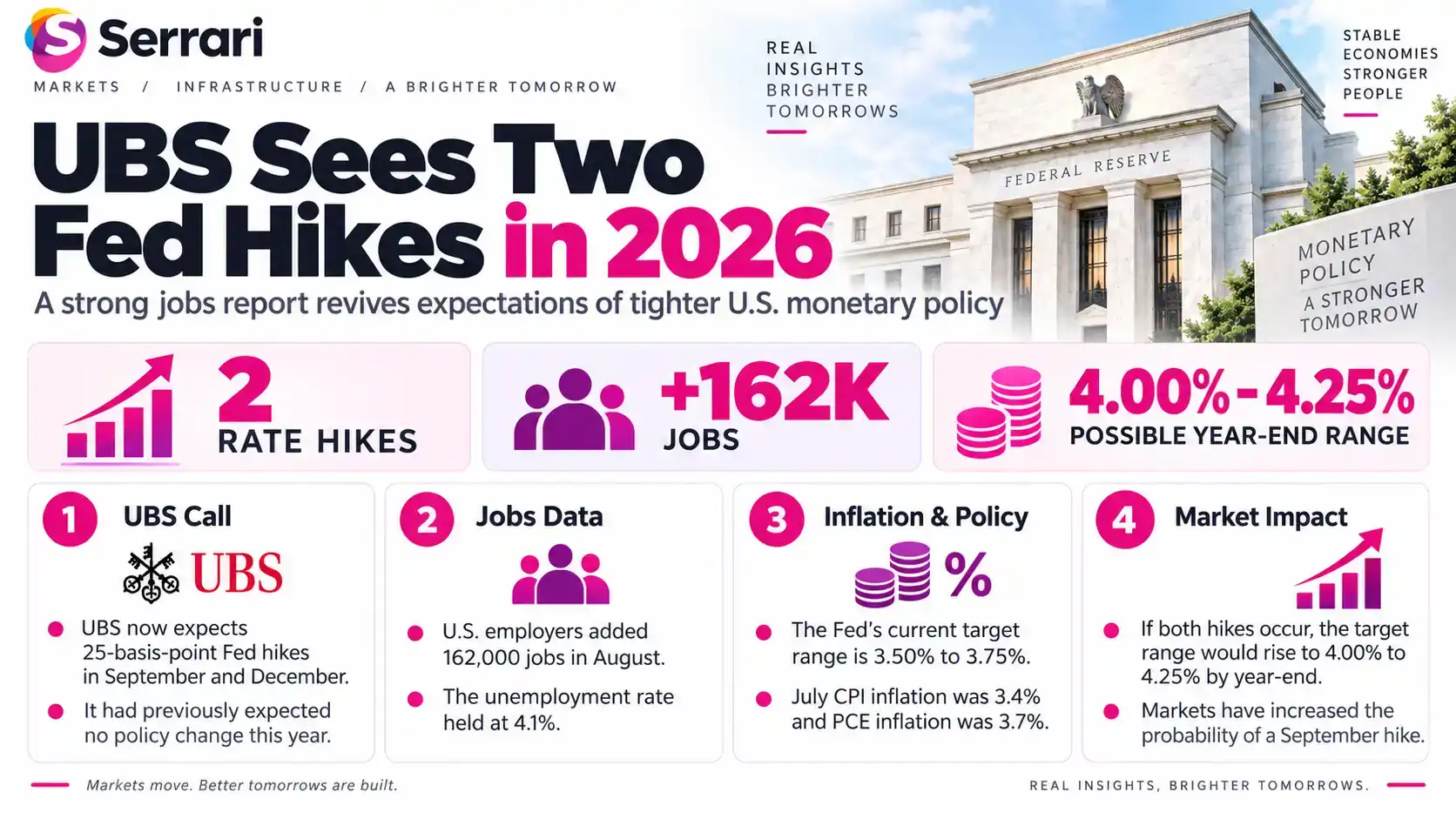
- UBS expects 25-basis-point Fed hikes in September and December 2026.
- The bank previously expected no further policy changes this year.
- U.S. employers created 162,000 jobs in August, significantly exceeding market expectations.
- The unemployment rate remained unchanged at 4.1%.
- The Fed’s current target range stands at 3.50%–3.75%.
- July headline CPI inflation stood at 3.4%, while the Fed’s preferred PCE inflation measure was 3.7%.
- Markets are assigning roughly a 60% probability to a September rate increase, although upcoming inflation data remain crucial.
Strong Jobs Report Changes the Rate Outlook
UBS’s revised forecast follows an August employment report showing nonfarm payrolls increased by 162,000, compared with expectations of roughly 55,000–65,000 jobs across major economist surveys.
The unemployment rate remained at 4.1%, while the labour-force participation rate increased. Wage growth was more moderate, with average hourly earnings rising around 3.1% from a year earlier, helping temper some fears that the strong labour market would automatically generate additional wage-driven inflation.
Still, the magnitude of the payroll gain substantially reduced concerns that high borrowing costs were pushing the U.S. labour market toward a sharp slowdown. A resilient employment environment gives policymakers greater flexibility to focus on above-target inflation without facing the same immediate pressure to support jobs through lower interest rates.
UBS Global Wealth Management consequently changed its 2026 policy forecast from no additional moves to quarter-point increases at both the September and December meetings.
Inflation Keeps Pressure on the Federal Reserve
The employment data are only one side of the Fed’s dual mandate. Inflation remains materially above the central bank’s 2% target, making the direction of prices increasingly important to the September decision.
The latest July consumer inflation figures showed headline CPI rising 3.4% year on year, although that was slightly lower than June’s 3.5%. Core CPI, excluding food and energy, increased 2.5%.
The Fed’s preferred inflation gauge has been running hotter. The July PCE price index increased 3.7% from a year earlier, while core PCE inflation stood at 3.3%.
That leaves policymakers confronting an economy where employment remains relatively strong while inflation is still above target — a combination that strengthens the argument for keeping monetary conditions restrictive.
Context is everything. Stay ahead of shifting trends with today’s market updates, and uncover emerging opportunities using the Serrari Group Market Index and Marketplace. Then, take control of your own financial future by exploring our Money & Life Reset Transformation Blueprint ™ to build stronger habits, create better systems, and design a path toward lasting wealth.
Warsh Signals Inflation Remains the Priority
Chair Kevin Warsh reinforced that message during his Jackson Hole address on August 28, saying that labour markets were stable and economic output remained solid while inflation was still too high.
Warsh described the Fed’s 2% PCE inflation objective as a firm target and said policymakers must be confident underlying inflation is moving toward that level at a sufficient pace.
His comments marked a distinctly cautious stance toward declaring victory over inflation. Warsh noted that while recent inflation readings had improved, the progress was not yet enough to convince him that the underlying trend had materially changed.
The Federal Reserve had already kept rates at 3.50%–3.75% in July, although three policymakers dissented and preferred an immediate quarter-point increase, illustrating the growing debate over whether further tightening is necessary.
Fed Officials Remain Divided Ahead of September
Not every policymaker is convinced that a September increase is required. Governor Christopher Waller recently indicated he could support leaving rates unchanged if incoming inflation figures continue showing that price pressures are moderating.
Waller’s position highlights why the Fed’s September 15–16 meeting remains finely balanced. Strong employment strengthens the case for tightening, but softer inflation readings immediately before the meeting could still persuade policymakers to wait.
Other financial institutions have adjusted their forecasts following the jobs data. Citigroup, for example, pushed its next expected rate cut into 2027, abandoning its previous projection for easing beginning later this year as the strong labour market shifted attention back toward inflation.
Markets Increase Bets on a September Hike
Investors have reacted quickly to the stronger employment picture. Futures markets increased the probability of a 25-basis-point September increase to around 58%–60%, compared with approximately 50% before the employment report.
The market-implied probabilities remain highly sensitive to incoming economic releases, particularly inflation data due before the Fed meeting.
Higher expectations for monetary tightening have already affected financial markets. Treasury yields rose after the employment report as investors priced in the possibility that rates could remain elevated for longer, while equities came under pressure from concerns about higher borrowing costs.
If UBS proves correct, two additional quarter-point increases would bring the federal funds target range to 4.00%–4.25% by December. That would affect borrowing costs across mortgages, corporate debt and other credit markets while potentially supporting the dollar and putting pressure on rate-sensitive assets.
The September decision will therefore depend on whether the Fed views the latest employment strength as confirmation that the economy can withstand another rate hike without jeopardising its maximum-employment mandate. With inflation still above target and labour conditions proving stronger than expected, the argument for renewed tightening has become considerably stronger than it appeared only weeks ago.
Sources: Reuters / U.S. Bureau of Labor Statistics / Federal Reserve / Bureau of Economic Analysis / CME Group
Your financial future isn’t something you wait for—it’s something you build.
The real question is: when do you begin?
Move beyond simply staying informed.
Navigate the markets with clarity—track trends through the Serrari Group Market Index, uncover opportunities in the Serrari Marketplace, and build practical knowledge with our Curated Wealth Builder Platform.
Stay connected to what truly matters.
Get daily insights on macro trends and financial movements across Kenya, Africa, and global markets—delivered through the Serrari Newsletter.
Growth opens doors.
Advance your career through professional programs including ACCA, HESI A2, ATI TEAS 7 , HESI EXIT , NCLEX – RN and NCLEX – PN, Financial Literacy!🌟—designed to move you forward with confidence.
See where money is flowing—clearly and in real time.
Track Money Market Funds, Treasury Bills, Treasury Bonds, Green Bonds, and Fixed Deposits, alongside global and African indexes, key economic indicators, and the evolving Crypto and stablecoin landscape—all within Serrari’s Market Index.