Türkiye has expanded a major infrastructure privatization programme that could transfer the operating rights of two Istanbul bridges and a wider group of state-run highways to private operators for 30 years. The move follows Presidential Decision No. 11750, published on September 5, 2026, which added three motorway assets to an existing privatization framework.
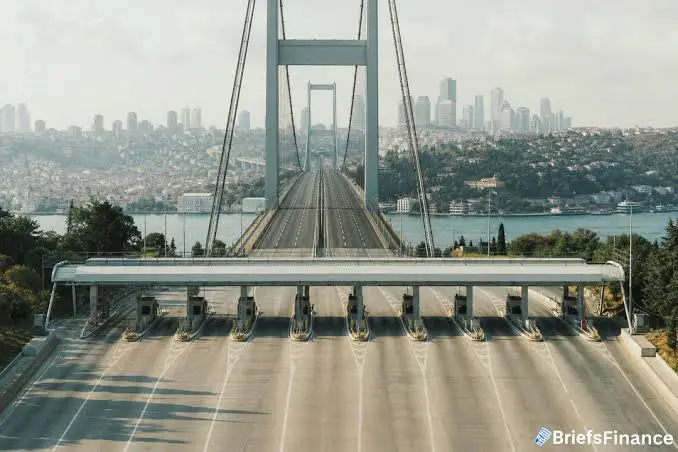
The July 15 Martyrs Bridge and Fatih Sultan Mehmet Bridge are among the most prominent assets covered. Crucially, the plan does not transfer ownership of the bridges or highways. The Turkish state will retain title while private investors may receive time-limited operating rights and take responsibility for maintenance, investment and day-to-day management.
Key Overview
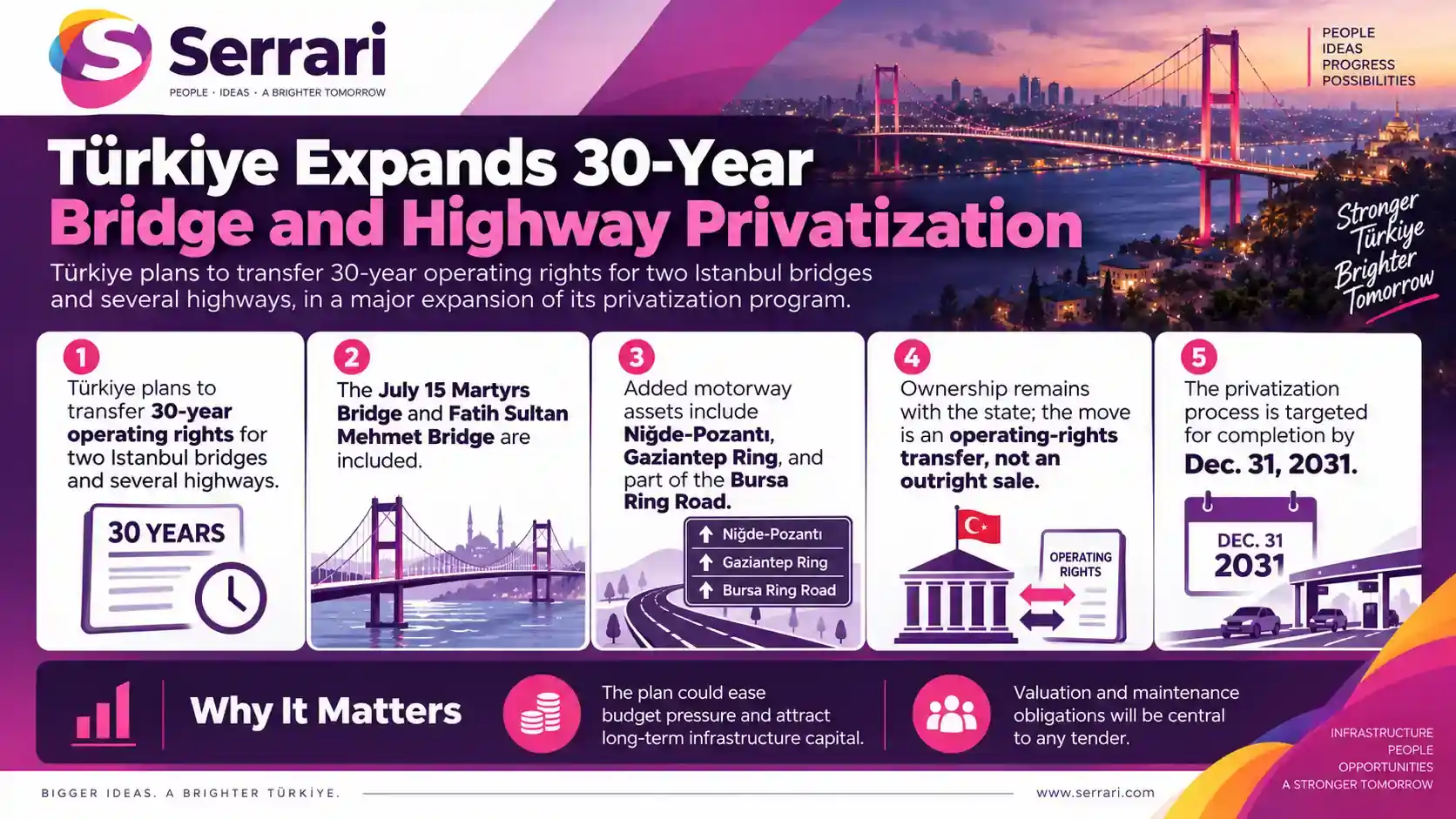
- Türkiye has set a 30-year operating period for bridges and highways included in the expanded privatization programme.
- The July 15 Martyrs Bridge and Fatih Sultan Mehmet Bridge are among the assets covered.
- Newly added roads include the Niğde-Pozantı Motorway, Gaziantep Ring Motorway and part of the Bursa Ring Road.
- State ownership will remain unchanged; the plan concerns operating rights rather than outright asset sales.
- The Privatization Administration has been authorized to manage the process, which is targeted for completion by December 31, 2031.
- Türkiye previously rejected a $5.72 billion bid for a 25-year bridge-and-highway operating package in 2013.
New Decree Broadens Türkiye’s Privatization Programme
The latest decision adds the Niğde-Pozantı Motorway, Gaziantep Ring Motorway and the Çağlayan Junction-Yenişehir Junction section of the Bursa Ring Road to the programme. The expanded framework also incorporates roads and bridges covered by earlier privatization decisions dating back to 2003 and 2010.
Associated infrastructure is included as well, covering connecting roads, maintenance and operating facilities, service areas, toll-collection centres and other supporting assets.
The two Istanbul crossings are particularly important. The July 15 Martyrs Bridge and Fatih Sultan Mehmet Bridge connect the European and Asian sides of Istanbul and together handled more than 430,000 vehicles a day in 2024.
The new framework also gives authorities more flexibility than the earlier privatization attempt. Assets may be offered together or divided into separate groups, potentially allowing different operators or investor groups to bid for individual packages.
Ownership Stays With the State
Despite the term “privatization,” Türkiye is not proposing to permanently sell the bridges and highways. The Privatization Administration clarified that ownership will remain with the state while operating rights may be transferred for a defined period.
The administration also stressed that publication of the decision does not itself mean a tender has been launched. Instead, the decree authorizes the agency to undertake the legal, technical and financial work needed to prepare any future privatization transaction.
Officials say the policy is intended to improve service quality, accelerate maintenance and investment and increase operating efficiency. Transport Minister Abdulkadir Uraloğlu had earlier explained that the government was studying operating-right transfers partly to move heavy maintenance and investment costs away from the central budget.
Authorities have also said the current decision does not automatically make free highways tolled, impose an additional toll increase or remove existing employment rights.
Context is everything. Stay ahead of shifting trends with today’s market updates, and uncover emerging opportunities using the Serrari Group Market Index and Marketplace. Then, take control of your own financial future by exploring our Money & Life Reset Transformation Blueprint ™ to build stronger habits, create better systems, and design a path toward lasting wealth.
Türkiye Revisits a Deal Rejected More Than a Decade Ago
Türkiye has tried to monetize the operating rights of its major bridges and highways before. A tender launched under a 2010 decision offered a large package of roads and the two Bosphorus bridges under a 25-year concession.
In December 2012, a consortium involving Koç Holding, Malaysia’s UEM Group and Gözde Girişim submitted the highest bid of $5.72 billion. The government ultimately cancelled the transaction in early 2013 after concluding that the offer undervalued the assets.
The latest programme differs in several important ways. The proposed operating period has increased from 25 to 30 years, more motorway assets have been added and the government is no longer required to privatize the entire portfolio as a single package.
This flexibility could broaden potential investor interest, particularly among international infrastructure funds, toll-road operators and long-term institutional investors.
Maintenance Costs and Valuation Will Shape the Tender
How Türkiye values the assets will be central to any eventual transaction. The Privatization Administration has pushed back against claims that state highways generate about $600 million in annual profit, saying the figure represents revenue rather than profit.
Officials estimate that roughly $300 million of that amount goes toward maintenance and repairs, before accounting for additional renewal investments, staffing and operating expenses. Any valuation will therefore need to incorporate future traffic, toll income, maintenance obligations, financing costs and investment requirements.
The government has set December 31, 2031 as the deadline for completing privatization procedures, leaving significant time for preparation, valuation and potential tenders.
For investors, the attraction lies in gaining long-term exposure to strategic transport routes with established traffic flows. For Türkiye, the challenge will be securing a price and operating model that improves infrastructure management without giving up ownership of some of its most important transport assets.
Sources: Resmi Gazete Ozeti / Anadolu Agency / Reuters / Euronews / Daily Sabah
Your financial future isn’t something you wait for—it’s something you build.
The real question is: when do you begin?
Move beyond simply staying informed.
Navigate the markets with clarity—track trends through the Serrari Group Market Index, uncover opportunities in the Serrari Marketplace, and build practical knowledge with our Curated Wealth Builder Platform.
Stay connected to what truly matters.
Get daily insights on macro trends and financial movements across Kenya, Africa, and global markets—delivered through the Serrari Newsletter.
Growth opens doors.
Advance your career through professional programs including ACCA, HESI A2, ATI TEAS 7 , HESI EXIT , NCLEX – RN and NCLEX – PN, Financial Literacy!🌟—designed to move you forward with confidence.
See where money is flowing—clearly and in real time.
Track Money Market Funds, Treasury Bills, Treasury Bonds, Green Bonds, and Fixed Deposits, alongside global and African indexes, key economic indicators, and the evolving Crypto and stablecoin landscape—all within Serrari’s Market Index.