
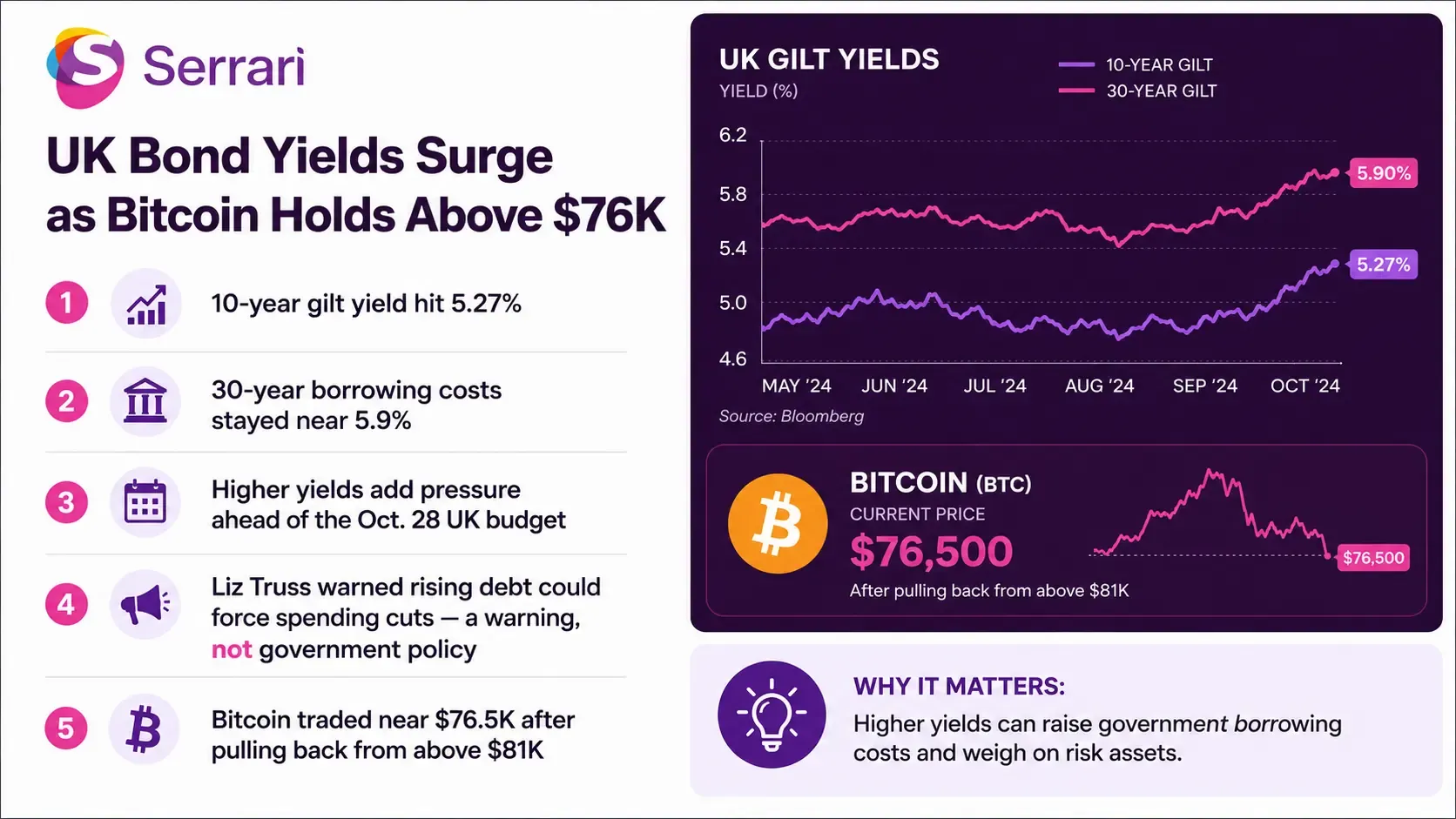
U.K. government borrowing costs surged on September 2 as a global bond selloff intensified, adding pressure to Britain’s public finances ahead of the October Budget. The benchmark 10-year gilt yield climbed as high as 5.294%, its highest level since August 2007, while 30-year borrowing costs remained close to 5.9%.
The move coincided with escalating geopolitical tensions, higher oil prices and renewed inflation concerns across major economies. Bitcoin, meanwhile, remained around the mid-$76,000 range during the selloff, showing resilience but also highlighting how higher bond yields are creating a tougher environment for non-yielding and risk-sensitive assets.
Key Overview
- U.K. 10-year gilt yields reached 5.294%, their highest level in roughly 19 years.
- Thirty-year U.K. borrowing costs remained close to 5.9%, around levels last seen in 1998.
- Higher yields could substantially reduce the government’s fiscal buffer before the October 28 Budget.
- Former Prime Minister Liz Truss warned that Britain’s debt pressures could ultimately result in emergency spending cuts, although no such policy has been announced.
- Bitcoin traded near $76,500 as Brent crude moved above $93 and U.S. Treasury yields approached 4.8%.
- The U.K. selloff forms part of a broader repricing of government bonds rather than an exclusively British shock.
UK Borrowing Costs Intensify Budget Pressure
Britain’s bond market deteriorated further on September 2, with the 10-year gilt yield initially reaching 5.268% before later rising to about 5.294%, extending a sharp increase from the previous session. Five-year gilt yields also rose to around 4.75%, while longer-dated borrowing costs stayed near multi-decade highs.
Higher yields do not mean the government immediately refinances its entire debt stock at those rates. Instead, the effect builds as existing bonds mature, new bonds are issued and official fiscal forecasts incorporate changing market interest-rate assumptions.
That still matters significantly for Britain’s budget calculations. Economists estimated that the latest increase in interest costs could reduce fiscal headroom to roughly £13 billion from £23.6 billion previously.
The £23.6 billion starting figure is consistent with the government’s March fiscal projections, which showed £23.6 billion of headroom against its stability rule.
Britain’s 2026 Budget has been officially scheduled for Wednesday, October 28, when updated economic and fiscal forecasts are also expected to be published. Until those calculations are completed, the precise effect of today’s bond yields on future taxation or spending remains uncertain.
Context is everything. Stay ahead of shifting trends with today’s market updates, and uncover emerging opportunities using the Serrari Group Market Index and Marketplace. Then, take control of your own financial future by exploring our Money & Life Reset Transformation Blueprint ™ to build stronger habits, create better systems, and design a path toward lasting wealth.
Truss Warning Is Not Government Policy
Former Prime Minister Liz Truss argued that increasing sovereign debt and what she described as currency debasement were contributing to rising global borrowing costs. She warned that Britain could eventually face “imposed emergency spending cuts” if economic growth and spending restraint fail to stabilise the situation.
That warning is a forecast rather than an announced government policy. No emergency spending package has been confirmed, and the eventual fiscal response will depend on borrowing costs, inflation, economic growth, tax revenues and the forecasts prepared for October.
Truss’s intervention inevitably recalls the market turmoil of 2022. During that episode, severe instability in long-dated gilts prompted the central bank to begin temporary purchases of long-dated government bonds to restore orderly market conditions.
The present environment is different, however. Government bond yields have been rising across several major economies, making the latest U.K. move part of a broader global repricing rather than a reaction to one domestic fiscal announcement.
Oil and Global Yields Add to the Selloff
Renewed fighting involving the U.S. and Iran has increased concerns about energy supplies and inflation. Brent crude moved above $93 per barrel as the conflict escalated, while the benchmark U.S. 10-year Treasury yield moved toward 4.8%.
Higher oil prices can reinforce inflationary pressure because energy feeds into transport, manufacturing and household costs. Persistent inflation can, in turn, reduce the likelihood of aggressive interest-rate cuts, making existing lower-yielding bonds less attractive and pushing their market yields higher.
Government borrowing costs have consequently risen beyond Britain, including across the U.S., Germany, France and Japan. For the U.K., however, sustained high yields are particularly important because they can progressively raise debt-servicing costs and reduce the fiscal room available for other priorities.
Bitcoin Holds Above $76K Despite Macro Pressure
Bitcoin traded around $76,500 during September 2 after falling more than 1% from midnight UTC and about 3% over the preceding week. The cryptocurrency had previously rallied from roughly $64,000 to a recent high around $81,000 before retreating.
The pullback illustrates the competing forces affecting digital assets. Bitcoin can attract investors concerned about currency depreciation and sovereign debt, but rising government bond yields increase the returns available from conventional interest-paying securities.
That higher risk-free return can make non-yielding assets comparatively less attractive while tighter financial conditions reduce investors’ willingness to hold volatile investments.
Bitcoin’s ability to remain above $76,000 therefore represents relative resilience rather than immunity from the broader macroeconomic environment. If bond yields and energy prices remain elevated, the interaction between inflation expectations, interest rates and investor isk appetite is likely to remain a major influence on cryptocurrency markets.
Sources: Reuters / CoinDesk / Office for National Statistics / Bank of England / HM Treasury
Your financial future isn’t something you wait for—it’s something you build.
The real question is: when do you begin?
Move beyond simply staying informed.
Navigate the markets with clarity—track trends through the Serrari Group Market Index, uncover opportunities in the Serrari Marketplace, and build practical knowledge with our Curated Wealth Builder Platform.
Stay connected to what truly matters.
Get daily insights on macro trends and financial movements across Kenya, Africa, and global markets—delivered through the Serrari Newsletter.
Growth opens doors.
Advance your career through professional programs including ACCA, HESI A2, ATI TEAS 7 , HESI EXIT , NCLEX – RN and NCLEX – PN, Financial Literacy!🌟—designed to move you forward with confidence.
See where money is flowing—clearly and in real time.
Track Money Market Funds, Treasury Bills, Treasury Bonds, Green Bonds, and Fixed Deposits, alongside global and African indexes, key economic indicators, and the evolving Crypto and stablecoin landscape—all within Serrari’s Market Index.