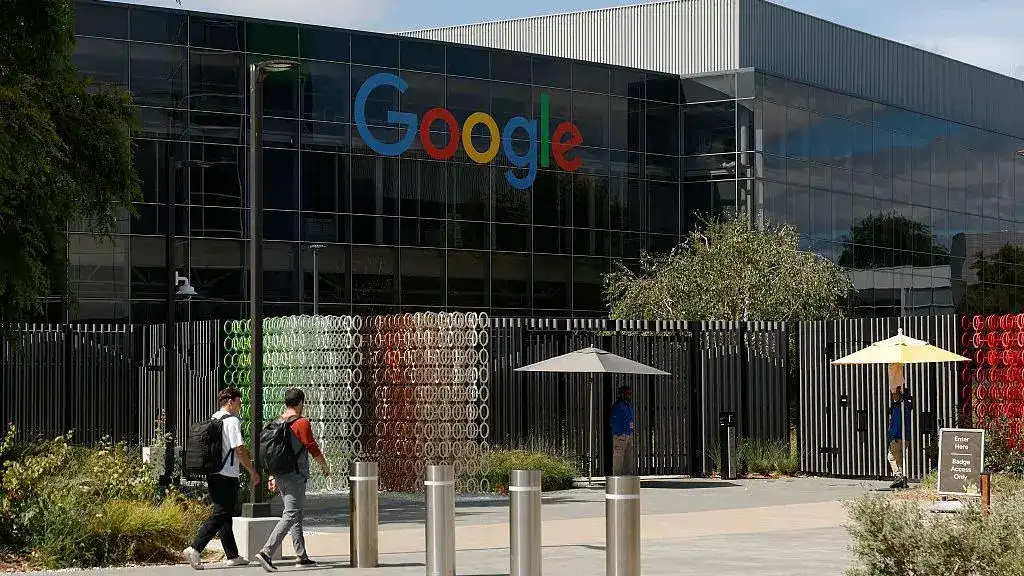
Google’s first AI hub in India has moved from announcement to construction, turning Visakhapatnam into one of the country’s most ambitious digital-infrastructure bets. The company’s US$15 billion commitment spans 2026 to 2030 and combines a gigawatt-scale data centre campus, new subsea cable infrastructure, expanded fibre networks and large-scale energy investment.
The project is designed to bring high-performance AI computing closer to Indian businesses, developers and researchers while strengthening international connectivity on India’s eastern coast. Construction officially began in April 2026, marking the shift from planning to physical buildout.
Key Overview
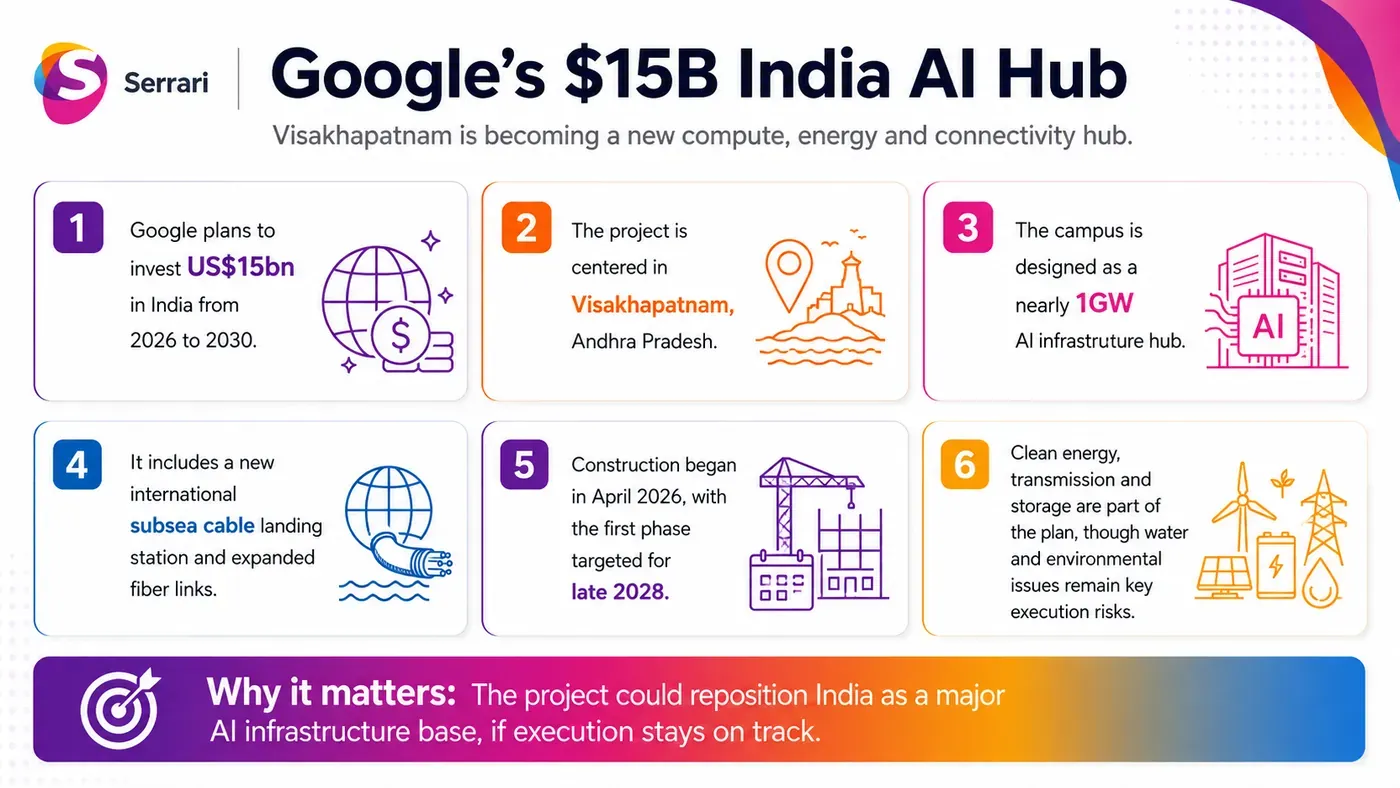
- The investment totals approximately US$15 billion between 2026 and 2030, making it Google’s largest investment in India to date.
- The Visakhapatnam campus is being developed as a nearly 1GW AI infrastructure hub with partners including AdaniConneX and Nxtra by Airtel.
- The project includes a new international cable landing station and multiple subsea cable connections on India’s eastern coast.
- The first phase is targeted to become operational by late 2028, with the wider buildout expected to continue over several years.
- The project also includes new transmission, clean-energy and storage infrastructure, although water use and environmental impacts have become important execution risks.
A Full AI Infrastructure Stack Takes Shape
The Visakhapatnam project goes well beyond a conventional cloud data centre. It is intended to provide the infrastructure required for large-scale AI training, inference and cloud services, supported by high-capacity power and network connections.
At the centre is a purpose-built campus capable of delivering gigawatt-scale computing capacity. Google has said the infrastructure will support the same class of services used across products such as Search, YouTube and Workspace while providing enterprises and startups with lower-latency access to advanced AI infrastructure.
The project is being developed alongside AdaniConneX and Nxtra by Airtel. AdaniConneX is involved in the data centre and energy infrastructure, while Airtel is helping develop connectivity and the cable landing system. The partners are effectively building an ecosystem around compute, electricity and telecommunications rather than a standalone facility.
Construction began at Tarluvada near Visakhapatnam on April 28, 2026. By late August, Google indicated that the first phase could be ready by late 2028, reflecting the complexity of coordinating data centre buildings, renewable generation, transmission capacity and subsea connectivity.
Visakhapatnam Becomes a New Connectivity Gateway
One of the project’s most strategically important elements is the creation of a major international subsea gateway. India’s international cable capacity has historically been concentrated around cities such as Mumbai and Chennai, so an additional eastern-coast landing point provides geographic diversification.
Airtel and Google plan to establish a new cable landing station in Visakhapatnam that will connect new international subsea cables with domestic fibre infrastructure. Multiple cable landings could reduce dependence on existing routes and improve resilience for cloud and AI workloads.
For Indian businesses, that matters because advanced AI services depend not only on computing power but also on reliable, low-latency data movement. A large compute cluster without sufficient connectivity would struggle to serve customers efficiently across India and international markets.
The hub therefore positions Visakhapatnam as both a computing centre and an internet gateway, potentially attracting additional cloud, telecom and digital-infrastructure investment to the region.
Context is everything. Stay ahead of shifting trends with today’s market updates, and uncover emerging opportunities using the Serrari Group Market Index and Marketplace. Then, take control of your own financial future by exploring our Money & Life Reset Transformation Blueprint ™ to build stronger habits, create better systems, and design a path toward lasting wealth.
Energy Demand Becomes the Critical Constraint
AI infrastructure at this scale requires enormous amounts of electricity. Google’s plans include new transmission lines, clean-energy generation and energy-storage systems intended to support the campus while adding capacity to the wider grid.
That investment is becoming increasingly important as data centres compete with households and industry for power and water. In Visakhapatnam, the project has already faced legal and environmental challenges over water and wildlife concerns.
Local campaigners have raised concerns about water availability and the site’s proximity to the Kambalakonda Wildlife Sanctuary. State authorities have disputed claims that the project will divert water intended for residential or rural users, while Google has said it plans to use advanced air-cooling technology to reduce pressure on local water resources.
Those disputes highlight a broader issue facing the global AI buildout: securing compute capacity is only one part of the equation. Energy availability, transmission capacity, water use and community acceptance can increasingly determine how quickly large AI projects reach operation.
India’s AI Infrastructure Race Accelerates
The scale of the Visakhapatnam hub signals a shift in India’s position within the global AI economy. Rather than relying mainly on overseas computing infrastructure, India is attracting increasingly large investments in domestic capacity capable of supporting AI services at scale.
The project also aligns with India’s broader ambition to expand digital infrastructure and artificial-intelligence adoption under its long-term development strategy. By combining compute, energy and connectivity in one location, the hub could help Indian companies access advanced infrastructure closer to their customers while strengthening the country’s role in global cloud networks.
However, execution will be the key test. The US$15 billion commitment is spread over five years, the first phase is still roughly two years from operation, and environmental and infrastructure constraints remain significant.
If the project stays on schedule, Visakhapatnam could emerge as one of Asia’s more important AI infrastructure clusters. Its success will depend not only on how much computing power is installed, but on whether the surrounding energy, cable and environmental systems can scale with it.
Sources: Google / Google Cloud Press Corner / Airtel / Adani / Reuters / Business Standard / Press Information Bureau
Your financial future isn’t something you wait for—it’s something you build.
The real question is: when do you begin?
Move beyond simply staying informed.
Navigate the markets with clarity—track trends through the Serrari Group Market Index, uncover opportunities in the Serrari Marketplace, and build practical knowledge with our Curated Wealth Builder Platform.
Stay connected to what truly matters.
Get daily insights on macro trends and financial movements across Kenya, Africa, and global markets—delivered through the Serrari Newsletter.
Growth opens doors.
Advance your career through professional programs including ACCA, HESI A2, ATI TEAS 7 , HESI EXIT , NCLEX – RN and NCLEX – PN, Financial Literacy!🌟—designed to move you forward with confidence.
See where money is flowing—clearly and in real time.
Track Money Market Funds, Treasury Bills, Treasury Bonds, Green Bonds, and Fixed Deposits, alongside global and African indexes, key economic indicators, and the evolving Crypto and stablecoin landscape—all within Serrari’s Market Index.