
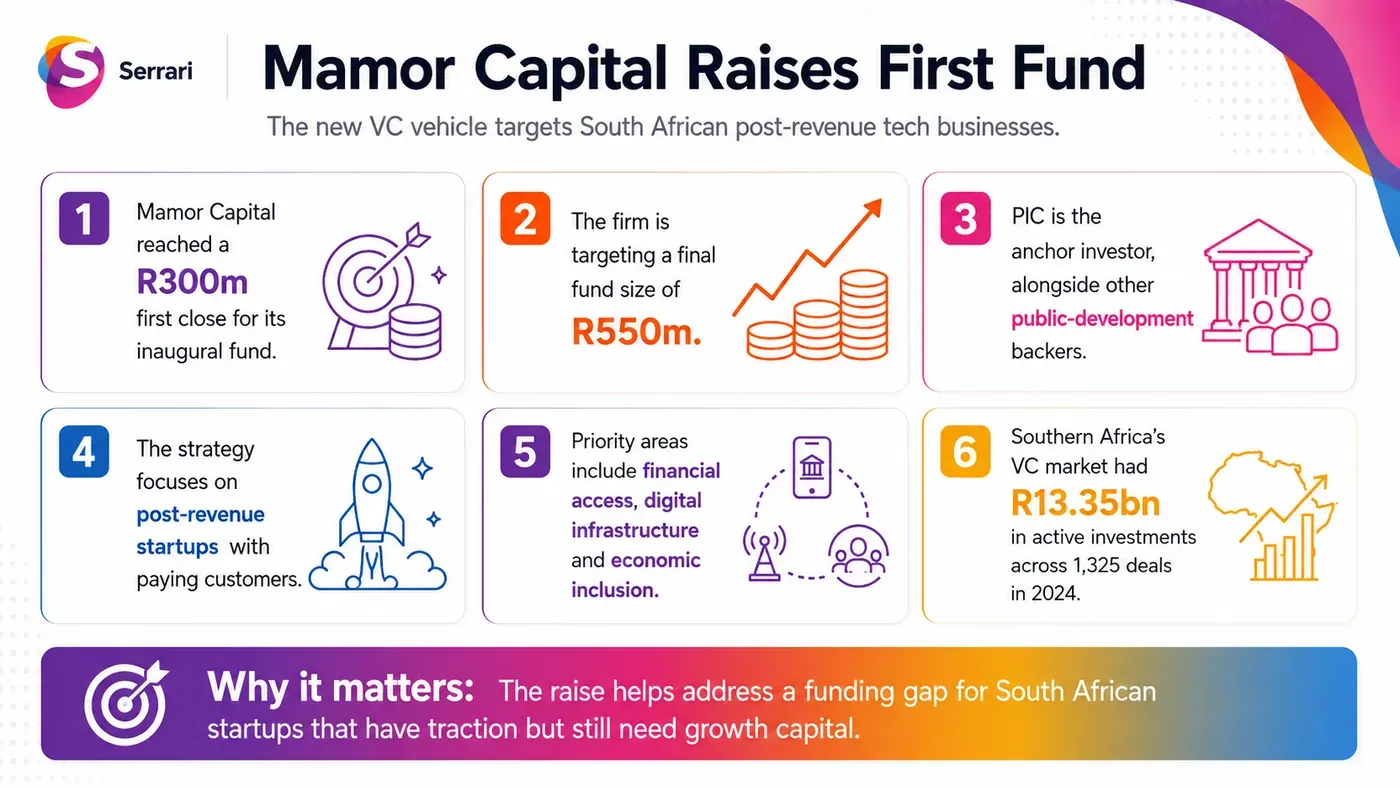
South African venture firm Mamor Capital Ventures has reached a R300 million first close for its inaugural fund, giving it capital to begin backing post-revenue technology businesses while it continues fundraising toward a R550 million target.
The first close is anchored by the Public Investment Corporation, with additional commitments from the High Impact Seed Fund of Funds, the Technology Innovation Agency and the Small Enterprise Development and Finance Agency. The fund’s strategy is aimed at a persistent gap in South Africa’s startup market: companies that have moved beyond the idea stage and can demonstrate real customer demand, but are still too early or risky for conventional bank financing.
Key Overview
- Mamor Capital has secured R300 million at first close and is targeting a final fund size of R550 million.
- The fund will focus on South African technology businesses that are already generating revenue rather than pre-product startups.
- Investment themes include financial access, digital infrastructure and technology that expands economic participation.
- The raise follows more than three years of fundraising, illustrating how difficult it remains for emerging venture managers to attract institutional capital.
- Southern Africa’s venture market ended 2024 with R13.35 billion in active investments across 1,325 deals, showing that the ecosystem is growing even as exits and follow-on funding remain constraints.
Mamor Targets the Post-Revenue Funding Gap
Mamor’s investment strategy sits between seed-stage experimentation and the larger growth rounds that more established businesses can access. The firm says it is looking for companies that have already proved customers are willing to pay, but still need capital to scale operations, deepen distribution or enter new markets.
That distinction is important because post-revenue does not necessarily mean profitable. Mamor’s approach is to assess whether a company has commercial demand, customer retention, a sufficiently large addressable market and a credible route toward sustainable profitability.
This allows the fund to avoid some of the highest-risk pre-revenue investments while still targeting businesses early enough to offer venture-style return potential. The strategy also gives founders another financing option at a stage where bank debt may be unavailable because of limited collateral, short operating histories or uncertain cash flows.
The fund will concentrate on businesses using technology to expand digital and financial access and address barriers to wider economic participation. That could include companies operating in areas such as fintech, digital infrastructure and technology-enabled services.
Institutional Backing Could Matter Beyond One Fund
The involvement of large public institutions is one of the most significant elements of the first close. Venture capital remains a relatively small allocation for many South African institutional investors because investment horizons are long, exits can be uncertain and early-stage companies carry higher failure risk.
The PIC has nevertheless been building exposure to the asset class through its early-stage strategy. Its earlier investment disclosures identified Mamor among the fund managers receiving anchor backing as part of an effort to crowd additional capital into venture funds and broaden institutional participation.
That matters because an anchor investor can do more than provide capital. A large institutional commitment can improve a fund manager’s credibility with other limited partners and make subsequent fundraising easier. Mamor said the PIC also helped mobilise further institutional commitments into Fund 1.
The SA SME Fund’s participation through its High Impact Seed Fund of Funds reinforces the same theme. That programme was created to strengthen South Africa’s early-stage innovation ecosystem by allocating capital through specialist fund managers rather than investing directly in startups.
For a first-time manager, securing this mix of institutional backing provides validation at a time when many local pension funds, banks and other large investors remain cautious about venture capital.
Context is everything. Stay ahead of shifting trends with today’s market updates, and uncover emerging opportunities using the Serrari Group Market Index and Marketplace. Then, take control of your own financial future by exploring our Money & Life Reset Transformation Blueprint ™ to build stronger habits, create better systems, and design a path toward lasting wealth.
South Africa’s VC Market Is Growing but Still Uneven
Mamor is raising into a market that has expanded substantially in recent years. Southern Africa recorded R13.35 billion in active VC investments across 1,325 deals by the end of 2024, up 24% year-on-year.
Technology remained dominant, accounting for 65.9% of deal value, while software and fintech were among the strongest subsectors. Series A activity also increased sharply, representing 42.5% of deals during 2024, signalling growing investor interest in companies that have moved beyond the earliest startup phase.
However, the market still faces important structural weaknesses. Limited exits can reduce the amount of capital recycled back into new funds, while gaps in follow-on financing can leave otherwise viable companies unable to fund their next stage of expansion.
That is the opportunity Mamor is trying to capture. Rather than competing primarily for very early ideas, the firm is positioning itself around companies that have already demonstrated commercial traction but have not yet become obvious candidates for larger institutional or private-equity capital.
First Close Is Only the Beginning
The R300 million first close gives Mamor the ability to begin deploying capital, but the firm still needs another R250 million to reach its R550 million target.
Fund performance will ultimately depend on investment selection, portfolio growth and eventual exits rather than fundraising alone. Post-revenue businesses may carry less product-market risk than pre-revenue startups, but they still face competition, execution risks and difficult paths to scale.
Even so, the first close is an important signal for South Africa’s venture ecosystem. It gives a black women-owned and managed investment firm institutional capital to back local technology companies while creating another potential bridge between seed-stage funding and larger growth capital.
If Mamor can deploy the fund successfully and deliver competitive returns, its impact may extend beyond its own portfolio by strengthening the case for more pension, institutional and public-sector capital to enter South African venture funds.
Sources: Mamor Capital Ventures / TechCabal / Public Investment Corporation / SAVCA / SA SME Fund / ITWeb
Your financial future isn’t something you wait for—it’s something you build.
The real question is: when do you begin?
Move beyond simply staying informed.
Navigate the markets with clarity—track trends through the Serrari Group Market Index, uncover opportunities in the Serrari Marketplace, and build practical knowledge with our Curated Wealth Builder Platform.
Stay connected to what truly matters.
Get daily insights on macro trends and financial movements across Kenya, Africa, and global markets—delivered through the Serrari Newsletter.
Growth opens doors.
Advance your career through professional programs including ACCA, HESI A2, ATI TEAS 7 , HESI EXIT , NCLEX – RN and NCLEX – PN, Financial Literacy!🌟—designed to move you forward with confidence.
See where money is flowing—clearly and in real time.
Track Money Market Funds, Treasury Bills, Treasury Bonds, Green Bonds, and Fixed Deposits, alongside global and African indexes, key economic indicators, and the evolving Crypto and stablecoin landscape—all within Serrari’s Market Index.