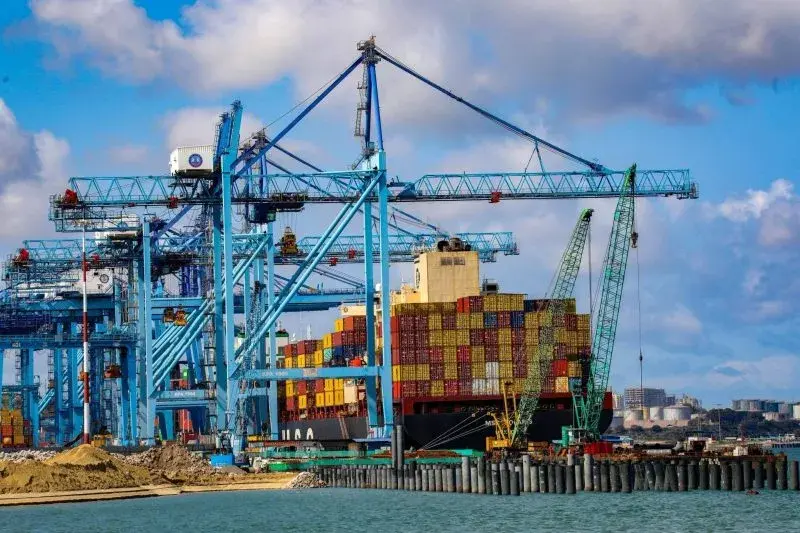
Kenya has moved four major port assets at Mombasa and Lamu into the procurement stage under the Public-Private Partnership framework, clearing the way for private investors to compete for long-term concessions. The approved assets are Mombasa Berths 11–14, Mombasa Container Terminal 1, Lamu Container Terminal Berths 1–3 and the Lamu Special Economic Zone.
The shift is part of a broader plan to move the two ports toward a landlord-port model in which the public sector keeps ownership and strategic oversight while private operators provide capital, equipment, operational expertise and terminal investment. Market engagement for the first phase is scheduled to begin in September 2026.
Key Overview
- The PPP Committee has approved feasibility studies for four strategic port assets in Mombasa and Lamu.
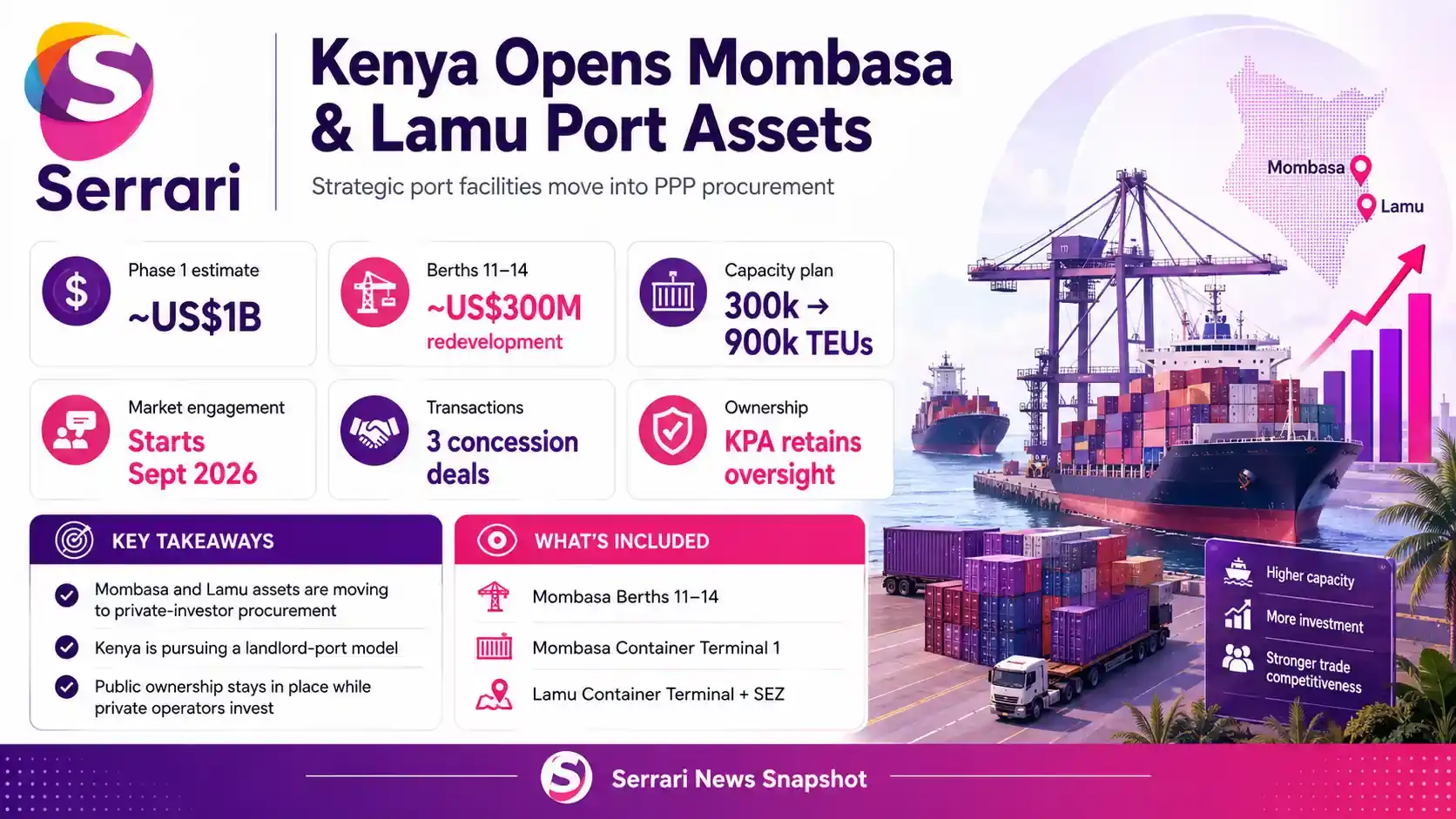
- Phase 1 will be structured as three transactions: Mombasa Berths 11–14, Mombasa Container Terminal 1, and an integrated Lamu Container Terminal–SEZ concession.
- Kenya Ports Authority will retain public ownership and strategic oversight.
- The first phase is estimated at about US$1 billion, with roughly US$300 million associated with redevelopment of Berths 11–14.
- Berths 11–14 are planned to expand from about 300,000 TEUs to 900,000 TEUs of annual yard capacity.
- A second phase of additional port assets is already undergoing feasibility work.
Port Concessions Move Into Competitive Procurement
The latest approval allows Kenya Ports Authority to advance the first phase into competitive procurement after the PPP Committee approved the feasibility studies for the four assets. The transactions are now moving beyond project preparation and toward direct engagement with potential investors.
The first phase will use three separate concession structures. Mombasa Berths 11–14 will form one transaction, Container Terminal 1 another, while the Lamu Container Terminal and Lamu Special Economic Zone will be offered as an integrated concession. A government PPP progress report had already identified the programme as a priority project under the Fourth Medium-Term Plan and confirmed competitive bidding as the intended procurement method.
The government expects investor engagement to begin in September 2026, with public disclosures and stakeholder engagement forming part of the procurement process.
Kenya Targets a Landlord-Port Operating Model
The strategic objective is to progressively shift Mombasa and Lamu toward a landlord-port model, where the port authority continues to own port land and core infrastructure while private companies operate terminals and invest in equipment and facilities.
For Kenya, the model is intended to bring private capital and specialist operating expertise into port expansion without transferring ownership of the underlying strategic assets. Kenya Ports Authority would remain the public owner and overseer while concessionaires take responsibility for agreed operational and investment obligations.
The structure could also allow KPA to focus more heavily on planning, regulation, common infrastructure and long-term port development rather than directly financing every terminal upgrade.
Context is everything. Stay ahead of shifting trends with today’s market updates, and uncover emerging opportunities using the Serrari Group Market Index and Marketplace. Then, take control of your own financial future by exploring our Money & Life Reset Transformation Blueprint ™ to build stronger habits, create better systems, and design a path toward lasting wealth.
Phase 1 Could Mobilise About US$1 Billion
The government’s 2026 investment projects catalogue estimates that development and concessioning of the Phase 1 port assets could mobilise approximately US$1 billion. The same catalogue puts the estimated investment required for Mombasa Berths 11–14 at about US$300 million.
That corrects a numerical inconsistency in some reporting that described the programme as a US$1 million initiative. The official catalogue lists the indicative funding requirement as approximately US$1,000 million.
At Lamu, Berths 1–3 are already built and equipped, while the Special Economic Zone is expected to generate revenue through businesses leasing space within the development. The integrated concession is designed to connect terminal activity with industrial and logistics investment around the port.
Mombasa Capacity Expansion Is Central to the Plan
Mombasa Berths 11–14 currently have container-handling capacity of about 300,000 TEUs annually. Under the redevelopment specifications, the berths would be rehabilitated, realigned and dredged to accommodate larger vessels, with yard capacity rising to about 900,000 TEUs a year.
Container Terminal 1, covering Berths 16–18, has capacity of approximately 962,000 TEUs annually. KPA is also developing Berth 19B, which is planned to extend the terminal quay by a further 240 metres.
The added capacity is intended to reduce congestion, improve cargo-handling efficiency and strengthen Mombasa’s position as a gateway for Kenya and neighbouring landlocked markets.
Earlier Legal Challenge Shaped the Process
The port concession programme has faced legal scrutiny before. A petition filed by the Taireni Association of Mijikenda challenged the earlier tender process covering several of the same assets, leading to conservatory orders and a three-judge bench.
Court records show the dispute was later compromised through a consent dated April 2, 2024, allowing the government to restart the programme under a revised PPP process. The latest procurement therefore places greater emphasis on competitive bidding, disclosure and stakeholder participation.
If successfully concluded, the concessions could become one of Kenya’s largest transport-sector PPP programmes, combining private financing with continued public ownership while expanding capacity at the country’s two most strategically important seaports.
Sources: People Daily / PPP Directorate / Invest Kenya / Kenya Ports Authority / Kenya Law / World Bank
Your financial future isn’t something you wait for—it’s something you build.
The real question is: when do you begin?
Move beyond simply staying informed.
Navigate the markets with clarity—track trends through the Serrari Group Market Index, uncover opportunities in the Serrari Marketplace, and build practical knowledge with our Curated Wealth Builder Platform.
Stay connected to what truly matters.
Get daily insights on macro trends and financial movements across Kenya, Africa, and global markets—delivered through the Serrari Newsletter.
Growth opens doors.
Advance your career through professional programs including ACCA, HESI A2, ATI TEAS 7 , HESI EXIT , NCLEX – RN and NCLEX – PN, Financial Literacy!🌟—designed to move you forward with confidence.
See where money is flowing—clearly and in real time.
Track Money Market Funds, Treasury Bills, Treasury Bonds, Green Bonds, and Fixed Deposits, alongside global and African indexes, key economic indicators, and the evolving Crypto and stablecoin landscape—all within Serrari’s Market Index.