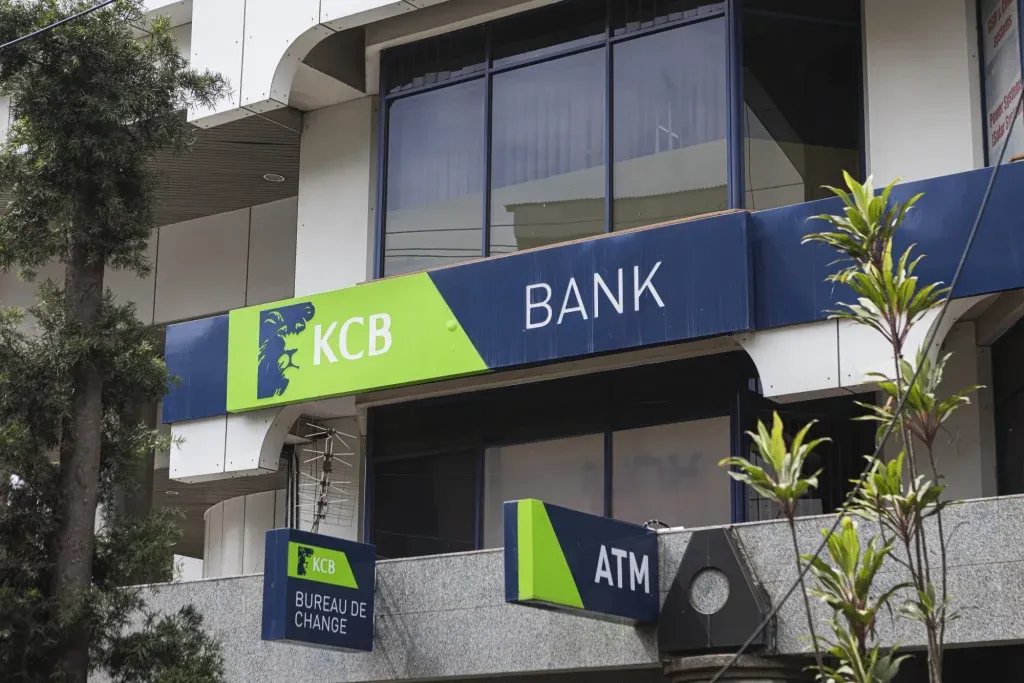
NSE banking stocks helped drive gains on the Nairobi Securities Exchange as investors responded to strong corporate earnings and improving market sentiment. KCB Group emerged as a major contributor, closing at KSh94.50 after reporting higher half-year profits, expanding its balance sheet and raising its interim dividend by 50%. The lender’s planned KSh300 billion sustainability bond programme has also drawn investor attention as KCB shares move closer to the psychological KSh100 level.
LIVENSE market summarySee NSE data →Key Overview
KCB Group reported a 20.8% increase in profit before tax to KSh49.3 billion for the six months to June 2026, while profit after tax rose 14% to KSh36.87 billion. The bank increased its interim dividend from KSh2 to KSh3 per share. Meanwhile, the broader NSE strengthened, with NASI gaining 2.7% and market capitalization reaching approximately KSh4.1 trillion.
KCB Group Drives NSE Banking Stocks Higher
KCB Group emerged as one of the notable drivers of the Nairobi Securities Exchange’s latest rally, with its share price moving closer to the KSh100 mark.
KCB closed the week at KSh94.50, leaving the counter less than KSh6 below the psychological threshold.
Investor interest followed the release of strong half-year financial results and the lender’s announcement of a substantial sustainability financing programme.
The performance adds to the strength seen across the banking sector, which has become an important driver of Kenya’s equity-market gains.
KCB Earnings Strengthen Investor Sentiment
KCB’s financial performance provided investors with several reasons for optimism.
Profit before tax increased 20.8% to KSh49.3 billion during the six months to June, compared with KSh40.8 billion in the corresponding period last year.
Profit after tax rose 14% to KSh36.87 billion, while total income increased 9.5% to KSh108.1 billion.
The bank’s balance sheet also expanded considerably. Total assets increased 16.8% to KSh2.3 trillion, while customer deposits rose 15.1% to KSh1.7 trillion.
Gross loans reached approximately KSh1.3 trillion, while KCB also reduced its stock of non-performing loans, improving the quality of its lending portfolio.
These figures indicate that the rally in KCB’s share prices is being supported by underlying earnings and balance-sheet growth rather than market sentiment alone.
Higher Dividend Adds to KCB’s Appeal
Shareholders are also benefiting directly from the stronger financial performance.
KCB’s board increased the interim dividend by 50% to KSh3 per share, compared with KSh2 during the corresponding period last year.
That translates into a total interim distribution of approximately KSh9.64 billion.
Dividend growth can strengthen the investment case for banking shares, particularly for investors looking for a combination of capital appreciation and income.
For KCB, the higher payout provides another potential catalyst as investors assess whether the stock can move above KSh100.
Context is everything. Stay ahead of shifting trends with today’s market updates and uncover emerging opportunities using the Serrari Group Market Index and Marketplace. Then, take control of your own financial future by exploring our Money & Life Reset Transformation Blueprint ™ to build stronger habits, create better systems, and design a path toward lasting wealth.
KSh300 Billion Sustainability Bond Programme
Investor attention has also turned to KCB’s proposed five-year Medium-Term Note programme.
The lender intends to establish a programme capable of raising up to KSh300 billion, subject to regulatory approvals and prevailing market conditions.
The first tranche could raise as much as KSh100 billion.
The programme would finance green, blue and social projects and, if fully executed, would rank among the largest corporate debt programmes contemplated in Kenya.
While the programme does not directly determine KCB’s equity valuation, it could broaden the lender’s long-term funding sources and support future lending growth.
Investors will therefore be watching how efficiently KCB deploys any capital raised and whether funded projects generate sustainable returns.
Nairobi Securities Exchange Extends Rally
The positive performance extended beyond individual NSE banking stocks.
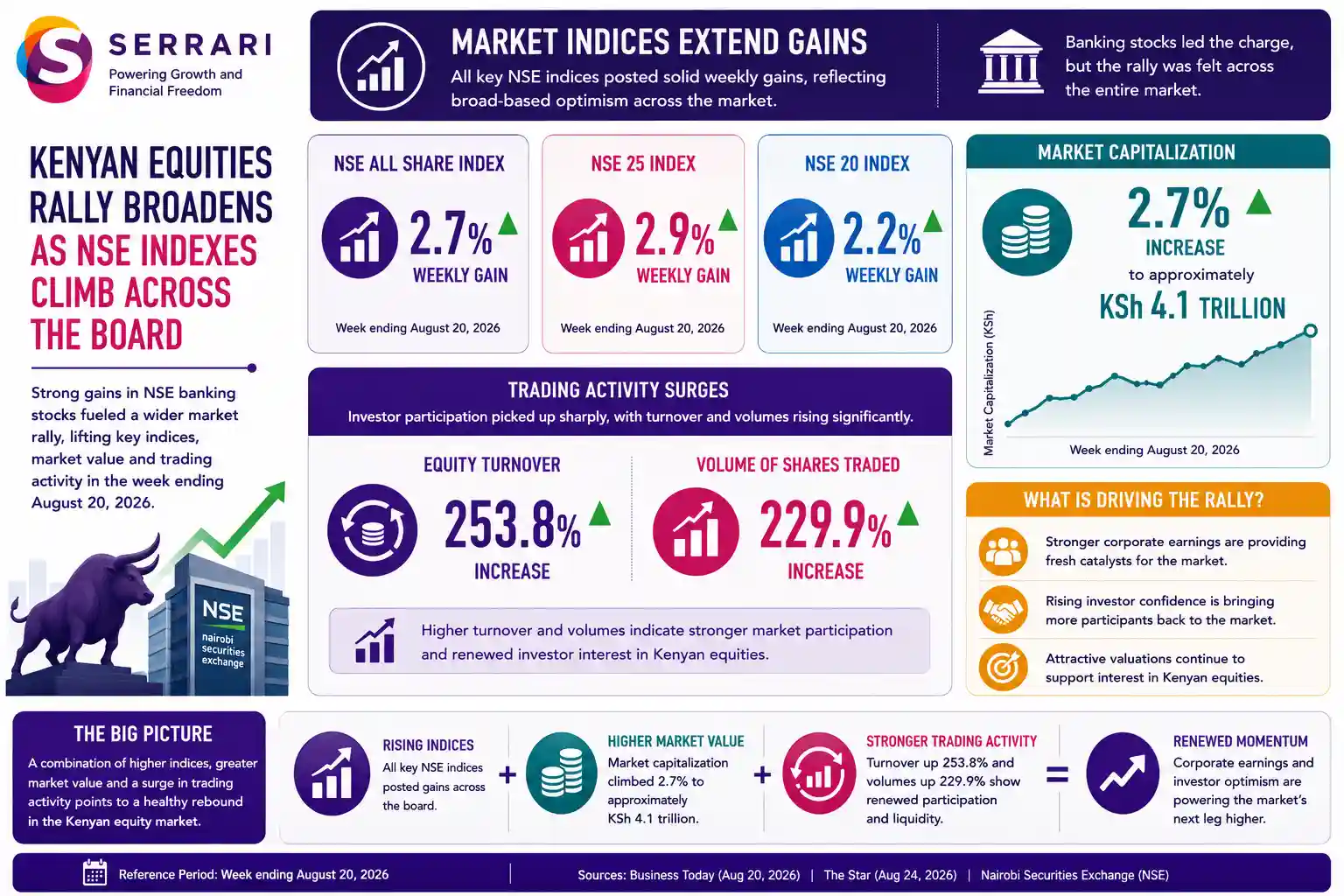
LIVENSE market summarySee NSE data →During the week ending August 20, the NSE All Share Index gained 2.7%, while the NSE 25 advanced 2.9% and the NSE 20 increased 2.2%.
Market capitalization climbed 2.7% to approximately KSh4.1 trillion.
Trading activity accelerated even more sharply. Equity turnover jumped 253.8%, while the volume of shares traded increased 229.9%.
The combination of rising indices, higher market value and stronger trading activity suggests renewed participation among investors as corporate earnings provide fresh catalysts for Kenyan equities.
Government Securities Also Attract Strong Demand
The improving appetite for financial assets was not limited to the stock market rally.
Kenya’s August 20 Treasury Bill auction attracted KSh71.7 billion in bids against an advertised KSh28 billion, producing a subscription rate of approximately 255.9%.
The 91-day Treasury Bill received KSh37.7 billion in bids, with KSh32.44 billion accepted at an average rate of 8.8%.
The 182-day paper attracted KSh18.57 billion, with KSh9.75 billion accepted at 8.9%, while the 364-day bill received KSh15.41 billion, all of which was accepted at an average rate of 9.04%.
Secondary bond-market turnover also increased 128.9% during the week.
Strong activity across both equities and fixed income suggests investors remain willing to deploy capital despite differing risk and return characteristics across the two markets.
Can KCB Shares Break Above KSh100?
The immediate milestone for KCB investors is whether the stock can move through KSh100.
Its KSh94.50 closing price means only a relatively modest additional gain would be required.
Strong bank earnings, a higher dividend and continued balance-sheet expansion provide fundamental support for the stock. The planned sustainability financing programme adds another potential long-term growth catalyst.
However, crossing KSh100 is not guaranteed. Future price performance will also depend on broader NSE conditions, foreign and domestic investor flows, interest rates and expectations for KCB’s future earnings.
The KSh100 level is therefore more of a psychological market milestone than a fundamental measure of the bank’s valuation.
FAQs
Why are NSE banking stocks rising?
NSE banking stocks have benefited from stronger corporate earnings, dividend growth and improving investor sentiment toward Kenyan equities. KCB has been one of the notable performers as investors respond to higher profits and continued balance-sheet expansion.
How much profit did KCB Group report?
KCB Group reported KSh49.3 billion in profit before tax for the first half of 2026, up 20.8% from KSh40.8 billion a year earlier. Profit after tax increased 14% to KSh36.87 billion.
What is KCB’s current share price?
KCB closed the referenced week at KSh94.50 per share, putting the stock less than KSh6 below the psychological KSh100 level. Whether it crosses that threshold will depend on future market demand and company performance.
How did the broader Nairobi Securities Exchange perform?
The NSE All Share Index rose 2.7% during the week ending August 20, while the NSE 25 gained 2.9% and the NSE 20 advanced 2.2%. Total market capitalisation increased to approximately KSh4.1 trillion.
Your financial future isn’t something you wait for—it’s something you build.
The real question is: when do you begin?
Move beyond simply staying informed.
Navigate the markets with clarity—track trends through the Serrari Group Market Index, uncover opportunities in the Serrari Marketplace, and build practical knowledge with our Curated Wealth Builder Platform.
Stay connected to what truly matters.
Get daily insights on macro trends and financial movements across Kenya, Africa, and global markets—delivered through the Serrari Newsletter.
Growth opens doors.
Advance your career through professional programs including ACCA, HESI A2, ATI TEAS 7 , HESI EXIT , NCLEX – RN and NCLEX – PN, Financial Literacy!🌟—designed to move you forward with confidence.
See where money is flowing—clearly and in real time.
Track Money Market Funds, Treasury Bills, Treasury Bonds, Green Bonds, and Fixed Deposits, alongside global and African indexes, key economic indicators, and the evolving Crypto and stablecoin landscape—all within Serrari’s Market Index.