
















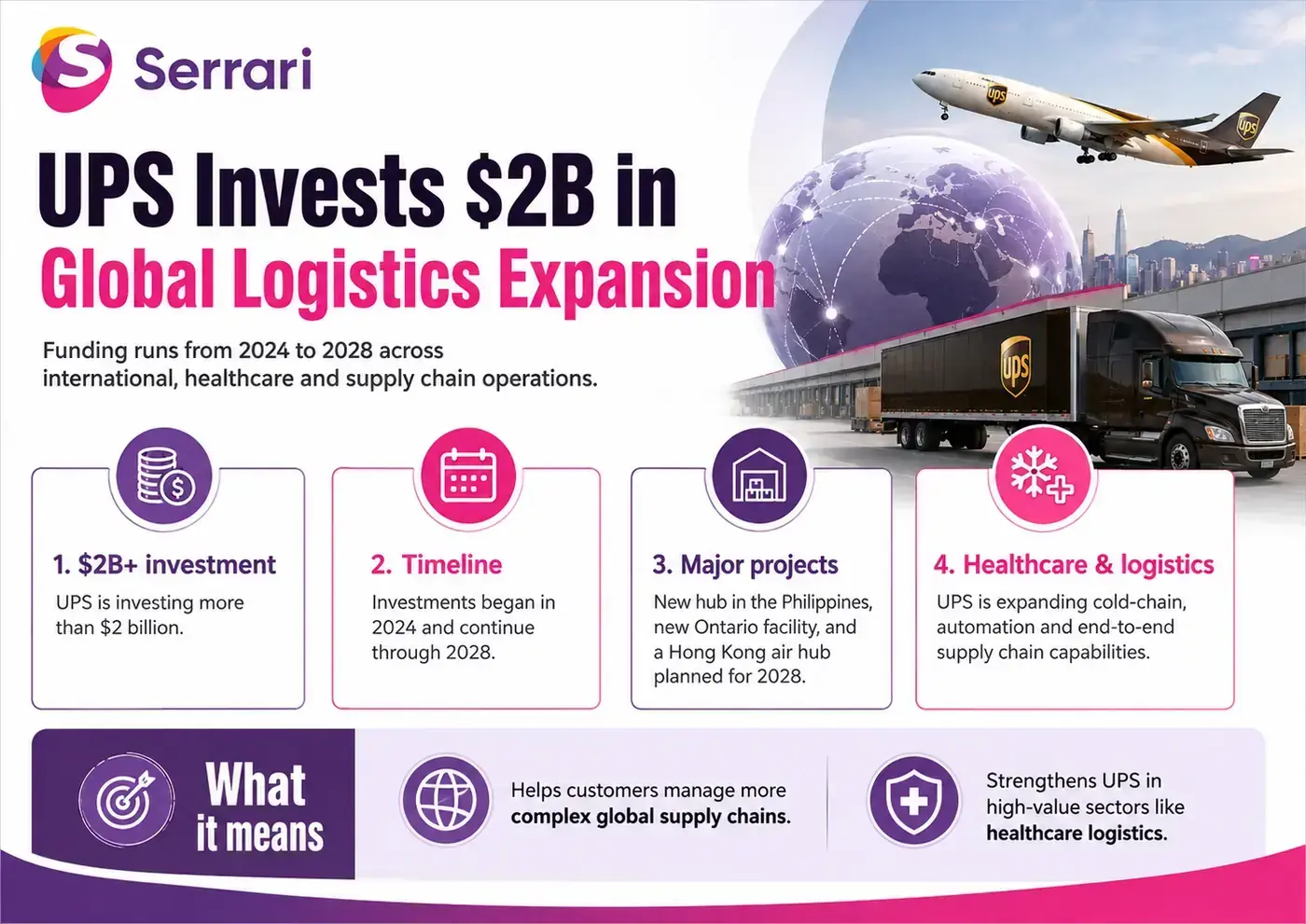
UPS is accelerating its push into higher-value logistics with more than $2 billion in ongoing investments across its international, healthcare and supply chain operations. The programme, which began in 2024 and is scheduled to run through 2028, combines new transport hubs, automated logistics facilities, air routes and specialized healthcare infrastructure across several major trade corridors.
Rather than simply adding parcel-processing capacity, the strategy is aimed at helping customers manage increasingly fragmented supply chains, shifting trade routes and more demanding requirements in sectors such as pharmaceuticals, technology, automotive and industrial manufacturing.
Key Overview
- UPS is investing more than $2 billion across its International, Healthcare and Supply Chain Solutions businesses between 2024 and 2028.
- New hubs are planned or under development in the Philippines, Canada and Hong Kong.
- Healthcare logistics remains a major focus, particularly temperature-controlled transportation for medicines and advanced therapies.
- Automation, robotics and integrated freight, brokerage and distribution services are becoming increasingly important within UPS’s network.
- The strategy positions UPS to compete for more specialized, higher-value logistics business rather than relying solely on conventional parcel delivery.
Building a More Flexible Global Logistics Network
UPS’s investment programme reflects a shift in what global companies increasingly require from logistics providers. Businesses facing changing tariffs, sourcing locations, regulations and geopolitical risks are seeking networks that can adapt quickly rather than depend on a small number of established trade routes.
Among the largest projects is a new hub at Clark International Airport in the Philippines expected to open in the fourth quarter of 2026. A new facility in Barrie, Ontario, is scheduled for 2027, while a major air hub at Hong Kong International Airport is planned for 2028.
The Hong Kong project is particularly significant. The fully automated air hub is being developed with direct aircraft access and is designed to handle close to one million tonnes annually. It is intended to strengthen connections between Asian manufacturing centres and markets in Europe, the United States and the broader Asia-Pacific region.
UPS has also expanded its Incheon Airport hub in South Korea, where the facility now includes temperature-controlled handling capabilities alongside automated sorting systems. The company has meanwhile developed a technology-enabled logistics centre in Taiwan as it builds greater capacity across Asia’s major production and export markets.
Air connectivity is being expanded alongside physical infrastructure. UPS is operating flights five times a week between Paris and Hong Kong and between Shenzhen and Sydney, increasing capacity on routes connecting European and Asia-Pacific commercial centres.
Context is everything. Stay ahead of shifting trends with today’s market updates, and uncover emerging opportunities using the Serrari Group Market Index and Marketplace. Then, take control of your own financial future by exploring our Money & Life Reset Transformation Blueprint ™ to build stronger habits, create better systems, and design a path toward lasting wealth.
Healthcare Logistics Becomes a Bigger Growth Engine
Healthcare is emerging as one of the most strategically important elements of the investment programme. Pharmaceuticals, biologics, advanced therapies and treatments such as GLP-1 medicines frequently require strict temperature management and reliable tracking throughout transportation.
In June 2026, UPS announced a separate $48 million investment in 27 temperature-controlled facilities across Europe, Asia and the Americas. The cross-dock facilities support products requiring controlled environments including 15°C to 25°C, 2°C to 8°C and frozen temperature ranges.
The expansion builds on UPS’s wider healthcare strategy. In November 2025, the company completed its $1.6 billion acquisition of Andlauer Healthcare Group, strengthening specialized cold-chain and pharmaceutical logistics capabilities across North America and international markets.
Together, these investments give UPS more control over sensitive shipments from manufacturing and storage through air transport, customs processing, distribution and final delivery. That integrated model can reduce handoffs between logistics providers, an important consideration when transporting high-value or temperature-sensitive products.
UPS Targets Higher-Value, Specialized Supply Chains
The investment programme also signals how UPS is attempting to differentiate itself from traditional parcel-delivery competition. Complex industries increasingly need logistics providers that can combine freight forwarding, customs brokerage, warehousing, transportation and distribution within one network.
UPS’s strategy therefore extends beyond faster delivery. The company is building infrastructure that allows customers to manage more of their supply chains through a single logistics provider while gaining greater visibility over goods moving between manufacturing centres and destination markets.
Asia-Pacific is central to that strategy. UPS has described the region as one of its fastest-growing markets and has been expanding facilities across the Philippines, Taiwan, South Korea, Hong Kong and other major commercial centres. Its recent Asia-Pacific network investments combine automation, expanded processing capacity and healthcare capabilities as companies diversify production and sourcing locations.
The more than $2 billion programme therefore represents a broader bet on the growing complexity of global commerce. As companies rethink where products are manufactured, stored and distributed, UPS is positioning specialized logistics, healthcare infrastructure and international connectivity as increasingly important sources of long-term growth.
Sources: CNBC / UPS / Business Wire / CEP Research
Your financial future isn’t something you wait for—it’s something you build.
The real question is: when do you begin?
Move beyond simply staying informed.
Navigate the markets with clarity—track trends through the Serrari Group Market Index, uncover opportunities in the Serrari Marketplace, and build practical knowledge with our Curated Wealth Builder Platform.
Stay connected to what truly matters.
Get daily insights on macro trends and financial movements across Kenya, Africa, and global markets—delivered through the Serrari Newsletter.
Growth opens doors.
Advance your career through professional programs including ACCA, HESI A2, ATI TEAS 7 , HESI EXIT , NCLEX – RN and NCLEX – PN, Financial Literacy!🌟—designed to move you forward with confidence.
See where money is flowing—clearly and in real time.
Track Money Market Funds, Treasury Bills, Treasury Bonds, Green Bonds, and Fixed Deposits, alongside global and African indexes, key economic indicators, and the evolving Crypto and stablecoin landscape—all within Serrari’s Market Index.