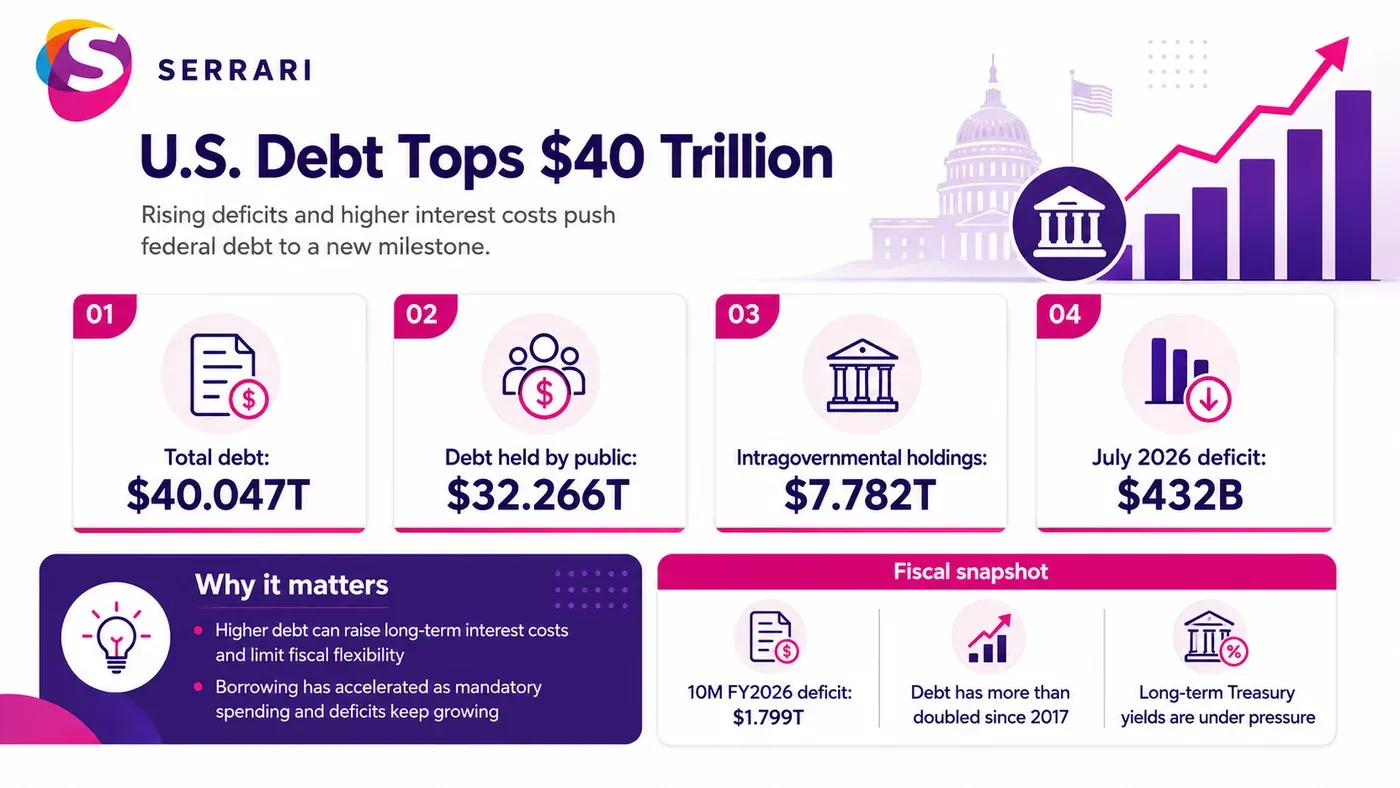
The United States’ gross federal debt has surpassed $40 trillion for the first time, reaching approximately $40.047 trillion on August 18, 2026. The milestone comes as persistent budget deficits, rising mandatory spending and elevated borrowing costs intensify debate over the long-term sustainability of U.S. public finances.
The official debt framework distinguishes between debt held by the public and intragovernmental holdings, with the $40 trillion total comprising roughly $32.266 trillion held by the public and $7.782 trillion held within government accounts at the milestone date.
Key Overview
- U.S. gross federal debt exceeded $40 trillion on August 18, 2026, less than five months after passing $39 trillion.
- Debt held by the public stood at about $32.3 trillion, while intragovernmental holdings accounted for about $7.8 trillion.
- The July 2026 federal budget deficit reached a record $432 billion for the month.
- The deficit for the first 10 months of fiscal 2026 reached $1.799 trillion, already exceeding the $1.775 trillion recorded for all of fiscal 2025.
- Rising interest expenses are consuming an increasingly large share of federal spending and limiting fiscal flexibility.
- Long-term Treasury yields have climbed sharply, prompting an expansion of government bond buyback operations.
Debt Has More Than Doubled Since 2017
The $40 trillion threshold represents a dramatic increase from approximately $19.95 trillion when Donald Trump first entered office in January 2017. Recent debt-growth calculations covering successive administrations show gross debt increased by roughly $7.8 trillion during Trump’s first term, about $8.4 trillion during Joe Biden’s presidency and another $3.8 trillion following Trump’s return to office in January 2025.
Those figures measure how much debt rose during each administration and should not be interpreted as assigning the entire increase directly to presidential policy. Congressional spending decisions, inherited programs, economic conditions, tax policy, interest costs and emergency measures all contribute to federal borrowing.
COVID-19 was particularly significant. Large bipartisan pandemic relief programs accounted for a substantial portion of the extraordinary borrowing recorded during 2020 and 2021, while longer-running structural deficits continued after the emergency spending subsided.
Fiscal 2026 Deficit Accelerates
The pace of new borrowing remains elevated. The federal government recorded a $432 billion deficit in July 2026, with receipts of about $334 billion against $766 billion of outlays during the month.
That pushed the deficit for the first 10 months of fiscal 2026 to $1.799 trillion, 10% above the equivalent period a year earlier and already higher than the entire fiscal 2025 deficit of $1.775 trillion.
July’s figures were partly affected by around $99 billion of August benefit payments being brought forward because of the calendar. Even after accounting for timing shifts, however, the adjusted monthly deficit remained approximately $333 billion, demonstrating that the underlying fiscal imbalance remains substantial.
Context is everything. Stay ahead of shifting trends with today’s market updates, and uncover emerging opportunities using the Serrari Group Market Index and Marketplace. Then, take control of your own financial future by exploring our Money & Life Reset Transformation Blueprint ™ to build stronger habits, create better systems, and design a path toward lasting wealth.
Interest Costs Add Pressure to the Budget
Higher debt levels become more consequential when borrowing costs rise because maturing government securities must increasingly be refinanced at higher interest rates.
Fiscal-year-to-date net interest spending reached roughly $931 billion through July, while the longer-term outlook remains challenging. Current federal budget projections put net interest spending at around $1 trillion in fiscal 2026, rising to approximately $2.1 trillion annually by 2036 if existing policies broadly remain in place.
Mandatory programs including Social Security, Medicare and Medicaid also represent a large share of federal expenditures, leaving policymakers with difficult choices over taxes, benefits and other spending if they seek to materially slow debt growth.
The 2025 reconciliation legislation is another major factor in the outlook. Updated 10-year fiscal projections estimate that the law will increase cumulative federal deficits by approximately $4.7 trillion between 2026 and 2035, after incorporating its economic and debt-service effects.
Rising Yields Put Debt Markets in Focus
Concerns about inflation, government borrowing and future Treasury issuance have contributed to higher long-term bond yields. The 30-year Treasury yield recently reached levels not seen since 2007, increasing financing pressure not only on government debt but also on mortgages and other borrowing whose rates are influenced by Treasury markets.
In response, the government announced that long-dated liquidity-support buybacks will at least double from a maximum of $2 billion to at least $4 billion per operation for selected 10- to 30-year securities beginning in September.
Buybacks can help improve market liquidity, but they do not reduce the fundamental fiscal imbalance created when government spending persistently exceeds revenues.
Why the $40 Trillion Milestone Matters
Gross debt is not the only measure economists use to assess fiscal sustainability. Debt held by the public relative to the size of the economy is often considered more economically meaningful because it measures obligations owed outside federal government accounts.
Still, crossing $40 trillion highlights the speed at which U.S. borrowing has expanded. The country moved from $39 trillion to $40 trillion in less than five months, while long-term projections show debt continuing to rise without significant changes to current tax and spending policies.
The core challenge is increasingly the interaction between persistent deficits and higher interest costs: more borrowing raises future interest expenses, while larger interest expenses themselves require additional borrowing. Breaking that cycle would ultimately require policymakers to address both federal revenues and the major categories of government spending.
Sources: U.S. Department of the Treasury / Reuters / Congressional Budget Office / Committee for a Responsible Federal Budget
Your financial future isn’t something you wait for—it’s something you build.
The real question is: when do you begin?
Move beyond simply staying informed.
Navigate the markets with clarity—track trends through the Serrari Group Market Index, uncover opportunities in the Serrari Marketplace, and build practical knowledge with our Curated Wealth Builder Platform.
Stay connected to what truly matters.
Get daily insights on macro trends and financial movements across Kenya, Africa, and global markets—delivered through the Serrari Newsletter.
Growth opens doors.
Advance your career through professional programs including ACCA, HESI A2, ATI TEAS 7 , HESI EXIT , NCLEX – RN and NCLEX – PN, Financial Literacy!🌟—designed to move you forward with confidence.
See where money is flowing—clearly and in real time.
Track Money Market Funds, Treasury Bills, Treasury Bonds, Green Bonds, and Fixed Deposits, alongside global and African indexes, key economic indicators, and the evolving Crypto and stablecoin landscape—all within Serrari’s Market Index.