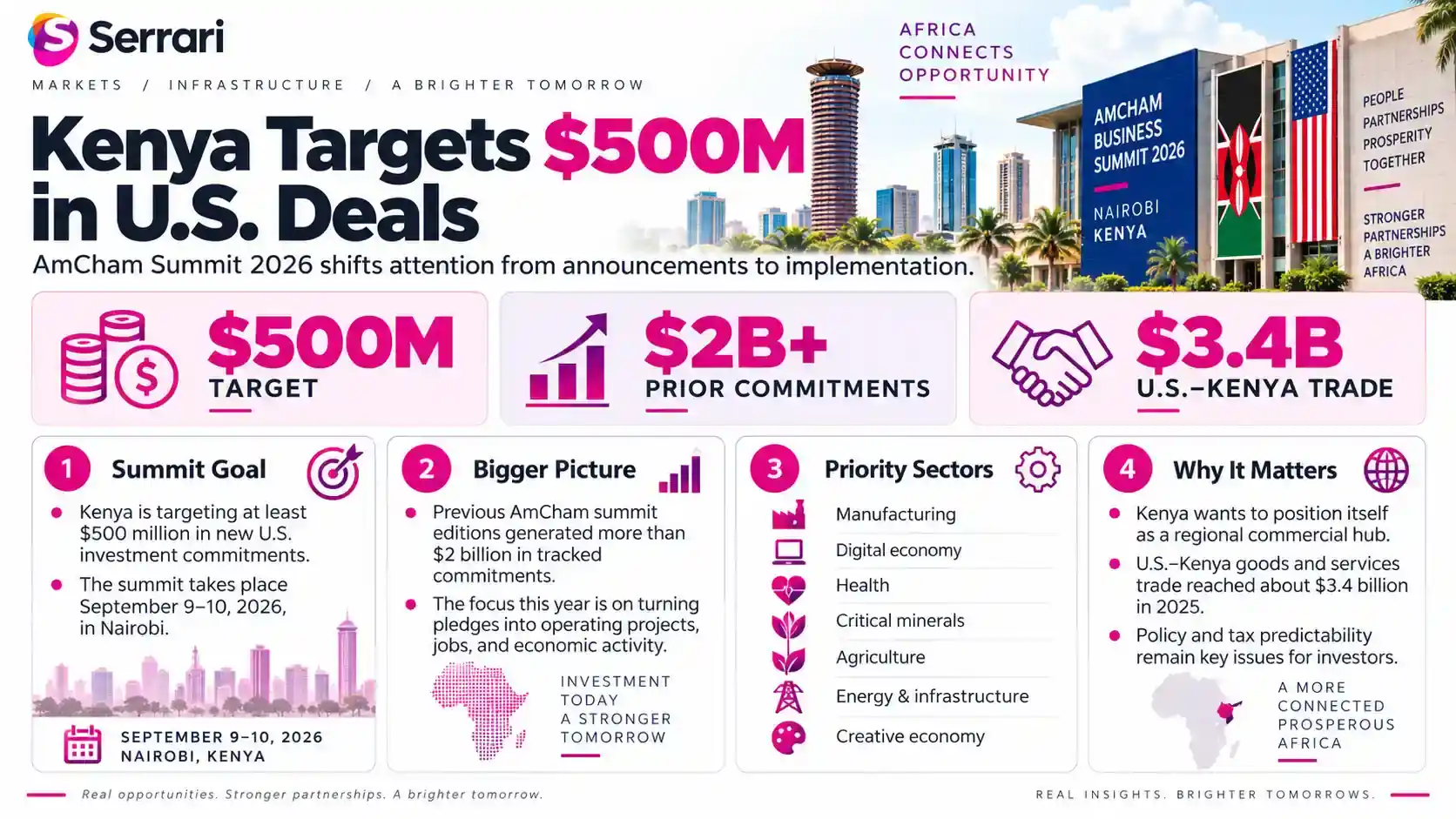
Kenya is targeting at least $500 million in new US investment commitments at the 2026 AmCham Business Summit, scheduled for September 9–10 in Nairobi, as organisers place greater emphasis on converting investment announcements into operating businesses, jobs and measurable economic activity.
The summit comes as Kenya seeks to position itself as a gateway to a wider East African market rather than simply a standalone investment destination. Its agenda combines policy discussions with deal-making across manufacturing, digital technology, health, critical minerals, agriculture, energy and infrastructure, and the creative economy.
Key Overview
- Kenya is targeting at least $500 million in US investment commitments from the 2026 summit.
- The summit takes place on September 9–10, 2026, at Windsor Golf Hotel & Country Club in Nairobi.
- Organisers say the previous four editions generated more than $2 billion in tracked investment commitments.
- Seven sectors are prioritised: manufacturing, digital economy, health, critical minerals, agriculture, energy and infrastructure, and creative industries.
- Kenya-US goods and services trade reached an estimated $3.4 billion in 2025.
- Policy and tax predictability remain major issues influencing long-term investment decisions.
Kenya Shifts the Summit From Announcements to Delivery
The 2026 gathering is being positioned as a more transaction-focused event, with Kenya seeking at least $500 million in fresh investment commitments from US investors while pushing companies and government agencies to move existing proposals toward implementation.
That distinction matters because investment announcements do not automatically translate into productive assets. AmCham Kenya CEO Paul Muthaura has argued that success should increasingly be measured by whether pledged capital produces operational businesses, employment and sustained economic activity rather than simply by headline deal values.
The official summit programme says the event will convene more than 800 delegates, facilitate more than 500 business-to-business and business-to-government meetings, and focus directly on investment and commercial partnerships. The September 9–10 programme combines sector discussions with structured matchmaking and dedicated deal rooms designed to connect investors with businesses and policymakers.
Organisers also say the previous four editions generated more than $2 billion in tracked investment commitments, providing the platform on which this year’s $500 million-plus ambition is being built.
Policy Predictability Remains an Investment Test
Attracting capital is only part of Kenya’s challenge. Keeping investors committed long enough to build factories, infrastructure, technology platforms and other long-term assets requires a stable regulatory environment.
Muthaura has identified tax and regulatory predictability as particularly important. Investors can often model relatively high taxes into long-term plans, but frequent changes make it more difficult to forecast returns, costs and investment timelines.
That concern remains relevant following passage of the Finance Act 2026. Most of its amendments took effect from July 1, while other changes have later commencement dates, requiring businesses to adjust compliance and investment planning around the revised framework.
Kenya’s broader task is therefore to balance its need for higher tax revenue with maintaining a competitive investment environment. For businesses evaluating projects requiring years of capital deployment, confidence that rules will remain reasonably consistent can be as important as the headline tax rate itself.
Context is everything. Stay ahead of shifting trends with today’s market updates, and uncover emerging opportunities using the Serrari Group Market Index and Marketplace. Then, take control of your own financial future by exploring our Money & Life Reset Transformation Blueprint ™ to build stronger habits, create better systems, and design a path toward lasting wealth.
Seven Sectors Drive the US-Kenya Investment Push
The summit is concentrating investment discussions around critical minerals, digital economy, health, manufacturing, energy and infrastructure, agriculture and the creative industries, reflecting areas where Kenya believes its domestic advantages overlap with US commercial priorities.
Manufacturing is particularly important because Kenya wants more products processed locally before export, allowing the country to retain a larger share of their economic value. Similar arguments apply to critical minerals, where Kenya could develop processing, logistics and supporting infrastructure rather than functioning solely as a transit or raw-material market.
Agriculture also presents a substantial opportunity, although the sector’s economic contribution in the raw report is overstated. Official statistics show that agriculture, forestry and fishing accounted for 23.2% of GDP in 2025, rather than around 30%.
Technology could nevertheless make the sector more attractive to institutional capital through farmer aggregation, precision agriculture, digital supply chains, cold storage and more efficient connections between producers and markets.
Kenya Looks Beyond Its Domestic Market
The investment proposition is also expanding beyond Kenya itself. AmCham chambers from Kenya, Uganda, Tanzania, Rwanda and Ethiopia are seeking stronger commercial integration so investors can approach the region as a larger interconnected market.
That regional approach addresses one of the constraints facing African economies individually: market size. A company considering manufacturing, healthcare, digital services or infrastructure investment can potentially justify larger commitments if products and services can move efficiently across several economies rather than serving only one national market.
The summit agenda reflects that strategy through discussions covering regional value chains and cross-border data flows, alongside infrastructure, investment financing and implementation of the African Continental Free Trade Area.
Trade Relationship Moves Beyond AGOA
Kenya’s relationship with the United States already extends well beyond development assistance. Total US-Kenya trade in goods and services reached an estimated $3.4 billion in 2025, increasing 7.2% from the previous year.
Kenya also remains listed as eligible for AGOA benefits in 2026, including preferential treatment for qualifying textile and apparel exports. However, the summit’s longer-term argument is that Kenya should use market access to develop deeper domestic production rather than depend solely on preferential export arrangements.
The $500 million target therefore represents only one measure of success. A more important test will be whether US capital results in factories, technology infrastructure, healthcare production, agricultural processing and other operating investments that deepen Kenya’s productive capacity.
If the summit converts a meaningful share of its investment pipeline into completed projects, Kenya could strengthen its position not only as a destination for US capital but as a regional platform through which American companies access the wider East African and continental markets.
Sources: AmChm Kenya / The Kenyan Wall Street / The Star / U.S. Trade Representative / Kenya National Bureau of Statistics / Kenya Revenue Authority
Your financial future isn’t something you wait for—it’s something you build.
The real question is: when do you begin?
Move beyond simply staying informed.
Navigate the markets with clarity—track trends through the Serrari Group Market Index, uncover opportunities in the Serrari Marketplace, and build practical knowledge with our Curated Wealth Builder Platform.
Stay connected to what truly matters.
Get daily insights on macro trends and financial movements across Kenya, Africa, and global markets—delivered through the Serrari Newsletter.
Growth opens doors.
Advance your career through professional programs including ACCA, HESI A2, ATI TEAS 7 , HESI EXIT , NCLEX – RN and NCLEX – PN, Financial Literacy!🌟—designed to move you forward with confidence.
See where money is flowing—clearly and in real time.
Track Money Market Funds, Treasury Bills, Treasury Bonds, Green Bonds, and Fixed Deposits, alongside global and African indexes, key economic indicators, and the evolving Crypto and stablecoin landscape—all within Serrari’s Market Index.