
British lenders approved 56,053 mortgages for house purchase in July, the lowest level since January 2024, according to Bank of England data. Consumer credit borrowing increased to £2.0 billion, above economists’ expectations, while the effective interest rate on newly drawn mortgages rose to 4.45%.
Key Overview
- Mortgage approvals: 56,053 in July, the lowest since January 2024.
- Remortgaging: Approvals with a different lender rose to 34,500.
- New mortgage rate: Increased to 4.45% from 4.35% in June.
- Consumer credit: Net borrowing rose to £2.0 billion.
- House prices: UK average house price reached £275,465 in August, up 1.6% annually.
- Household deposits: Increased by £3.8 billion in July.
UK Mortgage Approvals Fall to Lowest Level Since January 2024
British lenders approved the fewest mortgages for house purchase since January 2024 in July, while consumer lending grew more than expected, according to Bank of England data.
The Bank of England said lenders approved 56,053 mortgages in July, down from June and below all forecasts in a Reuters poll of economists, which had pointed to a rise to 59,500.
June’s reading was revised up to 58,215 from the 58,200 initially reported.
The July figure was also well below the previous six-month average of around 60,800, pointing to continued pressure from elevated borrowing costs.
Mortgage Rates Rise in July
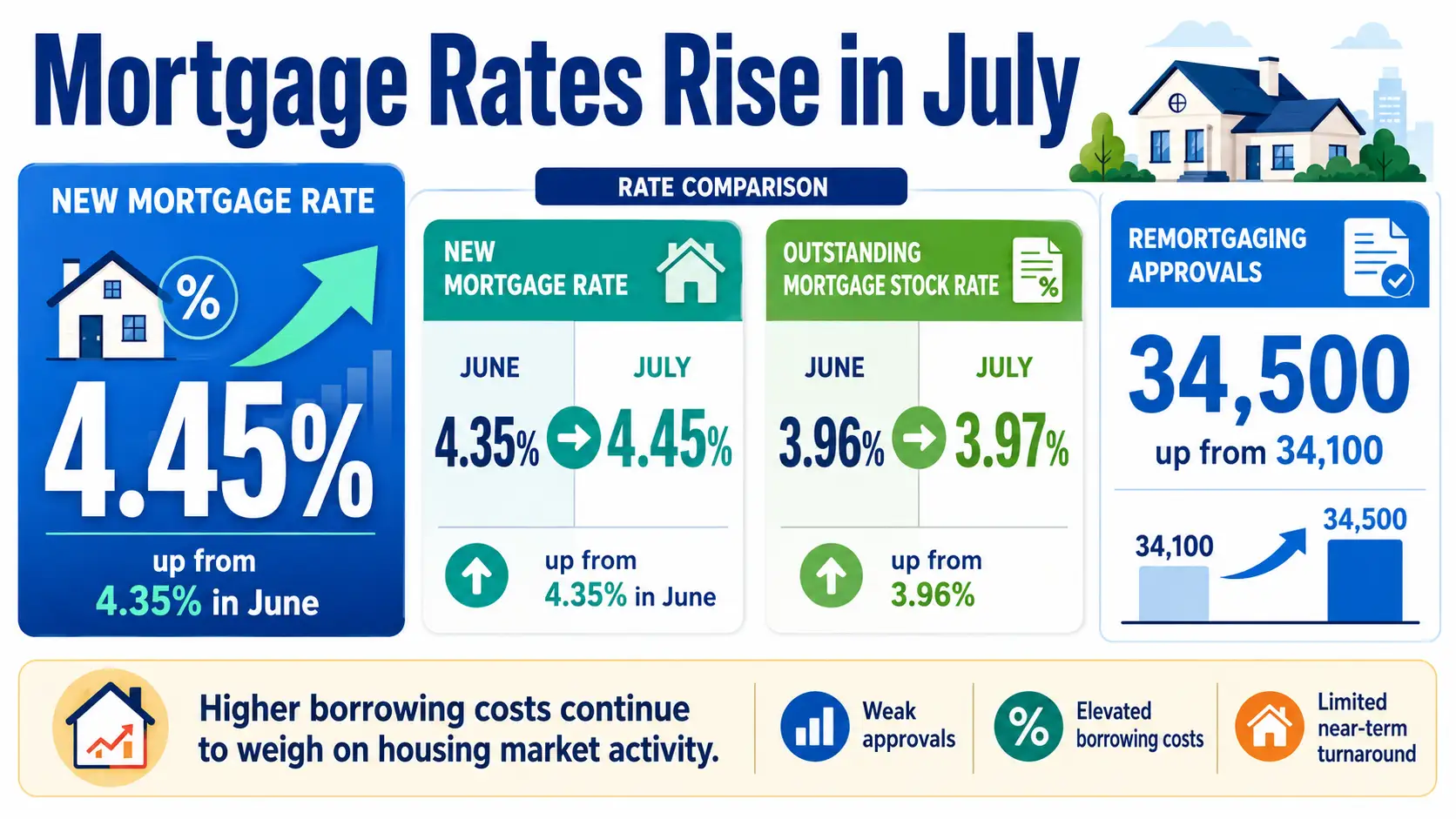
The effective interest rate on newly drawn mortgages increased to 4.45% in July from 4.35% in June.
The rate on the outstanding mortgage stock also increased slightly, reaching 3.97% from 3.96%.
Meanwhile, approvals for remortgaging with a different lender edged up to 34,500, compared with 34,100 previously.
The mortgage figures indicate continued weakness in housing market activity as borrowing costs remain elevated.
Lucian Cook, head of residential research at property firm Savills, said that while underlying house price affordability had shown signs of gradually improving, higher fixed-rate mortgage costs had prevented this from translating into an improvement in market activity.
“The increase in fixed rate mortgage costs we saw in mid-July, has prevented that from translating into any improvement in activity in the market, leading to a third consecutive month of weak mortgage approvals,” Cook said.
He added that with more inflation to work through the system, a sustained turnaround over the remainder of the year appeared unlikely.
UK House Prices Rise in August
The mortgage data came as Nationwide Building Society reported that the average UK house price edged up 0.2% month-on-month in August, following a 0.1% decline in July.
Across the UK, the average house price reached £275,465 in August, representing an annual increase of 1.6%.
The annual increase in house prices remained below the rate of consumer price inflation.
Hina Bhudia, a partner at Knight Frank Finance, said geopolitical tensions and elevated energy prices had pushed mortgage rates higher during the summer, weighing on demand in the housing market.
Mark Harris, chief executive at mortgage broker SPF Private Clients, said some lenders had been easing mortgage rates in recent days and weeks, but swap rates remained highly volatile in response to tensions in the Middle East.
He added that the slight increase in remortgaging numbers suggested some borrowers could be shopping around for better rates rather than remaining with their existing lender when their current deals expire.
Consumer Credit Borrowing Increases
The Bank of England’s Money and Credit report also showed that net borrowing of consumer credit increased to £2.0 billion in July, from £1.9 billion in June.
July’s figure was slightly above the previous six-month average of £1.9 billion.
Within the total, net borrowing through credit cards declined to £0.9 billion, from £1.0 billion in June.
Net borrowing through other forms of consumer credit, including car dealership finance and personal loans, increased to £1.1 billion, compared with £0.9 billion in June.
Tuesday’s data showed that net unsecured lending to consumers rose by £2.006 billion ($2.71 billion) during the month, above economists’ forecast of a £1.8 billion increase. It was the biggest rise since November 2025.
Context is everything. Stay ahead of shifting trends with today’s market updates, and uncover emerging opportunities using the Serrari Group Market Index and Marketplace. Then, take control of your own financial future by exploring our Money & Life Reset Transformation Blueprint ™ to build stronger habits, create better systems, and design a path toward lasting wealth.
Household Deposits Increase
Households’ deposits with banks and building societies increased by £3.8 billion in July, following net deposits of £6.2 billion in June.
UK non-financial businesses also increased their borrowing from banks and building societies.
The report showed that non-financial businesses borrowed, on net, £1.8 billion in loans from banks and building societies, including overdrafts, in July.
That followed £1.6 billion of net borrowing in June.
Sarah Coles, head of personal finance at AJ Bell, said savers and investors tend to be motivated by deadlines, pointing to changes to the cash ISA allowance from April 2027.
“From April 2027 savers under 65 will see their annual cash Isa allowance reduced from £20,000 to £12,000,” Coles said.
She added that cash ISA enthusiasm could build as the summer fades and the end of the tax year approaches.
Housing Market Outlook Remains Weak
Ruth Gregory, deputy chief UK economist at Capital Economics, said the July money and lending figures pointed to a weak near-term outlook for the housing market.
“July’s money and lending figures show that the near-term outlook for the housing market is weak, households may have funded some of their spending in July by lowering their saving rate and borrowing more, and overall monetary conditions are not conducive of a long period of high inflation,” Gregory said.
The mortgage data comes as financial markets continue to assess the Bank of England’s interest-rate outlook.
The central bank is widely expected to keep interest rates unchanged at 3.75% this month, while financial markets are pricing in a quarter-point increase by the end of the year.
Outlook
The decline in UK mortgage approvals to 56,053 in July points to continued weakness in housing market activity, with approvals remaining below the previous six-month average of around 60,800. Higher mortgage rates continue to weigh on demand, while the effective rate on newly drawn mortgages increased to 4.45%.
At the same time, consumer credit borrowing rose to £2.0 billion, while household deposits increased by £3.8 billion. Nationwide’s August data showed average UK house prices rising 0.2% month-on-month and 1.6% annually to £275,465. The housing market outlook remains weak as households and markets assess borrowing costs, inflation and the Bank of England’s interest-rate path.
FAQs
1. How many mortgages were approved in the UK in July?
British lenders approved 56,053 mortgages for house purchase in July, the lowest level since January 2024.
2. Why did UK mortgage approvals fall in July?
Mortgage approvals remained under pressure from elevated borrowing costs, with the effective interest rate on newly drawn mortgages rising to 4.45%.
3. How much did UK consumer credit borrowing increase in July?
Net consumer credit borrowing increased to £2.0 billion in July, up from £1.9 billion in June.
4. What happened to UK house prices in August?
The average UK house price rose 0.2% month-on-month in August to £275,465, representing a 1.6% annual increase.
Sources: Global Banking and Finance, The Times of India, Yahoo Finance UK, Trading Economics, Euronext
Your financial future isn’t something you wait for—it’s something you build.
The real question is: when do you begin?
Move beyond simply staying informed.
Navigate the markets with clarity—track trends through the Serrari Group Market Index, uncover opportunities in the Serrari Marketplace, and build practical knowledge with our Curated Wealth Builder Platform.
Stay connected to what truly matters.
Get daily insights on macro trends and financial movements across Kenya, Africa, and global markets—delivered through the Serrari Newsletter.
Growth opens doors.
Advance your career through professional programs including ACCA, HESI A2, ATI TEAS 7 , HESI EXIT , NCLEX – RN and NCLEX – PN, Financial Literacy!🌟—designed to move you forward with confidence.
See where money is flowing—clearly and in real time.
Track Money Market Funds, Treasury Bills, Treasury Bonds, Green Bonds, and Fixed Deposits, alongside global and African indexes, key economic indicators, and the evolving Crypto and stablecoin landscape—all within Serrari’s Market Index.