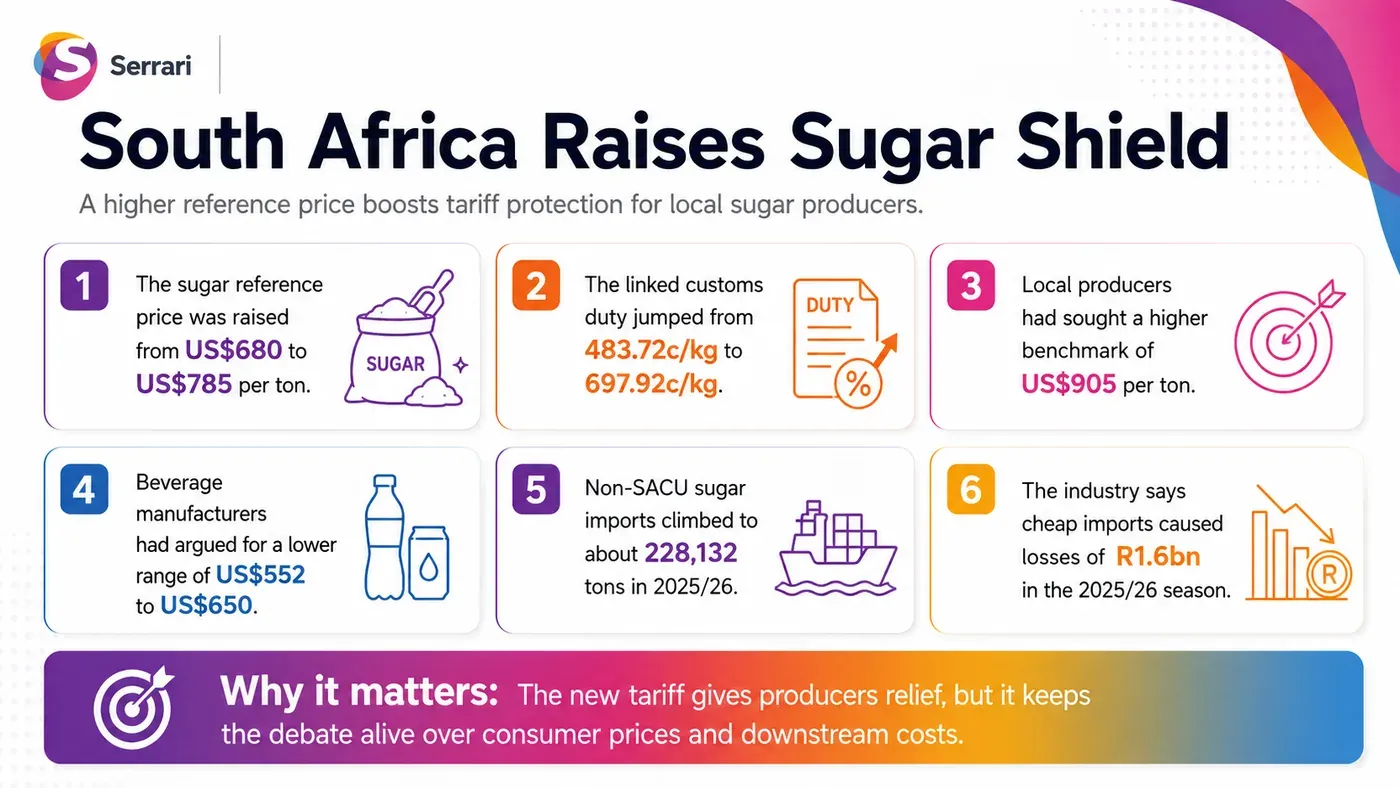
South Africa has raised the Dollar-Based Reference Price used to calculate sugar import duties from US$680 to US$785 per metric ton, giving local growers and millers stronger protection against cheaper foreign sugar. The new benchmark took effect on August 28 and immediately lifted the customs duty on affected sugar imports from 483.72 cents per kilogram to 697.92 cents per kilogram.
The decision follows mounting pressure on the domestic industry from lower global prices, higher import penetration and weaker profitability. However, the final US$785 level is a compromise: producers wanted US$905 per ton, while beverage manufacturers had argued for a lower benchmark of between US$552 and US$650 per ton.
Key Overview
- The sugar reference price has increased from US$680 to US$785 per ton.
- The resulting customs duty rose from 483.72c/kg to 697.92c/kg when the new benchmark was implemented.
- Local producers had requested US$905 per ton, arguing that the previous tariff no longer provided sufficient protection.
- Beverage manufacturers proposed reducing the benchmark to between US$552 and US$650 per ton because of concerns about input costs and consumer prices.
- Non-SACU sugar imports increased to about 228,132 tons in 2025/26, with Brazil remaining the largest supplier.
- The sugar industry says cheaper imports cost it R1.6 billion during the 2025/26 season.
How the Higher Sugar Tariff Works
South Africa does not use a fixed percentage duty as its primary sugar-protection mechanism. Instead, it operates a variable tariff based on a Dollar-Based Reference Price, or DBRP.
When international sugar prices fall sufficiently below the reference price, the tariff rises to narrow the gap. When global prices increase, the duty can decline. This structure is intended to protect domestic producers against sharp swings and distortions in international sugar markets without permanently imposing the highest possible tariff on downstream users.
The latest tariff investigation calculated the US$785 benchmark using a six-year weighted average London No. 5 sugar price of US$559 per ton, a 46% adjustment for distortions in the global market and average ocean freight costs of US$31 per ton.
Using the sugar price and exchange rate applied in the regulator’s calculation, the initial duty under the revised formula came to 697.92 cents per kilogram. That is equivalent to roughly 97.8% on an ad valorem basis, still below South Africa’s World Trade Organization bound ceiling of 105%.
Context is everything. Stay ahead of shifting trends with today’s market updates, and uncover emerging opportunities using the Serrari Group Market Index and Marketplace. Then, take control of your own financial future by exploring our Money & Life Reset Transformation Blueprint ™ to build stronger habits, create better systems, and design a path toward lasting wealth.
Cheap Imports Put Local Producers Under Pressure
The tariff increase follows a sharp rise in sugar entering South Africa from outside the Southern African Customs Union.
Official trade analysis shows non-SACU imports climbed to about 228,132 tons in 2025/26, up substantially from 57,961 tons in 2021/22. Brazil remained the largest supplier, accounting for 37% of imports in the latest period, while shipments from India, Thailand and the United Arab Emirates also became more significant.
The pressure has intensified as international sugar prices declined from earlier highs, making imported sugar more competitive against local production.
Local industry representatives say the impact has been severe. The industry estimates it lost R1.6 billion during the 2025/26 season because imported sugar displaced local sales. In the new 2026/27 season, imports had already reached 74,652 tons by June, with estimated industry losses of about R560 million.
The sector remains important in rural KwaZulu-Natal and Mpumalanga, supporting more than 25,000 registered growers and operating through 12 sugar mills.
Producers Say $785 Still Falls Short
Although producers welcomed the increase, the local industry argues that US$785 does not fully address the threat from imported sugar.
The industry had applied for a US$905 benchmark in October 2024, arguing that the higher level was needed to compensate for global market distortions and protect domestic production, employment and investment.
The regulator rejected that figure after concluding it would provide more protection than necessary when weighed against the interests of downstream manufacturers, consumers and South Africa’s international tariff commitments.
At the opposite end, beverage manufacturers requested a reduction to between US$552 and US$650, arguing that higher duties raise costs for producers and consumers. The regulator rejected that proposal because it would leave the domestic industry inadequately protected.
A Trade-Off Between Farm Jobs and Food Costs
The US$785 compromise illustrates the central policy challenge in South Africa’s sugar market. A higher tariff protects farmers, millers and rural employment, but sugar is also an important input for beverages, confectionery, baked goods, dairy products, canned foods and other manufactured products.
Higher protection can therefore raise costs elsewhere in the economy. The regulator concluded that US$785 offered additional support to local production while limiting the burden on downstream industries.
The decision is not permanent. The reference price will be reviewed after three years, unless market developments justify an earlier review, allowing authorities to reassess its impact on production, investment, jobs, market stability and downstream users.
For producers, the tariff increase provides immediate relief, but the debate is unlikely to end. If imports continue rising despite the new protection, pressure for further intervention could return well before the scheduled review.
Sources: International Trade Administration Commission of South Africa / South African Revenue Service / South African Sugar Association / Reuters / Business Day / Engineering News
Your financial future isn’t something you wait for—it’s something you build.
The real question is: when do you begin?
Move beyond simply staying informed.
Navigate the markets with clarity—track trends through the Serrari Group Market Index, uncover opportunities in the Serrari Marketplace, and build practical knowledge with our Curated Wealth Builder Platform.
Stay connected to what truly matters.
Get daily insights on macro trends and financial movements across Kenya, Africa, and global markets—delivered through the Serrari Newsletter.
Growth opens doors.
Advance your career through professional programs including ACCA, HESI A2, ATI TEAS 7 , HESI EXIT , NCLEX – RN and NCLEX – PN, Financial Literacy!🌟—designed to move you forward with confidence.
See where money is flowing—clearly and in real time.
Track Money Market Funds, Treasury Bills, Treasury Bonds, Green Bonds, and Fixed Deposits, alongside global and African indexes, key economic indicators, and the evolving Crypto and stablecoin landscape—all within Serrari’s Market Index.