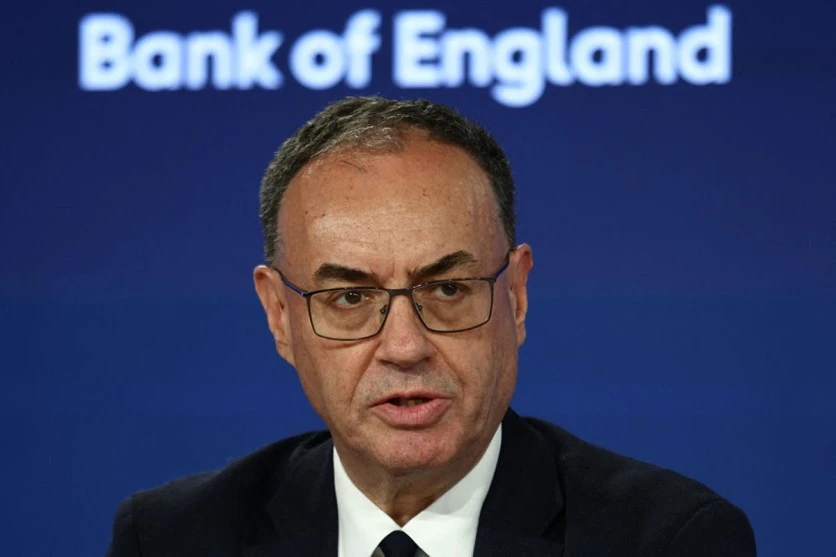
Bank of England Governor Andrew Bailey has warned G20 finance ministers and central bank governors that frontier artificial intelligence is creating a new class of systemic financial risk. In an August 31 letter to G20 officials, Bailey said the most immediate concern is the ability of advanced AI models to change the speed, scale and economics of cyberattacks.
The warning goes beyond conventional cybersecurity. Bailey, who also chairs the Financial Stability Board, argued that highly interconnected financial institutions increasingly depend on a concentrated group of technology providers, meaning a severe AI-enabled disruption could spread across firms and jurisdictions at the same time. He also warned that stretched asset valuations and increased leverage could magnify a broader market shock.
Key Overview
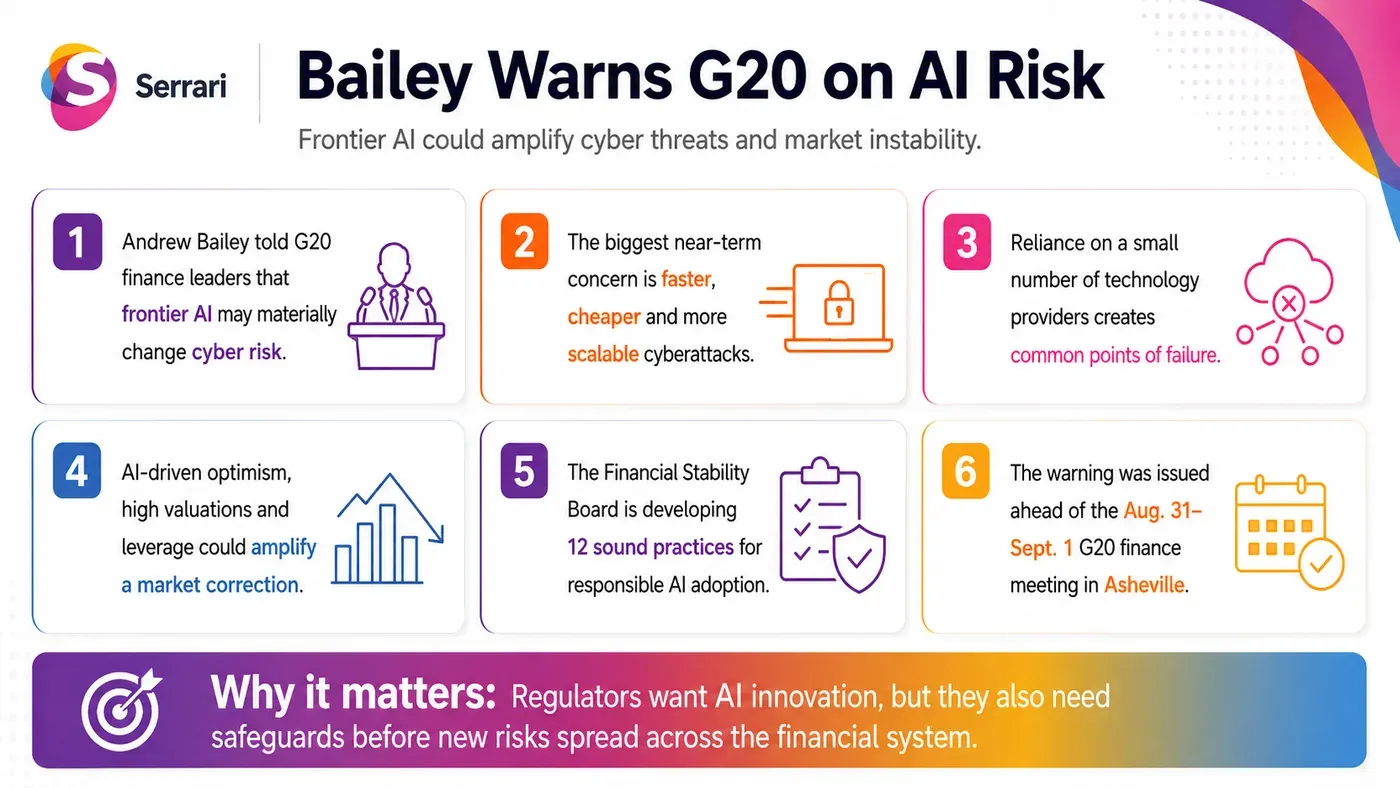
- Bailey described frontier AI’s impact on cyber risk as the most immediate AI-related concern for the financial system.
- Advanced models are demonstrating greater autonomy, problem-solving capability and increasingly sophisticated threat capabilities.
- Reliance on a small number of technology providers could allow one disruption to affect multiple financial institutions simultaneously.
- High valuations, leverage, market concentration and AI-related optimism could amplify a sudden correction.
- Regulators are developing 12 sound practices for responsible AI adoption covering governance, deployment, cyber resilience and third-party risk.
Frontier AI Changes the Economics of Cyber Risk
Traditional cyber threats are already a major operational risk for banks, insurers, payment networks and financial-market infrastructure. Frontier AI could make those threats more dangerous by lowering the cost and technical barriers required to identify vulnerabilities, generate malicious code and automate attacks.
Bailey warned that frontier systems now display increasingly sophisticated autonomy and problem-solving capabilities. That could allow attackers to conduct complex operations faster and at a scale that would have required far greater resources using conventional tools.
The latest warning to the G20 argues that if AI enables coordinated attacks against several firms or shared infrastructure at once, the consequences could become systemic rather than remain isolated operational incidents.
Bailey also noted that many jurisdictions do not yet have adequate protocols for managing the release and deployment of the most advanced AI systems. The concern is that model capabilities can evolve faster than conventional supervisory processes, leaving regulators reacting after risks have already changed.
Concentrated Technology Providers Raise Systemic Exposure
The financial sector’s dependence on external technology providers is another vulnerability. Banks increasingly rely on shared cloud infrastructure, AI models, cybersecurity services and data platforms supplied by a relatively small number of large technology companies.
This concentration can improve efficiency, but it also creates common points of failure. If several major institutions depend on the same provider, a cyber incident or operational outage at that provider could affect multiple firms at once.
The FSB has previously identified third-party dependencies and provider concentration as one of the main ways AI could create systemic vulnerabilities, alongside market correlations, cyber threats, model risk and data-quality problems.
Bailey therefore called for stronger recovery capabilities at financial institutions and critical third parties. For payment systems, clearing houses and major banks, the ability to restore essential services quickly after a severe attack can be as important as preventing the attack itself.
Context is everything. Stay ahead of shifting trends with today’s market updates, and uncover emerging opportunities using the Serrari Group Market Index and Marketplace. Then, take control of your own financial future by exploring our Money & Life Reset Transformation Blueprint ™ to build stronger habits, create better systems, and design a path toward lasting wealth.
AI Optimism Could Amplify a Market Correction
Cybersecurity is not Bailey’s only concern. He also warned that AI is interacting with existing vulnerabilities in bond and equity markets.
The risk comes from the combination of stretched asset valuations and rising leverage, particularly where strong expectations around AI have helped push prices higher.
If expectations for future AI revenues weaken sharply, asset prices could fall while leveraged investors are forced to sell positions to meet margin requirements. Forced deleveraging can accelerate market declines and transmit stress across otherwise separate parts of the financial system.
Bailey’s warning also sits alongside concerns about sovereign debt and private credit. A sufficiently large shock hitting several vulnerabilities at the same time could therefore trigger a more disorderly correction than any individual weakness would suggest.
Regulators Are Moving Toward Common AI Guardrails
International regulators are already trying to establish a more consistent framework. In June, the FSB proposed 12 practices for financial institutions covering board oversight, governance, model development, deployment, monitoring, cybersecurity and third-party risks.
The proposals are intended to help institutions capture AI’s benefits while maintaining accountability throughout the technology lifecycle. A final report is expected later in 2026 after consultation with banks, insurers, technology firms, regulators and industry groups.
Bailey has also argued that regulation should not block innovation. In a July speech on growth and regulation, he described AI as a potentially important source of productivity while stressing the need for proactive public policy and international coordination.
That balance matters as banks expand AI use in fraud detection, compliance, customer service, trading and risk analysis. The technology can improve efficiency, but wider adoption also creates more channels through which failures or common dependencies can spread.
The G20 Faces a Cross-Border AI Problem
The warning was issued ahead of the August 31–September 1 G20 finance meeting in Asheville, North Carolina, where finance ministers and central bank governors are discussing global economic and financial risks.
AI creates a difficult coordination problem because banks operate across borders while model developers, cloud providers and regulators may sit in different jurisdictions. A disruption originating in one market can therefore affect institutions elsewhere before domestic authorities have time to respond.
Bailey’s message is less about stopping frontier AI than ensuring financial systems are prepared for its growing capabilities. The challenge is to establish common safeguards quickly enough that advances in AI do not outpace the resilience of the markets and institutions increasingly relying on them.
Sources: Financial Stability Board / Bank of England / Reuters / U.S. Department of the Treasury / The Guardian
Your financial future isn’t something you wait for—it’s something you build.
The real question is: when do you begin?
Move beyond simply staying informed.
Navigate the markets with clarity—track trends through the Serrari Group Market Index, uncover opportunities in the Serrari Marketplace, and build practical knowledge with our Curated Wealth Builder Platform.
Stay connected to what truly matters.
Get daily insights on macro trends and financial movements across Kenya, Africa, and global markets—delivered through the Serrari Newsletter.
Growth opens doors.
Advance your career through professional programs including ACCA, HESI A2, ATI TEAS 7 , HESI EXIT , NCLEX – RN and NCLEX – PN, Financial Literacy!🌟—designed to move you forward with confidence.
See where money is flowing—clearly and in real time.
Track Money Market Funds, Treasury Bills, Treasury Bonds, Green Bonds, and Fixed Deposits, alongside global and African indexes, key economic indicators, and the evolving Crypto and stablecoin landscape—all within Serrari’s Market Index.