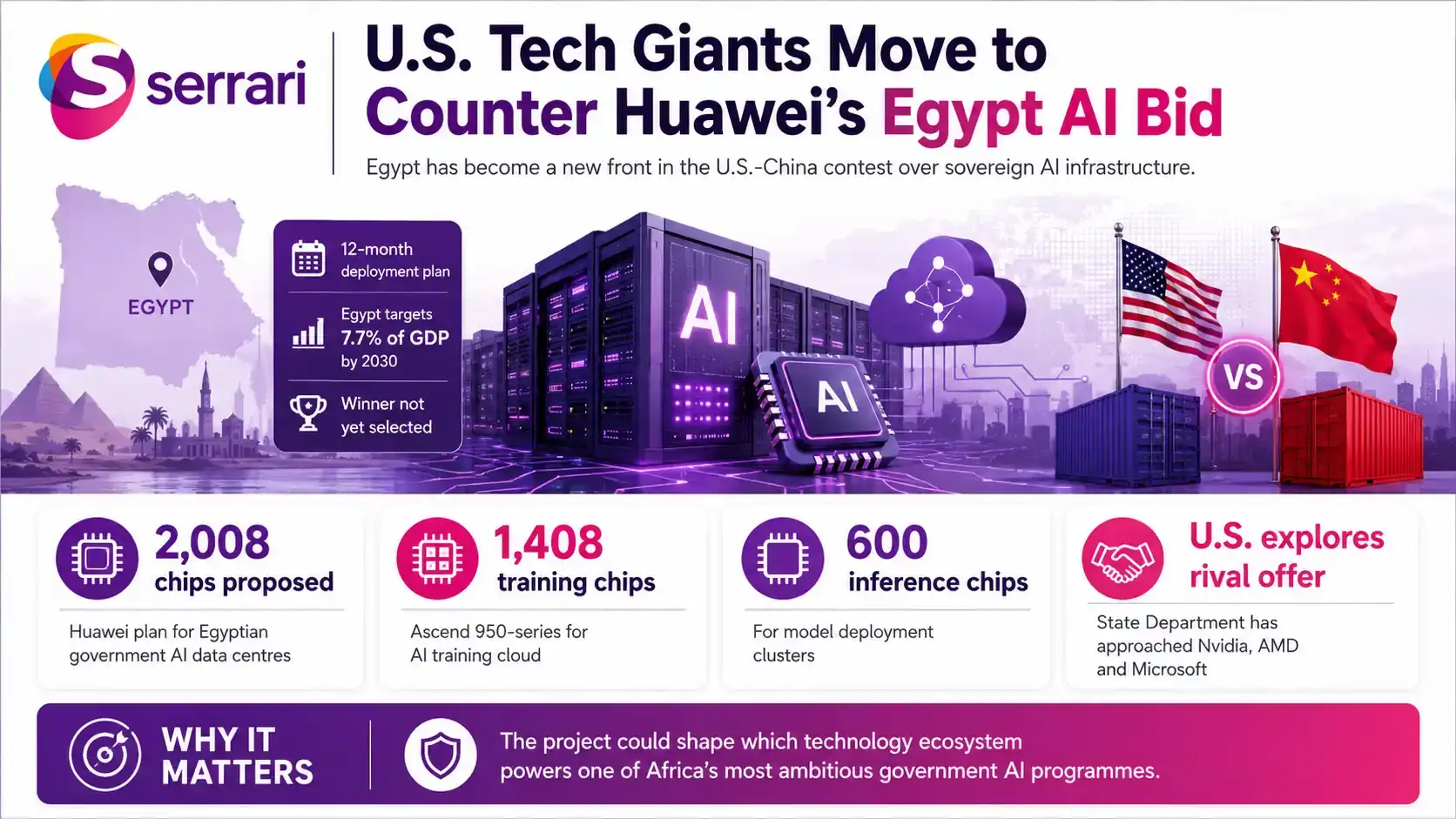
Egypt has become a new battleground in the U.S.-China contest over artificial intelligence infrastructure after Huawei proposed supplying 2,008 Ascend processors for government AI data centres. The plan would combine a large training cluster with two inference clusters and would be deployed over 12 months.
Washington is responding by exploring a competing American proposal involving Nvidia, AMD and Microsoft. However, no U.S. consortium has announced a finalized bid, and Egypt has not selected a winner. The contest remains at the proposal stage, but it could influence which technology ecosystem underpins one of North Africa’s most ambitious sovereign AI programmes.
Key Overview
- Huawei has proposed 1,408 Ascend 950-series processors for an AI training cloud.
- Another 600 Ascend processors would support two inference clusters.
- The total proposed deployment is 2,008 chips over a 12-month build.
- The U.S. State Department has approached Nvidia, AMD and Microsoft about a possible counteroffer.
- A successful Huawei deal could become the first publicly confirmed overseas deployment of Ascend accelerators.
- Egypt aims to expand AI’s contribution to its economy significantly by 2030.
- Surveillance functions included in the Chinese proposal add a security dimension to the competition.
Huawei Pitches a 2,008-Chip AI Build
Huawei’s proposal calls for 1,408 Ascend 950-series chips to power an AI training cloud, with another 600 processors—either from the 950 family or the older Ascend 910B generation—used across two inference clusters. The reported 12-month deployment plan would give Egypt dedicated infrastructure for training and running artificial intelligence models.
The scale is modest compared with the vast GPU clusters being built by leading global technology companies. Strategically, however, it could be much more important. Huawei has developed its Ascend line as an alternative to U.S.-designed accelerators while American restrictions have constrained its access to advanced semiconductor manufacturing technology.
If completed, the Egyptian project could become the first publicly confirmed overseas export of Huawei’s Ascend accelerators. That would provide the company with a showcase for selling Chinese AI infrastructure to governments across Africa, the Middle East and other emerging markets.
Washington Tries to Build a Rival Offer
After learning of the proposal, the U.S. State Department contacted Nvidia, AMD and Microsoft about assembling an American alternative. At this stage, however, the response remains exploratory. None of the three companies has publicly confirmed participation in a formal bid, and details covering financing, hardware and cloud infrastructure remain unclear.
The rivalry matters because shipments of advanced American AI processors to Egypt have faced U.S. licensing requirements since 2023. That gives Washington influence over the availability and conditions attached to U.S.-origin technology while also giving Cairo a reason to examine Chinese alternatives.
For Egypt, the decision extends beyond raw computing performance. Selecting an AI platform can shape future procurement, developer tools, cloud services, security architecture and compatibility across government systems for years.
Context is everything. Stay ahead of shifting trends with today’s market updates, and uncover emerging opportunities using the Serrari Group Market Index and Marketplace. Then, take control of your own financial future by exploring our Money & Life Reset Transformation Blueprint ™ to build stronger habits, create better systems, and design a path toward lasting wealth.
Egypt’s AI Ambitions Raise the Stakes
Egypt has been expanding its national AI ambitions, with officials citing a goal for artificial intelligence to contribute 7.7% of GDP by 2030 as the country develops skills, infrastructure and domestic AI companies.
Its second national AI strategy also calls for scalable AI infrastructure and cloud services, alongside stronger data governance and local talent development. Because Egypt does not manufacture leading-edge AI accelerators domestically, large sovereign AI projects remain dependent on foreign suppliers.
Surveillance Features Add a Security Dimension
Huawei’s proposal reportedly goes beyond computing hardware. It includes cooperation with Chinese AI company iFlytek and functions such as vehicle recognition, individual identification linked to a national population database and broader situational-awareness systems.
The reported surveillance package increases the geopolitical sensitivity because both Huawei and iFlytek have faced U.S. trade restrictions since 2019. Washington has repeatedly raised national-security and data-governance concerns around some Chinese technology deployments.
Export-control rules create another complication. U.S. guidance warns that using certain Chinese advanced-computing chips can create compliance risks, specifically listing the Huawei Ascend 910B, 910C and 910D among processors presumed to implicate General Prohibition 10 in specified circumstances.
That guidance should not be read as automatically applying the same presumption to every Ascend 950 processor. It is nevertheless relevant because Huawei’s Egyptian proposal could use the 910B in its inference clusters.
Egypt Faces a Choice Between Competing AI Ecosystems
The tender illustrates how sovereign AI infrastructure is becoming a tool of geopolitical influence. Washington wants countries building national AI capacity to rely on American chips, software and cloud platforms, while China is increasingly offering its own alternatives.
Competition could give Cairo negotiating leverage on pricing, financing and technology transfer, but it also forces decisions over export controls, data governance and long-term dependence on one technology stack.
Egypt has not yet awarded the project. Whichever platform ultimately wins could become a reference point for similar government AI procurements across Africa, making the 2,008-chip proposal strategically larger than its hardware count alone suggests.
Sources: Bloomberg / Business Insider Africa / Channel Insider / U.S. Bureau of Industry and Security / Egypt State Information Service / Egypt National AI Council
Your financial future isn’t something you wait for—it’s something you build.
The real question is: when do you begin?
Move beyond simply staying informed.
Navigate the markets with clarity—track trends through the Serrari Group Market Index, uncover opportunities in the Serrari Marketplace, and build practical knowledge with our Curated Wealth Builder Platform.
Stay connected to what truly matters.
Get daily insights on macro trends and financial movements across Kenya, Africa, and global markets—delivered through the Serrari Newsletter.
Growth opens doors.
Advance your career through professional programs including ACCA, HESI A2, ATI TEAS 7 , HESI EXIT , NCLEX – RN and NCLEX – PN, Financial Literacy!🌟—designed to move you forward with confidence.
See where money is flowing—clearly and in real time.
Track Money Market Funds, Treasury Bills, Treasury Bonds, Green Bonds, and Fixed Deposits, alongside global and African indexes, key economic indicators, and the evolving Crypto and stablecoin landscape—all within Serrari’s Market Index.