Senegal has begun transferring funds for the next coupon payment on its U.S. dollar sovereign bond maturing in 2048, signalling its intention to remain current on external debt obligations despite intense concerns over the country’s debt burden.
The payment is due on September 13, 2026, and news that the transfer process had begun prompted a sharp improvement in the bond’s price. The 2048 security rose about 2.5 cents to 51.47 cents on the dollar, reflecting investor relief that an immediate payment disruption appeared less likely.
The development follows a new $2.2 billion staff-level financing agreement between Senegal and the International Monetary Fund, although that programme still requires management and Executive Board approval before financing is released.
Key Overview
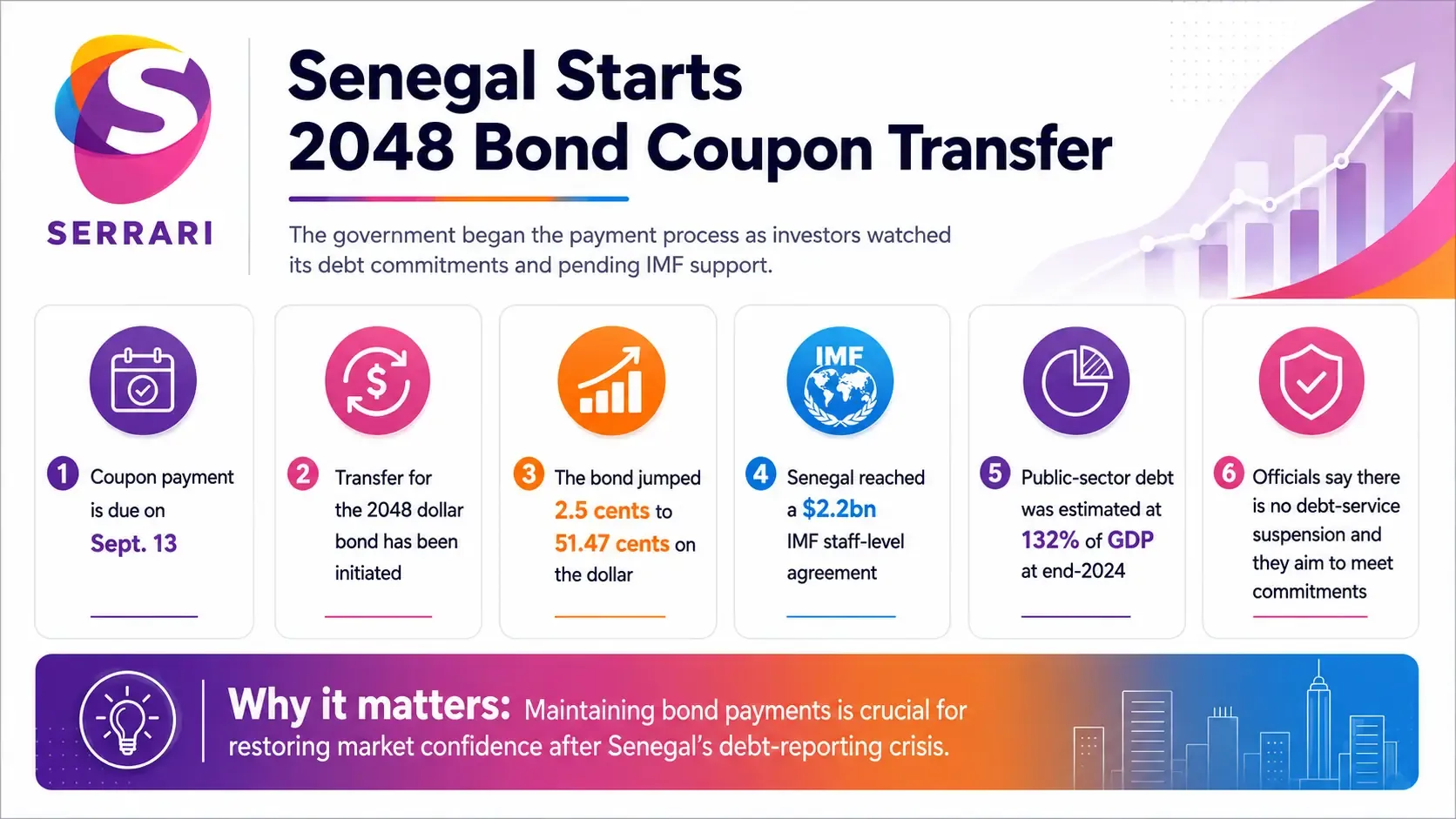
- Senegal has initiated the transfer for its September 13 coupon payment on the 2048 dollar bond.
- The bond jumped 2.5 cents to 51.47 cents on the dollar following the announcement.
- The security carries a 6.75% coupon and matures in March 2048.
- Senegal and the IMF have reached a staff-level agreement for a $2.2 billion, 36-month programme.
- The IMF estimates total public-sector debt reached around 132% of GDP at the end of 2024.
- The debt problem intensified after audits uncovered substantial previously undisclosed government liabilities.
- Senegalese authorities have said they intend to continue meeting debt-service commitments while pursuing reforms.
Coupon Payment Offers Investors Short-Term Reassurance
The decision to begin transferring funds ahead of the September 13 deadline is important because Senegal’s international bonds have come under significant pressure as investors assess whether the country can manage its unusually high debt burden without disrupting payments to creditors.
Alioune Diouf, head of capital markets at Senegal’s economy ministry, said authorities would do their utmost to fulfil their commitments and noted that no debt-service suspension had been announced under the new IMF agreement.
The 2048 bond was originally issued in 2018 and carries a 6.75% coupon, with interest paid semi-annually. Current bond information shows a September 13, 2026 interest-payment date, making the government’s early transfer a closely watched test of its ability to continue servicing commercial external debt.
However, initiating a transfer is not the same as confirming final receipt by bondholders. The payment will only be fully completed once the funds pass through the relevant payment system and reach investors.
Context is everything. Stay ahead of shifting trends with today’s market updates, and uncover emerging opportunities using the Serrari Group Market Index and Marketplace. Then, take control of your own financial future by exploring our Money & Life Reset Transformation Blueprint ™ to build stronger habits, create better systems, and design a path toward lasting wealth.
IMF Deal Changes the Debt Outlook
The bond payment comes just days after Senegal reached a preliminary agreement for a new three-year IMF programme worth approximately $2.2 billion, or SDR1.537 billion.
The proposed 36-month Extended Credit Facility arrangement aims to restore macroeconomic stability and debt sustainability, reduce fiscal and external vulnerabilities, increase social spending and create conditions for stronger private-sector-led growth.
Crucially, the deal is not yet final. IMF staff said approval remains conditional on additional corrective measures linked to Senegal’s earlier misreporting of public finances.
Those requirements matter because the country’s current debt problems became substantially more severe after the new government uncovered liabilities that had not been properly reported under the previous administration.
Subsequent audits led authorities to revise historical government debt dramatically higher. A detailed reconciliation exercise raised central government debt to 111% of GDP at end-2023, while wider public-sector debt was later estimated at approximately 132% of GDP by the end of 2024.
Hidden Debt Reshaped Senegal’s Finances
Senegal’s current fiscal crisis stems partly from significant underreporting of deficits and borrowing between 2019 and 2023.
An audit found that the average fiscal deficit during the period had been understated substantially, while previously undisclosed liabilities included hidden borrowing equivalent to 25.3 percentage points of GDP.
The discovery disrupted Senegal’s relationship with international lenders and contributed to sharp falls in its sovereign bonds. It also increased refinancing risks as the government sought alternative sources of funding through domestic and regional markets.
Recent estimates put Senegal’s sovereign debt at roughly CFA23.67 trillion, or about $42 billion, at the end of 2024 before some wider public-sector liabilities are included. The country also has more than $7 billion of international bonds outstanding, making its relationship with commercial creditors important to any effort to restore debt sustainability.
Why the Bond Still Trades Near Half Its Face Value
Although the coupon-transfer announcement lifted prices, the 2048 bond trading at roughly 51 cents on the dollar still reflects considerable investor concern.
A bond trading far below its $1 face value signals that investors demand substantial compensation for perceived repayment and restructuring risk. The 6.75% 2048 security was recently priced at around 50 cents, implying a yield far above its original coupon.
Markets are therefore assessing more than whether Senegal can make one coupon payment. Investors want clarity on how the government and IMF intend to reduce the debt burden and whether future debt operations could affect international bondholders.
The new IMF programme provides an important framework for rebuilding confidence, but Senegal will still need to strengthen fiscal controls, improve debt transparency and demonstrate that its borrowing trajectory can become sustainable.
For now, beginning the September coupon transfer sends an important signal that authorities intend topreserve debt-service continuity. Whether that reassurance lasts will depend on implementation of the IMF-backed reforms and the government’s ability to restore credibility after one of Africa’s most significant recent public-debt reporting crises.
Sources: Reuters / International Monetary Fund / Senegal Ministry of Economy and Finance
Your financial future isn’t something you wait for—it’s something you build.
The real question is: when do you begin?
Move beyond simply staying informed.
Navigate the markets with clarity—track trends through the Serrari Group Market Index, uncover opportunities in the Serrari Marketplace, and build practical knowledge with our Curated Wealth Builder Platform.
Stay connected to what truly matters.
Get daily insights on macro trends and financial movements across Kenya, Africa, and global markets—delivered through the Serrari Newsletter.
Growth opens doors.
Advance your career through professional programs including ACCA, HESI A2, ATI TEAS 7 , HESI EXIT , NCLEX – RN and NCLEX – PN, Financial Literacy!🌟—designed to move you forward with confidence.
See where money is flowing—clearly and in real time.
Track Money Market Funds, Treasury Bills, Treasury Bonds, Green Bonds, and Fixed Deposits, alongside global and African indexes, key economic indicators, and the evolving Crypto and stablecoin landscape—all within Serrari’s Market Index.