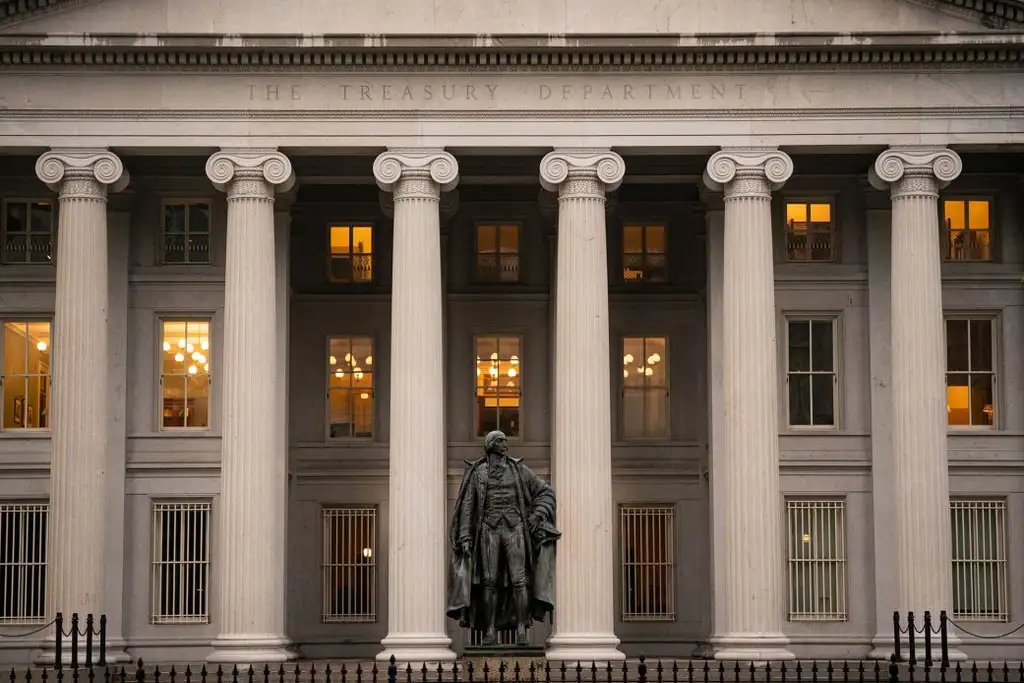
The U.S. Treasury is sharply increasing its purchases of older long-dated government securities as policymakers try to improve liquidity in a bond market facing elevated yields, heavy government borrowing and growing competition for investor capital.
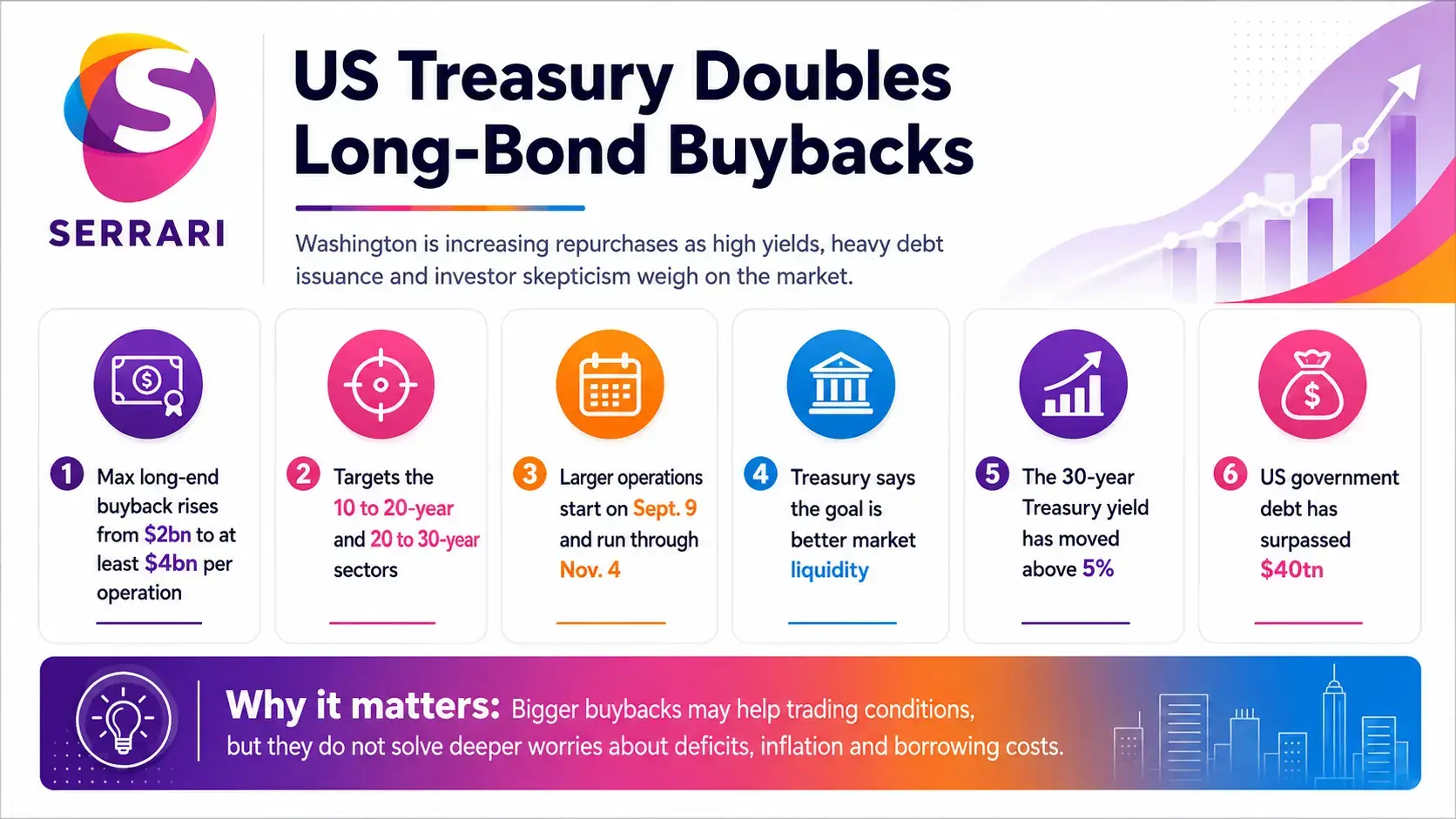
Beginning September 9, Treasury will at least double the maximum size of liquidity-support buybacks in the 10-to-20-year and 20-to-30-year maturity sectors, raising the limit from $2 billion to at least $4 billion per operation. The higher limits will remain in place through November 4, when Treasury conducts its next quarterly refunding review.
Treasury Secretary Scott Bessent says the objective is better market functioning rather than directly forcing interest rates lower. Investors remain divided over whether larger government purchases can materially improve conditions without addressing the deeper forces pushing long-term yields higher.
Key Overview
- Treasury will raise long-end buyback operations from a maximum $2 billion to at least $4 billion each.
- The increase takes effect on September 9, 2026 and runs through November 4.
- The programme targets older, less-liquid 10-to-30-year Treasury securities.
- Treasury says the objective is liquidity support, not monetary-policy easing.
- Long-term yields have climbed sharply, with the 30-year yield recently above 5%.
- U.S. federal debt has surpassed $40 trillion, increasing sensitivity to borrowing costs.
- Heavy corporate bond issuance, including financing for artificial-intelligence investment, is competing with government debt for investor demand.
Why Treasury Is Buying Its Own Bonds
Treasury’s buyback programme is designed largely to improve trading in older securities known as off-the-run Treasurys.
Newly issued benchmark government bonds generally attract more trading and investor attention. Older issues can become less liquid, meaning they are harder for dealers and investors to buy or sell efficiently. Treasury’s liquidity-support programme provides investors with a regular opportunity to sell some of those securities back to the government.
By becoming a buyer, Treasury can reduce inventories sitting on dealers’ balance sheets and potentially free up their capacity to make markets in other securities. That can improve liquidity across parts of the enormous U.S. government bond market.
The regular buyback programme was introduced in May 2024, decades after Treasury last conducted meaningful repurchases. It has two main purposes: improving secondary-market liquidity and managing government cash flows.
For the August-to-October quarter, Treasury had already planned to purchase up to $38 billion in off-the-run securities across different maturity groups for liquidity support.
Context is everything. Stay ahead of shifting trends with today’s market updates, and uncover emerging opportunities using the Serrari Group Market Index and Marketplace. Then, take control of your own financial future by exploring our Money & Life Reset Transformation Blueprint ™ to build stronger habits, create better systems, and design a path toward lasting wealth.
Why Long-Term Treasury Yields Are So High
The expansion comes after a difficult period for long-dated government bonds.
The 10-year Treasury yield has recently traded around the upper-4% range, while the 30-year yield has moved above 5%. Higher yields mean investors are demanding greater returns to hold long-term U.S. debt.
Several forces are contributing.
Federal borrowing remains exceptionally high, with U.S. gross government debt now above $40 trillion. Investors therefore have to absorb a substantial flow of new Treasury issuance at the same time that concerns about inflation and long-term fiscal sustainability remain elevated.
The government is also competing with companies for investment capital. A surge in corporate borrowing, particularly by technology businesses financing massive AI infrastructure programmes, has added to the volume of bonds available to investors.
When investors have more alternatives, Treasury securities may need to offer higher yields to remain attractive.
Buybacks Can Affect Yields but Are Not Fed QE
Mechanically, buying bonds creates additional demand. Higher demand can push their prices upward, while bond yields move in the opposite direction.
That is why some investors suspect Treasury’s larger programme could also be intended to relieve pressure on long-term interest rates.
Bessent has rejected that interpretation. He said Treasury is responding to relatively thin trading in parts of the market and could purchase more than $4 billion in individual operations if conditions warrant.
The distinction from Federal Reserve quantitative easing is important.
When the Fed conducts large-scale asset purchases, it creates central-bank reserves and uses its balance sheet as a monetary-policy tool. Treasury buybacks instead form part of government debt management. Purchased securities are retired, while the money needed for buybacks ultimately becomes part of Treasury’s overall financing requirements.
Treasury has also previously stated that buybacks are not designed to materially alter the maturity structure of federal debt or function as an emergency response to acute market stress.
Investors Question Whether Buybacks Solve the Real Problem
The programme’s scale remains small compared with a Treasury market worth tens of trillions of dollars, which limits its ability to overpower broader economic forces.
Markets initially responded positively when the larger buybacks were announced, but long-term yields subsequently climbed again. That suggests investors remain focused on inflation, fiscal deficits, debt issuance and the supply of competing bonds.
Even some policymakers have questioned whether market interventions can offset those structural pressures. Federal Reserve Governor Christopher Waller recently argued that fiscal conditions and changing demand for government debt are contributing to persistently higher borrowing costs.
The Treasury therefore faces a difficult balance. Larger buybacks could make older securities easier to trade and improve market functioning, but they cannot by themselves resolve concerns over deficits, inflation or the growing volume of federal debt.
For borrowers, the stakes extend beyond Washington. Treasury yields influence mortgage rates, corporate borrowing costs and other interest rates throughout the economy. If long-term government yields remain elevated, financing conditions can stay expensive even without further increases in the Federal Reserve’s policy rate.
The September buybacks will provide an early test of whether greater Treasury participation can meaningfully improve liquidity. The larger question is whether smoother trading can reassure investors when the underlying supply of debt and concerns over America’s fiscal trajectory remain firmly in place.
Sources: U.S. Department of the Treasury / Reuters / CNBC / NPR / Federal Reserve
Your financial future isn’t something you wait for—it’s something you build.
The real question is: when do you begin?
Move beyond simply staying informed.
Navigate the markets with clarity—track trends through the Serrari Group Market Index, uncover opportunities in the Serrari Marketplace, and build practical knowledge with our Curated Wealth Builder Platform.
Stay connected to what truly matters.
Get daily insights on macro trends and financial movements across Kenya, Africa, and global markets—delivered through the Serrari Newsletter.
Growth opens doors.
Advance your career through professional programs including ACCA, HESI A2, ATI TEAS 7 , HESI EXIT , NCLEX – RN and NCLEX – PN, Financial Literacy!🌟—designed to move you forward with confidence.
See where money is flowing—clearly and in real time.
Track Money Market Funds, Treasury Bills, Treasury Bonds, Green Bonds, and Fixed Deposits, alongside global and African indexes, key economic indicators, and the evolving Crypto and stablecoin landscape—all within Serrari’s Market Index.